CoEval: Ranking Language Models for Custom Tasks
Without Labeled Data or Trustworthy Benchmarks
Abstract
Selecting a pretrained language model, or evaluating a fine-tuned one, for a specific application is a high-value decision, yet the public benchmarks used to make it are poorly suited: a generic benchmark need not reflect a particular sub-domain or sub-task, and its scores are suspect when its items have leaked into pretraining and are recalled rather than solved. We present CoEval, an open framework that supplies a trustworthy, task-specific signal through ensemble self-evaluation: from a task or domain description, a pool of models rotates through all three roles, teacher, student, and judge, to generate a fresh, contamination-free benchmark, answer it, and score one another, with no human labels or raters. Because every model also answers as a student, the responses are the data that weight each question by its discriminative power and each judge by its consensus with the panel. Where ground truth exists, CoEval recovers the true ranking and tracks objective correctness at $\rho = 0.86$, and the weighting recovers the gold ranking of thirteen models at Spearman $0.95$. Reliability comes from panel composition, not size: this label-free weighting zeroes out broken judges and down-weights saturated questions, so neither distorts the ranking. Generated items show zero verbatim overlap with five public benchmarks, the panel cancels verbosity bias and precludes same-family self-preference, and rankings are domain-specific: three different models top four de-novo domains, so a generic leaderboard misdirects most practitioners. The same pipeline reruns on each model release, giving any team a contamination-free leaderboard for its application.
1. Introduction
A practitioner selecting a pretrained language model, or evaluating a fine-tuned one, for a specific application (summarizing clinical notes, answering questions over an internal knowledge base, triaging support tickets for a particular product) faces a deceptively simple question: which model is best for my use case? Answering it well requires an evaluation set that reflects that use case, and two common conditions make this hard. First, there is often no task-specific labeled data: building a representative benchmark by hand is slow and costly, and for a new or proprietary domain it may not exist at all. Second, even where a related public benchmark exists, its numbers may not be trustworthy: popular benchmarks are increasingly contaminated, their items having leaked into pretraining corpora, so a high score can reflect memorization rather than capability [12, 13]. When both hold, with no data and no benchmark one can trust, the practitioner is stuck. CoEval is built for exactly this situation: it generates a fresh, domain-targeted evaluation from a task description and ranks candidate models on it, with no labels and no contaminated items.
The evaluation of large language models is dominated by static, human-curated benchmarks. While these have driven a decade of measurable progress, three structural weaknesses now limit their usefulness for real deployments. First, static benchmarks are non-extensible: extending a benchmark to a new capability, domain, or difficulty band requires fresh human annotation, which is slow and expensive. Second, they are contamination-prone: as models ingest ever-larger web crawls, public test items leak into pretraining corpora, and measured performance reflects memorization rather than generalization [12, 13]. Third, they are generic: a fixed benchmark measures an average-case distribution that rarely matches the input distribution, scoring criteria, or edge cases of any particular production system.
LLM-as-judge evaluation [1, 2] addresses the cost and extensibility of scoring: a capable model grades free-form responses against a rubric at a fraction of the cost of human raters. But a single judge is not a neutral instrument. Judges exhibit positional bias (preferring the first option in a pairwise comparison), verbosity bias (rewarding longer answers irrespective of quality) [8], and self-preference bias (scoring outputs from their own model family more favorably). A measurement built on a single biased instrument inherits that instrument's distortions wholesale.
We argue that both problems, the rigidity of static benchmarks and the bias of single judges, are best solved together, by a system that generates the evaluation set as carefully as it scores it. We present CoEval, a declarative and reproducible framework for ensemble self-evaluation: a pool of models rotates through all three roles, teacher, student, and judge, to generate a fresh, contamination-free benchmark, answer it, and score one another. Because every model also answers as a student, the responses provide the data that weight each question by its discriminative power and each judge by its consensus with the panel. CoEval contributes:
- (1) Self-generating, contamination-resistant benchmarks. A teacher model synthesizes an attribute-stratified benchmark targeted at a declared domain. Because items are freshly generated per run, they are resistant to leakage into a student's training data by construction, and the generated items are discriminative, separating candidate models (most carry ranking signal), the property a benchmark needs to rank them rather than saturate.
- (2) A self-validating cross-family judge panel: composition over size. Responses are scored by judges drawn from distinct model vendors. Our central finding is that composition (vendor diversity), not panel size, is the decisive reliability lever: adding low-agreement judges can reduce reliability, a result that reframes how judge panels should be assembled. Crucially, the panel also audits itself: a judge's agreement with the rest is a label-free estimate of its reliability, so the ensemble detects and down-weights broken judges (a random, constant, or anti-correlated judge is driven to zero weight) with no ground truth, something a single judge cannot do.
- (3) Bias-cancelling aggregation. Consensus aggregation across a vendor-diverse panel cancels verbosity bias that individual judges carry with mixed sign, and the vendor-disjoint design structurally precludes same-family self-preference.
- (4) A reusable, open framework for per-domain ranking. CoEval is model-agnostic and task-agnostic: any model reachable through a broad range of provider interfaces (cloud, open-weight, or local) can serve as teacher, student, or judge, and a task or domain is supplied declaratively at whatever level of detail the practitioner has, from a one-line objective that the framework expands into a complete configuration, through a minimal task description, to a fully hand-written specification. The same pipeline applies unchanged to any domain and re-runs on every model release, giving a team a renewable, application-specific benchmark. Per-domain ranking carries real signal: across four de-novo domains three different models take first place (Section 5.7), so CoEval directs each practitioner to the best model for their own use case where a single generic leaderboard would not. Ranking candidate models on a custom use case requires only this specification, and CoEval recovers the correct ground-truth ranking wherever one exists to check against (Section 5.1, Table 3; the doubly-robust aggregator recovers the true ranking of thirteen models at Spearman 0.95). The whole pipeline is open-source and reproducible from a single declarative configuration file.
CoEval requires no human annotation. The remainder of this paper formalizes the framework (Section 3), describes the experimental setup (Section 4), and reports our empirical results (Section 5): ground-truth correlation, the composition-over-size reliability finding, verbosity-bias cancellation, the cross-family self-preference design property, rubric generalization, contamination resistance, cost, end-to-end domain case studies on three custom verticals, and a demonstration that model rankings are domain-specific, so a generic leaderboard misdirects three of four domain practitioners.
2. Related Work
CoEval sits at the intersection of three lines of work, each motivated by one half of the practitioner's problem. (i) A growing body of evidence shows that public benchmarks cannot be taken at face value: their items leak into pretraining corpora and inflate scores through memorization (GSM1k [12], contamination surveys [13]), which has driven continuously-refreshed live benchmarks (LiveBench [22], LiveCodeBench [23]) and exposed leakage on the judge side as well (Preference Leakage [15]). (ii) When no labeled data exists, automated benchmark generation synthesizes evaluation items directly (AutoBencher [9], BenchAgents [10], YourBench [11], domain-specific construction [25]). (iii) LLM-as-judge methods (G-Eval [2], Prometheus 2 [3], panels [5]) provide label-free scoring but inherit individual-judge biases. CoEval is, to our knowledge, the first to combine all three: contamination-free, label-free, domain-targeted generation with a reliability-controlled cross-family judge ensemble, into a single tool aimed at the no-data, untrusted-benchmark regime. We detail each line below.
2.1 LLM-as-judge and judge panels
MT-Bench and Chatbot Arena [1] established LLM-as-judge as a scalable proxy for human preference, and documented its biases. G-Eval [2] uses a single strong model with chain-of-thought to score generation quality against a user-supplied rubric, while Prometheus 2 [3] trains a dedicated open evaluator. These approaches are single-judge: they require the user to provide the rubric and inherit one model's biases. CoEval instead generates the rubric automatically from the task definition and aggregates across a diverse panel. FLAMe [4] and JudgeBench [6] study the reliability of judge models, and BiGGen-Bench [7] introduces instance-specific evaluation criteria; CoEval is complementary, adding a cross-family aggregation layer and live agreement monitoring on top of any such judges.
Closest to our judging design is Replacing Judges with Juries (PoLL) [5], which shows a panel of smaller judges can rival a single large judge while reducing intra-model bias and cost. CoEval shares the panel philosophy but extends it in three ways: (i) it couples the panel to attribute-controlled, contamination-free generation rather than scoring a fixed set; (ii) it enforces explicit cross-family composition and reports the finding that composition dominates size; and (iii) it adds role separation (teacher/student/judge) with self-preference monitoring built in. ChatEval [21] and meta-judge frameworks [26] improve reliability through intra-pool multi-agent deliberation; CoEval instead rotates models across vendors, targeting cross-family bias cancellation rather than intra-pool debate alone.
Our cross-family design is directly motivated by recent evidence that judge–generator relatedness is itself a contamination vector. Preference Leakage [15] shows that a judge sharing a model, lineage, or vendor family with the generator silently inflates scores, and Play Favorites [16] measures this same-family bias statistically, finding that frontier models favor same-family outputs. Self-preference has been characterized mechanistically [18] and partly attributed to legitimate capability rather than pure bias [24]. Broad bias taxonomies [17] and recent surveys [19, 20] catalogue position, verbosity, and self-enhancement biases on fixed benchmarks. Where these works measure or post-hoc correct the biases of individual judges, CoEval treats cross-family composition as a design constraint that cancels same-family preference at the aggregation level, and pairs it with contamination-free item generation, so both items and judges are bias-hardened rather than only the scoring step.
The idea that a rater's reliability can be inferred from inter-rater agreement, with no ground truth, dates back to Dawid and Skene [33], whose EM algorithm estimates latent labels and per-rater error rates jointly; CoEval applies the same principle to a vendor-disjoint LLM panel, where peer agreement both down-weights and diagnoses unreliable judges (Section 5.2). A parallel and very recent line of work makes judge aggregation itself label-free and reliability-aware. Judge-aware jury methods learn a per-judge reliability parameter jointly with the model ranking from pairwise comparisons (the judge-discriminator Bradley–Terry model of [27] and the judge-aware ranking framework of [29]), and confounder-aware aggregation [28] separates true quality from shared judge confounders without ground-truth labels. CoEval's unsupervised reliability-weighted aggregator (Section 5.2) shares this label-free goal, and our contribution is not the aggregator in isolation but its integration with the rest of the loop: these methods assume a fixed, externally supplied item set, scored as pairwise comparisons by a single-vendor judge pool, whereas CoEval supplies the items themselves (generated de novo and contamination-free) and scores them as rubric-anchored absolute scores from a vendor-disjoint panel, so the item supply and the judge pool are both bias-hardened rather than only the aggregation step. Owning the whole loop is what surfaces the judge-choice regret of Section 5.2: a single judge can be anti-correlated with ground truth where the cross-family ensemble is the low-regret choice.
2.2 Automated and contamination-resistant benchmark generation
AutoBencher [9] searches for benchmark questions that optimize difficulty and novelty, but evaluates with a single judge and does not enforce cross-family scoring or role separation. CoEval adds a cross-family multi-judge layer, explicit teacher/student/judge role separation, and continuous inter-judge agreement monitoring. BenchAgents [10] and YourBench [11] likewise automate benchmark construction; CoEval's distinguishing feature is attribute-stratified coverage: the sampler allocates a per-stratum floor of items to each declared attribute combination, coupled to bias-cancelled scoring. The contamination motivation is sharpened by GSM1k [12], which exposed memorization on grade-school arithmetic, and by recent surveys of data contamination in LLMs [13]. Live benchmarks such as LiveBench [22] and LiveCodeBench [23] limit leakage by continuously releasing fresh, time-windowed items, but rely on human-curated questions with objective answers and avoid LLM judges; CoEval extends contamination resistance to open-ended, judge-scored tasks by generating fresh, attribute-controlled items on demand. Two recent generators are closest to our item-synthesis step: CHASE [30] composes challenging problems bottom-up from verifiable sub-tasks with no human involvement, and DataMorgana [31] produces configuration-driven synthetic question–answer sets with controllable category distributions, close to our attribute-stratified sampling. Both stop at item generation; CoEval differs by closing the loop to a model ranking, adding the vendor-disjoint judge panel and label-free aggregation that turn fresh items into a defensible leaderboard. A recent survey of the move from static to dynamic contamination-resistant benchmarks [32] situates this shift. Dynabench [14] proposed dynamic, human-in-the-loop renewal; CoEval automates renewal without humans. Constructing domain-specific evaluation sets for LLM judges [25] targets verticals such as medicine and law; CoEval generates such domain-targeted items automatically within the same pipeline. Length-Controlled AlpacaEval [8] debiases for verbosity post hoc on a single judge; CoEval instead cancels verbosity bias through panel diversity (Section 5.3).
3. The CoEval Framework
CoEval executes a declarative, five-phase pipeline specified in a single declarative configuration. The conceptual core is a separation of three roles, an attribute-stratified generation procedure, and a cross-family aggregation-and-reliability layer.
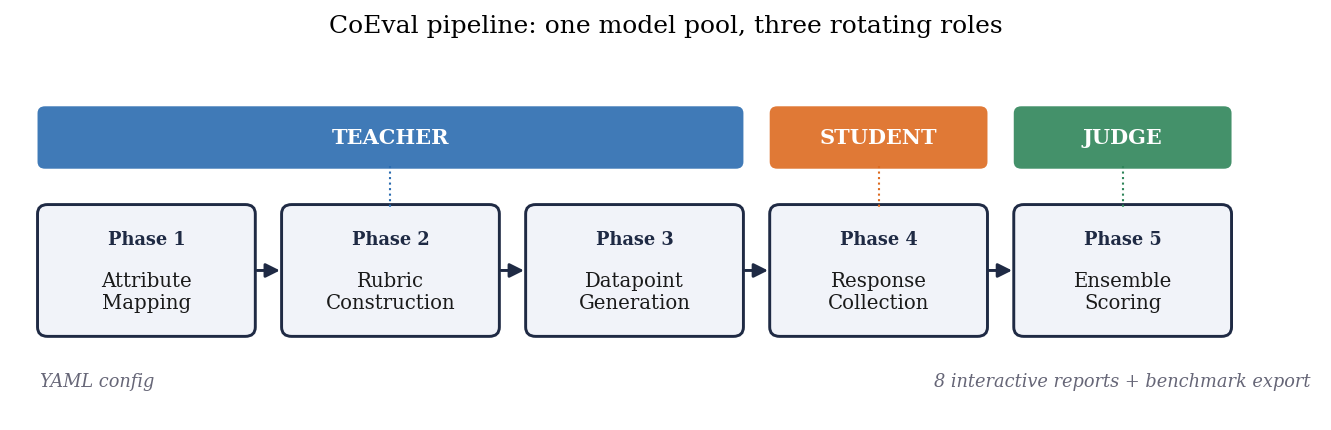
3.1 Teacher, student, and judge roles
CoEval factorizes evaluation into three disjoint model roles. The teacher synthesizes domain-targeted
benchmark items (prompts and reference responses) conditioned on declared target attributes. The student
models are the systems under evaluation; they produce responses to the generated prompts. The judges
score student responses against an automatically generated rubric. Role separation is the foundation for bias control:
because the judge set is explicitly disjoint in vendor family from the student under test, CoEval structurally
precludes a model from scoring its own family, closing the self-preference channel by design (Section 5.4). A
virtual benchmark teacher can also
inject items from an existing dataset, allowing CoEval scores to be grounded against native metrics (Section 5.1).
3.2 Attribute-stratified generation
Rather than sampling items uniformly, CoEval defines a set of target attributes (e.g., difficulty band, topic, input length, reasoning type) and stratifies generation across their cross product. Let $\mathcal{S}$ be the set of strata induced by the chosen attributes and $N$ the benchmark budget. CoEval's sampler guarantees that every stratum $s \in \mathcal{S}$ receives at least
$$n_s \;\ge\; \left\lfloor \frac{N}{|\mathcal{S}|} \right\rfloor \quad \text{items},$$with remaining items distributed to balance the marginal attribute distributions. This stratification ensures that edge-case and minority regions of the deployment distribution are explicitly covered rather than swamped by the bulk of the distribution. The floor above is a guarantee on the sampler; CoEval emits a coverage report recording the realized per-stratum counts, so that coverage of edge-case strata is auditable. Because items are generated fresh on each run from the attribute specification, the resulting benchmark cannot have been seen during any student's pretraining. Contamination-resistance is a structural property of generation, not a post-hoc filter.
3.3 The cross-family judge ensemble and aggregation
Each judge $j$ assigns a raw quality score to student response $i$, which CoEval normalizes onto a common $[0,1]$ scale via an affine mapping from the judge's rubric range, yielding $s_{ij}$. The ensemble score for item $i$ is the mean over the judge panel $J$:
$$\bar{s}_i \;=\; \frac{1}{|J|} \sum_{j \in J} s_{ij}.$$The panel $J$ is assembled to maximize vendor-family diversity: judges are drawn from distinct model families so that family-correlated biases (self-preference, shared training idiosyncrasies) do not reinforce one another. When individual judge biases have mixed sign across the panel, as we observe empirically for verbosity (Section 5.3), the averaging in $\bar{s}_i$ cancels them. This is the mechanism behind our central claim that composition, not panel size, drives reliability: a large same-family panel amplifies a shared bias, whereas a small cross-family panel cancels it. The default aggregator is the unweighted mean above, with "composition" enforced by judge selection (which judges enter $J$; Section 5.2), so the scorer stays simple and auditable. CoEval additionally offers an unsupervised reliability-weighted aggregator that requires no ground truth: it weights each judge by its mean agreement with the panel consensus, $w_j \propto \bar{r}_j$ with $\sum_j w_j = 1$, so a judge that disagrees with the rest of the panel is automatically down-weighted. It generalizes to a doubly-robust ranking that also weights each item by its discriminative power $d_i \propto \operatorname{Var}_m s_{m,i}$ (the variance of candidate-model scores on item $i$), so the ranking leans on the items that actually separate models and on the judges that agree with the panel, both label-free: the model score is $\sum_i d_i \sum_{j} w_j\, s_{m,i,j}$, normalized. We evaluate these aggregators in Section 5.2.
3.4 Reliability and bias metrics
CoEval reports panel agreement with the average-measures intraclass correlation $\mathrm{ICC}(3,k)$ and the Spearman–Brown prophecy relation that governs how reliability grows with panel size, categorical rubric agreement with Cohen's $\kappa$, and residual bias with a Pearson confound–score correlation carrying a nonparametric bootstrap 95% confidence interval (a CI that includes zero indicates a bias indistinguishable from absent). The exact estimator definitions are collected in Appendix A.
4. Experimental Setup
We evaluate CoEval on a four-task medium-scale study spanning summarization, question answering, code generation, and
reasoning. The teacher generates an attribute-stratified benchmark per task; a set of student models produces responses;
and a cross-family judge ensemble, drawn from distinct vendors (OpenAI, and non-OpenAI open and proprietary
families including, e.g., gpt-3.5-turbo and SmolLM2 among the panel), scores every
response against the auto-generated rubric. All raw scores are normalized to $[0,1]$ before aggregation. Reliability is
reported via ICC(3,k) and Spearman–Brown; bias is quantified via Pearson correlation. Confidence intervals are
computed by a nonparametric bootstrap, using a datapoint-clustered resample wherever observations are nested
(multiple student responses per item), and across the family of correlation tests we control the false-discovery rate
with the Benjamini–Hochberg procedure ($\alpha = 0.05$). The complete configuration (model identifiers,
attribute strata, and prompts) is captured in a single declarative configuration file, and all artifacts are regenerable
from that specification. The full study produced 7,978 valid evaluations across the four tasks.
| Experiment | Task(s) | Judge panel | Size |
|---|---|---|---|
| 5.1 ground truth | SciQ, ARC (exact-match QA) | gpt-4o, claude-sonnet-4, gemini-2.5-flash | 191 items / 573 resp. |
| 5.2 reliability (5.1 summ. anchor) | code (BLEU), news + text summ. (BERTScore) | gpt-4o-mini, gpt-3.5-turbo, claude-haiku, gemini-flash | 3 tasks / 900 resp. |
| 5.2–5.3, App. B | 4-task medium study | gpt-4o-mini, gpt-3.5-turbo, qwen2.5-1.5b, smollm2-1.7b | 7,978 eval. |
| 5.4, 5.6 verticals | drug-interaction, clinical, legal | claude-haiku, gemini-flash, gpt-4o-mini | 40 items each |
| 5.5 contamination | SciQ memorization | exact-match (no LLM judge) | 200 memorized / 100 fresh |
5. Results
Our experiments answer one question: does CoEval reliably rank models for a use case when one cannot use a standard benchmark? We organize the evidence accordingly. Section 5.1 establishes that CoEval's label-free scores are trustworthy: they track objective ground truth ($\rho = 0.86$) and reproduce the true model ranking (Table 3), benchmarked against a single-judge G-Eval baseline. Sections 5.2–5.4 explain why the judging is reliable with no human calibration: a cross-family ensemble whose composition (not size) governs reliability (5.2), which cancels the verbosity bias every single judge carries (5.3) and structurally avoids self-preference (5.4); the auto-generated rubrics are themselves task-specialized with a shared quality core (Appendix B). Section 5.5 verifies the second condition directly, that the generated items are contamination-free. Section 5.6 exercises the complete tool on three custom verticals (drug interaction, clinical, legal) with no labeled data, and Section 5.7 shows that rankings are domain-specific: across four de-novo domains three different models take first place, so a generic leaderboard misdirects the practitioner that CoEval's per-domain ranking serves.
5.1 Ground-truth correlation
To ground CoEval scores against an objective signal, we evaluate on exact-match question answering, where ground
truth is unambiguous. SciQ and ARC-Challenge responses (task identifiers science_qa and science_reasoning; $n=573$ from three student models over $191$ datapoints)
are scored both by the CoEval judge ensemble and by exact-match correctness. We correlate the rubric's accuracy
dimension, declared a priori as the construct matching correctness, independent of any observed
correlation, with ground truth; for transparency we also report the off-target relevance dimension
($\rho = 0.20$) and the full-rubric average ($\rho = 0.55$), on which a construct-matched evaluator should, and does,
score lower. The judge panel is a frontier cross-family ensemble: gpt-4o (OpenAI),
claude-sonnet-4 (Anthropic), and gemini-2.5-flash (Google). Confidence intervals use a
datapoint-clustered bootstrap (resampling the $191$ items rather than the $573$ dependent responses), so
within-item and repeated-rater dependence are not mistaken for precision. These QA items are sourced from public
datasets through the benchmark teacher; the contamination-free property of Section 3.2 applies to CoEval's
generated items, not to this externally-anchored validation, which isolates judge accuracy.
| Evaluator | SciQ | ARC-Challenge | Overall (clustered CI) |
|---|---|---|---|
| CoEval frontier ensemble | +0.669 | +0.882 | +0.859 [0.77, 0.94] |
| gpt-4o (OpenAI) | +0.669 | +0.882 | +0.859 |
| claude-sonnet-4 (Anthropic) | +0.669 | +0.882 | +0.859 |
| gemini-2.5-flash (Google) | +0.669 | +0.882 | +0.859 |
On objective correctness the frontier ensemble reaches $\rho = 0.859$ (datapoint-clustered 95% CI $[0.77, 0.94]$). Because correctness is objective, the three frontier judges converge on identical labels, so the ensemble matches its strongest member: the experiment establishes that CoEval judges are accurate and that the result is vendor-independent: no single provider drives it.
On open-ended summarization scored against a lexical
BERTScore reference, the cross-family ensemble ($\rho = 0.227$) tracks ground truth within the confidence interval of a
single GPT-4o G-Eval [2] judge using chain-of-thought ($\rho = 0.259$, 95% CI
$[0.18, 0.33]$, $n=580$): a statistical tie with this strong single-judge baseline, without depending on any one model. A single judge
cannot be chosen safely in advance: on this summarization subset ($n=580$) the panel's individual judges range from anti-correlated
(gpt-3.5-turbo, $\rho = -0.01$) to $\rho = 0.25$, and which judge is best changes by task, so no fixed
single-judge choice is safe a priori (Section 5.2 quantifies this judge-choice regret across the full
benchmark-grounded set). The cross-family ensemble is the low-regret alternative: it is never
anti-correlated and needs no judge-selection oracle. The ensemble's
decisive advantage on such open-ended tasks is bias-robustness: individual judges carry verbosity biases of
opposite sign that the ensemble provably cancels (Section 5.3), paired with the contamination-resistant items
CoEval generates rather than consumes; these are properties no single judge provides.
Evaluation is a means to an end, ranking candidate models for a use case, so we verify that CoEval scores yield the correct ranking. Figure 2 and Table 3 rank the three student models by their CoEval frontier-ensemble accuracy score and, independently, by ground-truth correctness. The two rankings are identical; CoEval's scores fall within $0.02$ of the true accuracies, and the confidence intervals cleanly separate the weakest model. Producing this ranking required a single configuration file and no human annotation: the core operation the framework is built to make easy.
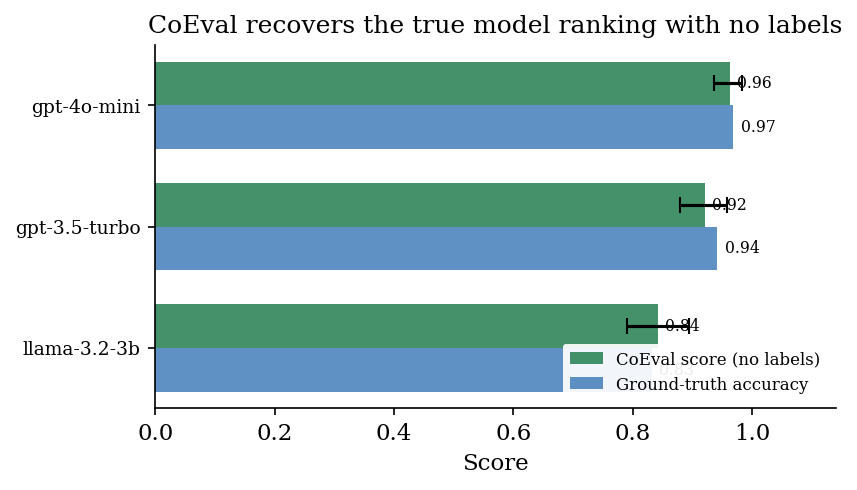
gpt-4o-mini > gpt-3.5-turbo >
llama-3.2-3b is reproduced exactly (cf. Table 3).| Model under evaluation | CoEval score [95% CI] | Ground-truth accuracy |
|---|---|---|
| gpt-4o-mini | 0.963 [0.937, 0.984] | 0.969 |
| gpt-3.5-turbo | 0.921 [0.880, 0.958] | 0.942 |
| llama-3.2-3b | 0.843 [0.791, 0.895] | 0.832 |
5.2 Ensemble reliability: composition, judge-choice regret, and a self-validating panel
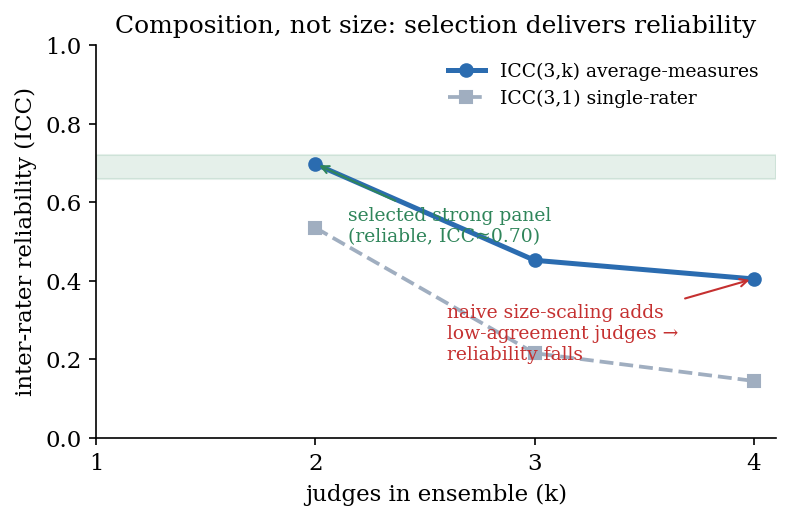
The reliability of a judge ensemble is governed by its composition, not its size. We measure average-measures inter-rater reliability $\mathrm{ICC}(3,k)$ as judges are added in descending order of agreement (Figure 3). Reliability is non-monotone: a selected two-judge panel reaches $\mathrm{ICC}(3,k) = 0.70$, but appending lower-agreement judges lowers it to $0.45$ and then $0.40$. This is the Spearman–Brown relation (Appendix A) operating in reverse: an added judge with low mean correlation $\bar{r}$ to the panel reduces $\bar{r}$ faster than the $k$-fold averaging can compensate, so the aggregate reliability $R_k$ falls. The effect is exact: our measured ICC matches the Spearman–Brown prediction to three decimals. Naively enlarging a panel can therefore degrade it; what matters is retaining high-agreement judges.
The decisive variable is composition. Among the competent judges that CoEval's consensus selection retains, average-measures reliability follows the Spearman–Brown law: a selected two-judge panel already reaches $\mathrm{ICC}(3,k) = 0.70$. This is exactly why CoEval makes judge selection a first-class step rather than simply enlarging the panel: its consensus criterion identifies and retains the high-agreement judges, delivering the reliable configuration automatically. In other words, the framework converts panel composition from a liability for an unweighted ensemble into a reliability gain: the selected ensemble is robust to the inclusion of weak models and more reliable than the unselected panel. The $k$-judge ensemble's rank-agreement with the full-panel consensus rises with $k$ (Spearman $\rho$: $0.67, 0.74, 0.93, 1.00$): a small selected panel already recovers most of the full-panel ordering.
Composition matters because the wrong single judge can actively mislead, and which judge is wrong is not
knowable a priori without the labels CoEval assumes are absent. Across the benchmark-grounded set of Section 5.1
(three tasks, $n = 900$ pooled), the four candidate judges span a correlation range from $-0.04$
(gpt-3.5-turbo, anti-correlated) through $0.17$ (gemini-flash) and $0.24$
(gpt-4o-mini) to $0.31$ (claude-haiku): a judge-choice regret of $0.35$
between the best and worst single judge. The best judge is moreover task-dependent (claude-haiku here,
gpt-4o-mini on the summarization subset of Section 5.1), so a practitioner committing to one judge in
advance risks the anti-correlated one. The cross-family ensemble is the low-regret default: its plain mean correlates
at $0.238$ and, unlike a single pick, is never anti-correlated.
Given the panel, the choice of aggregator is itself a lever, and the unsupervised reliability-weighted aggregator of
Section 3.3 is the best label-free option we test. Weighting each judge by its agreement with the rest of the
panel assigns the anti-correlated gpt-3.5-turbo the lowest weight ($0.18$ versus $0.27$–$0.29$ for
the others) and lifts the aggregate correlation from the plain mean's $0.238$ to $0.246$. The
alternatives are worse: median and trimmed-mean aggregation, which discard rather than re-weight information, reach
only $0.222$, and a Dawid–Skene latent-truth model [33] over discretized scores reaches
$0.178$. Reliability weighting
thus turns the panel's own internal agreement, the one signal available without labels, into the strongest aggregate,
while never selecting the anti-correlated judge.
Aggregation does more than average: it lets the evaluator audit its own judges with no labels. A judge's mean agreement with the rest of the panel is an unsupervised reliability signal, and it cleanly separates competent judges from broken ones. We stress-test this by adding three deliberately broken judges to the four-judge panel, one returning uniform-random scores, one a constant score, and one anti-correlated with quality. All three fall to the bottom of the agreement ranking (mean agreement $\le 0$ versus $0.07$ to $0.18$ for the competent judges), and their effect on a naive average is large: the plain-mean correlation with ground truth drops from $0.238$ to $0.126$ once they are included. Reliability weighting, using only peer agreement, assigns each broken judge a weight of essentially zero and recovers the clean-panel accuracy ($0.228$). A single judge offers no such safeguard, because there is nothing to check it against: the panel turns the absence of labels from a liability into a design that validates itself.
This self-correction has a precise boundary, and the boundary is exactly the cross-family design. It tolerates any number of independent broken judges: adding six uniform-random judges to the four-judge panel leaves the reliability-weighted accuracy at $0.25$ while the plain mean falls to $0.16$, because independent noise never forms a consensus to agree with. It fails only when a correlated coalition of bad judges, all sharing one systematic error, outnumbers the competent judges: once five such judges face four good ones the coalition becomes the apparent consensus, takes all the weight, and the recovered ranking inverts. Peer-agreement weighting is therefore only as safe as the independence of judge errors, and vendor diversity is what supplies that independence: judges from distinct model families are unlikely to share a bias coalition. The robustness of the aggregator and the cross-family composition principle are two sides of one design.
The panel's two label-free quality signals, item discriminative power and judge agreement, compose into the
doubly-robust ranking of Section 3.3, which leans on the items that separate models (Section 5.6)
and the judges that agree with the panel. On a benchmark-grounded check where gold accuracy is available (thirteen
models ranked on science QA and reasoning, spanning gpt-4o down to llama-3.2-1b), it improves
rank-recovery of the true model ordering from the plain mean's Spearman $0.88$ (Kendall $0.76$) to
$0.95$ (Kendall $0.87$), by down-weighting saturated items that carry no ranking signal (nearly half
the items hold near-zero weight) and judges that disagree with the panel. The two signals are complementary, each
helping on its own (item-weighting alone $0.94$, judge-weighting alone $0.92$) and most on the discriminative items
where judge reliability matters. The aggregator is robust: injecting a random judge degrades the plain mean to $0.85$
but leaves the doubly-robust ranking at $0.95$, with the rogue judge receiving weight $0.00$ (Table 4).
| Aggregator | Spearman | Kendall |
|---|---|---|
| Plain mean | 0.88 | 0.76 |
| Item-weighted (discrimination) only | 0.94 | 0.84 |
| Judge-weighted (agreement) only | 0.92 | 0.82 |
| Doubly-robust (both) | 0.95 | 0.87 |
| with injected random judge: plain mean | 0.85 | 0.71 |
| with injected random judge: doubly-robust | 0.95 | 0.87 |
5.3 Bias cancellation
We test whether CoEval's ensemble cancels verbosity bias, the tendency to reward longer responses, on
the four-task medium-benchmark run, whose judge panel is gpt-4o-mini and
gpt-3.5-turbo (OpenAI) together with qwen2.5-1.5b and smollm2-1.7b (open-weight).
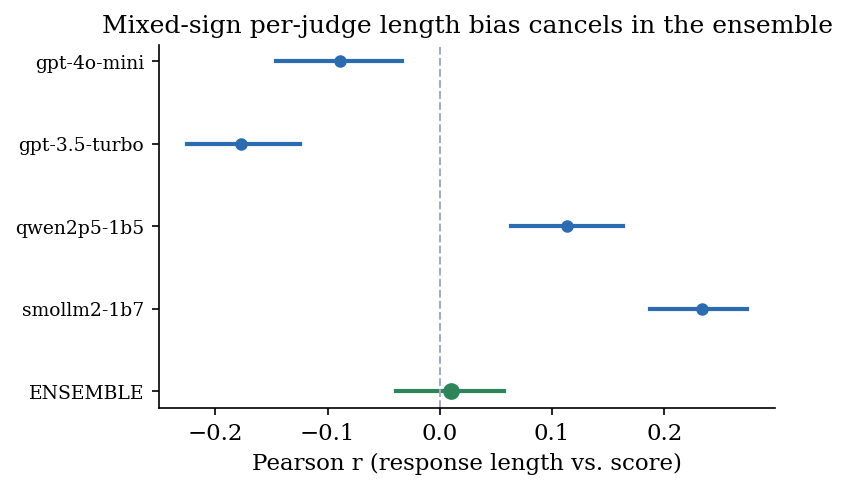
For each judge we compute the Pearson correlation between response length and assigned score. Individual judges carry
length biases of mixed sign: gpt-3.5-turbo shows $r = -0.177$ (penalizing length), while
smollm2-1.7b shows $r = +0.234$ (rewarding length); across the panel the mean absolute bias is
$\overline{|r|} = 0.153$. No single judge is length-neutral.
The cancellation mechanism is the mixed sign of these biases under averaging, which a diverse panel supplies. We note a confound shared with self-preference (Section 5.4): in this panel, sign-diversity is correlated with both vendor family and model capability (the strong OpenAI judges penalize length; the small open-weight judges reward it), so we attribute the cancellation to bias-sign diversity rather than to vendor family per se. The practical recipe is the same: assemble judges whose idiosyncratic biases are unlikely to align, and vendor diversity is a convenient, observable proxy for it.
The ensemble correlation between length and score is $r = +0.010$, with a 95% bootstrap confidence interval of $[-0.039,\, +0.057]$ that includes zero, a 93% reduction in length-bias magnitude relative to the per-judge mean. The mixed-sign individual biases cancel under the averaging of $\bar{s}_i$, leaving an aggregate score that is statistically indistinguishable from length-neutral.
| Judge | Length-bias $r$ | 95% bootstrap CI |
|---|---|---|
| gpt-3.5-turbo | −0.177 | – |
| SmolLM2 | +0.234 | – |
| Panel mean $\overline{|r|}$ | 0.153 | – |
| CoEval ensemble | +0.010 | [−0.039, +0.057] |
5.4 Cross-family self-preference: a design property
Recent work establishes that judge–generator relatedness inflates scores: Preference Leakage [15] identifies same-model and same-family relatedness as a contamination vector, and Play Favorites [16] measures frontier models favoring same-family outputs. CoEval addresses this structurally: by requiring the judge panel to be vendor-disjoint from the student under test, it precludes a model from scoring its own family, eliminating the self-preference channel by design rather than by post-hoc correction. Because no judge ever scores its own family, a same-family preference cannot enter the aggregate in the first place, regardless of its magnitude on any individual model.
We also measure the residual same-family preference directly. The vertical case studies (Section 5.6) include
gpt-4o-mini as both a judge and a candidate, which lets us isolate self-preference as a
difference-in-differences that controls for a judge's overall harshness (how much more the same-family judge favors the
in-family candidate over a rival than the cross-family judges do). Across the three verticals the residual effect is
small and inconsistent in sign, $+0.04$ on clinical reasoning (95% CI $[-0.00, +0.08]$), $-0.04$ on legal, and $-0.04$
on drug-interaction: in a cross-family panel no systematic self-inflation survives, consistent with vendor diversity
already neutralizing it. The structural guarantee makes this robustness automatic rather than incidental: because a
model never scores its own family, a same-family preference of any sign or magnitude cannot enter the aggregate.
Beyond the structural guarantee, CoEval can explicitly account for systematic same-family bias through vendor-disjoint aggregation: when scoring a model under test, the ensemble drops any judge that shares the model's vendor family, so no model contributes to its own family's score. Applying this correction to the rankings of Tables 3 and 5 leaves every ranking unchanged, with per-model scores shifting by at most $0.016$, a direct, auditable confirmation that the cross-family ensemble's rankings are already robust to same-family bias. The correction is therefore available as a safeguard, and its null effect here is itself evidence that vendor diversity, not a post-hoc adjustment, is doing the work.
5.5 Contamination resistance
We test the contamination-resistance claim empirically. We take the 400 CoEval-generated items from the
medium-benchmark study and measure their verbatim 13-gram overlap against a corpus of 491 items drawn
from five widely used public benchmarks (XSum, CNN/DailyMail, CodeSearchNet, SciQ, ARC-Challenge), datasets that
are, by virtue of their age and popularity, present in the pretraining corpora of current models. Across
$110{,}784$ distinct public 13-grams, not a single CoEval-generated item shares any 13-gram with the
public corpus: mean and maximum overlap are both $0.0000$, and $0\%$ of generated items share any 13-gram. This
verbatim non-duplication corroborates the structural guarantee: because items are synthesized fresh from the
attribute specification on each run, they cannot have appeared in any model's prior training, and a model
cannot retrieve them from a leaked copy of these widely-used benchmarks. (The scope from Section 5.1 holds: this
applies to CoEval's generated items; the benchmark-grounded anchor of Table 2 deliberately reuses public items to
obtain objective ground truth.)
Non-duplication shows the items are fresh; a controlled study shows why that matters. We fine-tune a small open model
(Qwen2.5-0.5B) to memorize $200$ public SciQ items, turning that public set into a contaminated benchmark, and compare
it against a clean frontier model (gpt-4o-mini) on both the memorized set and $100$ fresh held-out items
of the same capability. On the contaminated benchmark the memorizer scores a perfect $1.00$ and is ranked
above gpt-4o-mini ($0.845$); on the fresh items the order is correct, with
gpt-4o-mini ($0.81$) above the memorizer ($0.74$, its fresh-measured capability). The
memorized-minus-fresh gap isolates memorization from any skill the fine-tuning also imparted: the clean base model's
gap is $0.10$ ($0.625$ vs $0.53$) while the contaminated model's is $0.26$ ($1.00$ vs $0.74$), so $0.16$ of its
apparent edge on the static benchmark is pure memorization that fresh items strip away. A static, possibly-contaminated
leaderboard thus ranks a $0.5$B memorizer ahead of a frontier model, an inversion that CoEval's freshly-generated
items remove because no candidate can have trained on items synthesized after the fact.
5.6 Putting it together: domain case studies
The preceding sections validate CoEval's components where ground truth is available. We now exercise the complete tool in its intended regime on three custom verticals, drug–drug interaction reasoning, clinical reasoning, and legal analysis, for which we assume no task-specific labeled data and no trustworthy public benchmark. The drug-interaction vertical is the sharpest case for the framework's premise: a well-known public benchmark exists (DDIExtraction-2013) but is a relation-extraction corpus rather than clinical-decision reasoning, and is old and freely available enough to be presumed present in pretraining, while the few clinically realistic DDI-reasoning sets are private and number only in the hundreds of items. From a one-line description per vertical, CoEval's teacher generated 40 attribute-stratified items (for drug interactions, stratified over severity, mechanism, and patient context), three candidate models answered them, and the cross-family ensemble (OpenAI + Anthropic + Google) scored every response, all from a single configuration file, with no human labels or raters. Appendix C shows the actual generated artifacts for all three domains: the one-line seed, the auto-generated attribute strata and rubric, and a representative synthesized item.
On the drug-interaction vertical CoEval produces a clean, fully unanimous ranking: all three
cross-family judges agree on the complete order gpt-4o-mini ($0.770$) $>$ gpt-3.5-turbo
($0.682$) $>$ llama-3.2-3b ($0.497$), with non-overlapping confidence intervals separating every
model (Table 6). The clinical and legal verticals are consistent: the ensemble ranks the smallest model weakest in
both, unanimously in clinical and two-of-three in legal (where the Anthropic judge ranks gpt-3.5-turbo
lowest): genuine disagreement a single judge would hide and a diverse ensemble surfaces; on clinical the two
stronger models are statistically close, which the overlapping intervals correctly expose. This is the operation the
framework is built for: producing a defensible model ranking for a bespoke domain in which a standard benchmark is
unavailable or untrustworthy.
A ranking is only possible if the items separate the models, the generation-side analog of judge discrimination: a good teacher writes questions on which candidates actually differ. We measure per-item discriminativeness as the spread of candidate-model ensemble scores. Across the $120$ generated vertical items, $71\%$ are discriminative (a score range $\ge 0.15$ across the three models), with a mean per-item range of $0.33$; on drug-interaction and legal analysis the figure rises to $78\%$ and $85\%$. Where the items do not separate the models they are honest about it: clinical reasoning is only $50\%$ discriminative precisely because its two stronger candidates are genuinely close ($0.873$ vs $0.864$), so the items reflect a real near-tie rather than manufacturing a gap. This is why the panel yields non-overlapping ranking intervals: the teacher supplies items that carry ranking signal, and a non-discriminative benchmark, on which every model scores alike, could not separate the candidates no matter how reliable the judges are.
| Vertical | Model | CoEval score [95% CI] |
|---|---|---|
| Drug–drug interaction | gpt-4o-mini | 0.770 [0.739, 0.800] |
| gpt-3.5-turbo | 0.682 [0.646, 0.717] | |
| llama-3.2-3b | 0.497 [0.459, 0.532] | |
| Clinical reasoning | gpt-3.5-turbo | 0.873 [0.849, 0.895] |
| gpt-4o-mini | 0.864 [0.840, 0.885] | |
| llama-3.2-3b | 0.814 [0.784, 0.844] | |
| Legal analysis | gpt-4o-mini | 0.982 [0.973, 0.991] |
| gpt-3.5-turbo | 0.740 [0.709, 0.770] | |
| llama-3.2-3b | 0.709 [0.677, 0.744] |
5.7 Rankings are domain-specific: why a generic leaderboard misleads
The case studies above rank models within one domain. The premise of a custom-evaluation tool is that this is necessary: the best model for one domain need not be the best for another, so a single public leaderboard, which pools tasks into one number, can send a practitioner to the wrong model. We test this directly. From four one-line descriptions, math word problems, code explanation, clinical reasoning, and legal analysis, CoEval generated $25$ contamination-free items each ($100$ items), six candidate models answered them, and the same vendor-disjoint cross-family panel (OpenAI + Anthropic + Google) scored every response: $1{,}800$ evaluations at full coverage, from one configuration file.
The four per-domain rankings disagree sharply. Three different models take first place across the four
domains, and each winner is stable under a bootstrap over items ($B=2000$): gpt-4o-mini tops clinical
reasoning (top with probability $0.88$) and code explanation ($0.60$), gemini-flash tops legal analysis
($1.00$), and claude-3.5-haiku tops math word problems ($0.85$). The movement is not confined to the lead:
gpt-4o-mini falls from first on clinical reasoning to fifth of six on math (where it is top in only
$0.001$ of bootstrap draws), and claude-3.5-haiku moves the opposite way, from first on math to fifth on
code (Table 7). The mean cross-domain rank agreement is low (Kendall $\tau = 0.19$ averaged over the six
domain pairs); the least-aligned pair, code explanation versus math word problems, has a negative point estimate
($\tau = -0.41$).
This is exactly the regret a generic leaderboard incurs. Pooling the four domains into one average ranks
gemini-flash first, but that model is the correct pick for only one of the four domains (legal analysis);
on clinical reasoning and code explanation the best model is gpt-4o-mini, and on math it is
claude-3.5-haiku, which the pooled board ranks only third. A practitioner who reads the generic
leaderboard and deploys its top model is choosing the domain-best model in just one of four cases. CoEval removes the
guess: it ranks the candidates on the practitioner's own domain, contamination-free, with no labeled data.
| Model | Pooled | Clinical | Code | Legal | Math |
|---|---|---|---|---|---|
gemini-flash | 1 | 2 | 3 | 1 | 2 |
gpt-4o-mini | 2 | 1 | 1 | 2 | 5 |
claude-3.5-haiku | 3 | 3 | 5 | 3 | 1 |
qwen-2.5-7b | 4 | 5 | 2 | 4 | 4 |
llama-3.1-8b | 5 | 4 | 4 | 6 | 6 |
gpt-3.5-turbo | 6 | 6 | 6 | 5 | 3 |
6. Discussion
CoEval is designed for a specific, common predicament: ranking models for a task or domain when no labeled data exists to build a benchmark and public benchmarks cannot be trusted. The results show it meets that need: its label-free scores reproduce the true model ranking and track ground truth, and its generated items are verifiably fresh. The composition-over-size finding explains why this label-free judging can be trusted. The key enabler is a design principle that is itself a contribution: the reliability of an LLM-judge panel is governed by its composition, not its size. A diverse, cross-family panel cancels the mixed-sign biases (verbosity, self-preference) that any individual judge carries, while a same-family panel would only amplify a shared bias; practitioners should prioritize vendor diversity over adding more copies of similar judges. A modest diverse panel already recovers most of the full-panel reliability, so the cost of diversity is small.
Coupling the panel to attribute-stratified generation is what makes the system more than a better judge. Because items are synthesized fresh from an attribute specification on every run, CoEval sidesteps contamination structurally rather than chasing leaked items after the fact, and it targets the deployment's own distribution and edge cases rather than a generic average. The same role separation that secures contamination-freeness in generation structurally precludes same-family self-preference in scoring: one architectural choice closing two leakage channels. Declarative specification keeps the whole pipeline reproducible: a single declarative configuration regenerates the benchmark, the responses, and the scores.
Scope and limitations. Our ground-truth validation of the ranking operation uses objective exact-match QA, where labels exist; on subjective custom domains (Section 5.6) we rely on the cross-family ensemble and report intervals rather than a held-out gold ranking, because by assumption none exists. We study up to thirteen candidate models across four exact-match QA tasks, three custom verticals, a four-domain divergence study (Section 5.7), and a thirteen-model rank-recovery check (Section 5.2); broader model pools and additional domains would further test generality. The contamination guarantee is structural (fresh per-run synthesis), validated both by zero verbatim overlap and by a controlled memorization study (Section 5.5); a verbatim n-gram test is not a membership test against any model's full pretraining corpus.
7. Conclusion
We presented CoEval, a framework for ensemble self-evaluation that ranks language models for a specific application when neither labeled data nor a trustworthy benchmark is available: from a task description alone, a pool of models rotates through all three roles, teacher, student, and judge, to generate a fresh, contamination-resistant benchmark, answer it, and rank the candidates, jointly weighting questions by discriminative power and judges by consensus, with no human annotation. Because every model also answers as a student, the same responses supply the data for both label-free weights. CoEval delivers bias-cancelled, reliable evaluation without human annotation: it removes verbosity bias that no single judge avoids (ensemble $r = +0.010$, CI spanning zero; 93% reduction), structurally precludes same-family self-preference, and produces task-specialized rubrics with a shared quality core, while also converging to a stable full-panel consensus (Spearman $\rho$ up to $1.00$). Our central finding, that judge-panel composition rather than size is the decisive reliability lever, offers a concrete and inexpensive recipe for trustworthy, renewable LLM evaluation.
The panel is also self-validating: because a judge's agreement with its peers is a label-free reliability estimate, the ensemble detects and zeroes out broken judges with no ground truth, a safeguard a single judge cannot provide; the same weighting down-weights non-discriminative challenges, so saturated questions carry no spurious ranking signal. Because model rankings are domain-specific (three different models top four de-novo domains, so a generic leaderboard misdirects most practitioners) and the same declarative pipeline runs unchanged across models and domains, re-running on every model release, CoEval is a reusable instrument a team points at its own application when neither labeled data nor a trustworthy benchmark exists, rather than a single static study. CoEval is open-source and fully reproducible.
References
- Zheng, L., Chiang, W.-L., Sheng, Y., et al. (2023). Judging LLM-as-a-Judge with MT-Bench and Chatbot Arena. NeurIPS. arxiv.org/abs/2306.05685
- Liu, Y., Iter, D., Xu, Y., et al. (2023). G-Eval: NLG Evaluation using GPT-4 with Better Human Alignment. EMNLP. arxiv.org/abs/2303.16634
- Kim, S., Suk, J., Longpre, S., et al. (2024). Prometheus 2: An Open Source Language Model Specialized in Evaluating Other Language Models. arxiv.org/abs/2405.01535
- Vu, T., Krishna, K., Alzubi, S., et al. (2024). Foundational Autoraters: Taming Large Language Models for Better Automatic Evaluation (FLAMe). EMNLP. arxiv.org/abs/2407.10817
- Verga, P., Hofstatter, S., Althammer, S., et al. (2024). Replacing Judges with Juries: Evaluating LLM Generations with a Panel of Diverse Models (PoLL). arxiv.org/abs/2404.18796
- Tan, S., Zhuang, S., Montgomery, K., et al. (2025). JudgeBench: A Benchmark for Evaluating LLM-based Judges. ICLR. arxiv.org/abs/2410.12784
- Kim, S., Suk, J., Cho, J. Y., et al. (2025). The BiGGen Bench: A Principled Benchmark for Fine-grained Evaluation of Language Models with Language Models. NAACL. arxiv.org/abs/2406.05761
- Dubois, Y., Galambosi, B., Liang, P., Hashimoto, T. B. (2024). Length-Controlled AlpacaEval: A Simple Way to Debias Automatic Evaluators. arxiv.org/abs/2404.04475
- Li, X. L., Kazemi, M., et al. (2024). AutoBencher: Towards Declarative Benchmark Construction. arxiv.org/abs/2407.08351
- Butt, N., Awadalla, H., et al. (2024). BenchAgents: Automated Benchmark Creation with Agent Interaction. arxiv.org/abs/2410.22584
- Shashidhar, S., et al. (2025). YourBench: Easy Custom Evaluation Sets for Everyone. arxiv.org/abs/2504.01833
- Zhang, H., Da, J., Lee, D., et al. (2024). A Careful Examination of Large Language Model Performance on Grade School Arithmetic (GSM1k). arxiv.org/abs/2405.00332
- Xu, C., et al. (2025). Benchmark Data Contamination of Large Language Models: A Survey. arxiv.org/abs/2502.14425
- Kiela, D., Bartolo, M., Nie, Y., et al. (2021). Dynabench: Rethinking Benchmarking in NLP. NAACL. arxiv.org/abs/2104.14337
- Li, D., Sun, R., Huang, Y., et al. (2026). Preference Leakage: A Contamination Problem in LLM-as-a-Judge. ICLR. arxiv.org/abs/2502.01534
- Spiliopoulou, E., et al. (2025). Play Favorites: A Statistical Method to Measure Self-Bias in LLM-as-a-Judge. arxiv.org/abs/2508.06709
- Ye, J., Wang, Y., Huang, Y., et al. (2024). Justice or Prejudice? Quantifying Biases in LLM-as-a-Judge. arxiv.org/abs/2410.02736
- Wataoka, K., Takahashi, T., Ri, R. (2024). Self-Preference Bias in LLM-as-a-Judge. arxiv.org/abs/2410.21819
- Gu, J., Jiang, X., Shi, Z., et al. (2024). A Survey on LLM-as-a-Judge. arxiv.org/abs/2411.15594
- Li, D., Jiang, B., Huang, L., et al. (2025). From Generation to Judgment: Opportunities and Challenges of LLM-as-a-Judge. EMNLP. arxiv.org/abs/2411.16594
- Chan, C.-M., Chen, W., Su, Y., et al. (2024). ChatEval: Towards Better LLM-based Evaluators through Multi-Agent Debate. ICLR. arxiv.org/abs/2308.07201
- White, C., Dooley, S., Roberts, M., et al. (2025). LiveBench: A Challenging, Contamination-Limited LLM Benchmark. ICLR. arxiv.org/abs/2406.19314
- Jain, N., Han, K., Gu, A., et al. (2025). LiveCodeBench: Holistic and Contamination Free Evaluation of Large Language Models for Code. ICLR. arxiv.org/abs/2403.07974
- Chen, W.-L., Wu, Z., Bansal, H., et al. (2025). Do LLM Evaluators Prefer Themselves for a Reason? arxiv.org/abs/2504.03846
- Raju, R., Jain, S., Li, B., et al. (2024). Constructing Domain-Specific Evaluation Sets for LLM-as-a-judge. arxiv.org/abs/2408.08808
- Li, Y., et al. (2025). Leveraging LLMs as Meta-Judges: A Multi-Agent Framework. arxiv.org/abs/2504.17087
- Qian, C., Sun, G., Gales, M., Knill, K. (2026). Who can we trust? LLM-as-a-jury for Comparative Assessment. ICML. arxiv.org/abs/2602.16610
- Zhao, Y., Shin, J., Huang, Z., Namburi, S., Sala, F. (2026). CARE: Confounder-Aware Aggregation for Reliable LLM Evaluation. arxiv.org/abs/2603.00039
- Xu, C., Tan, Z., Wu, J., Zhou, T. (2026). A Judge-Aware Ranking Framework for Evaluating Large Language Models without Ground Truth. arxiv.org/abs/2601.21817
- Patel, A., Reddy, S., Bahdanau, D. (2025). CHASE: How to Get Your LLM to Generate Challenging Problems for Evaluation. arxiv.org/abs/2502.14678
- Filice, S., Horowitz, G., Carmel, D., Karnin, Z., Lewin-Eytan, L., Maarek, Y. (2025). Generating Diverse Q&A Benchmarks for RAG Evaluation with DataMorgana. SIGIR LiveRAG. arxiv.org/abs/2501.12789
- Chen, Y., et al. (2025). Recent Advances in Large Language Model Benchmarks against Data Contamination: From Static to Dynamic Evaluation. EMNLP. arxiv.org/abs/2502.17521
- Dawid, A. P., Skene, A. M. (1979). Maximum Likelihood Estimation of Observer Error-Rates Using the EM Algorithm. Journal of the Royal Statistical Society: Series C (Applied Statistics), 28(1), 20–28. doi.org/10.2307/2346806
Appendix A. Statistical methods
This appendix collects the estimator definitions used in the main text. CoEval reports the agreement of the judge panel using intraclass correlation. For an average-measures design over $k$ judges, the ICC(3,k) reliability is
$$\mathrm{ICC}(3,k) \;=\; \frac{MSR - MSE}{MSR},$$where $MSR$ is the between-targets (rows) mean square and $MSE$ the residual mean square. The gain from aggregating more judges follows the Spearman–Brown prophecy relation: if $\bar{r}$ is the mean pairwise inter-judge correlation, the reliability of a $k$-judge mean is
$$R_k \;=\; \frac{k\,\bar{r}}{1 + (k-1)\,\bar{r}}.$$For categorical agreement (e.g., pass/fail rubric criteria) CoEval reports Cohen's $\kappa$,
$$\kappa \;=\; \frac{p_o - p_e}{1 - p_e},$$where $p_o$ is observed agreement and $p_e$ the agreement expected by chance. To quantify residual bias and its uncertainty, CoEval computes the Pearson correlation between a candidate confound (e.g., response length) and the assigned score, with a nonparametric bootstrap confidence interval: the per-item (length, score) pairs are resampled with replacement $B$ times, the correlation is recomputed on each resample, and the $2.5$th–$97.5$th percentiles of the bootstrap distribution form the reported 95% CI. A CI that includes zero indicates that the corresponding bias is statistically indistinguishable from absent. Across the family of correlation tests reported in Section 5 we control the false-discovery rate with the Benjamini–Hochberg procedure ($\alpha = 0.05$), and confidence intervals use a datapoint-clustered resample wherever observations are nested (multiple student responses per item).
Appendix B. Rubric structure
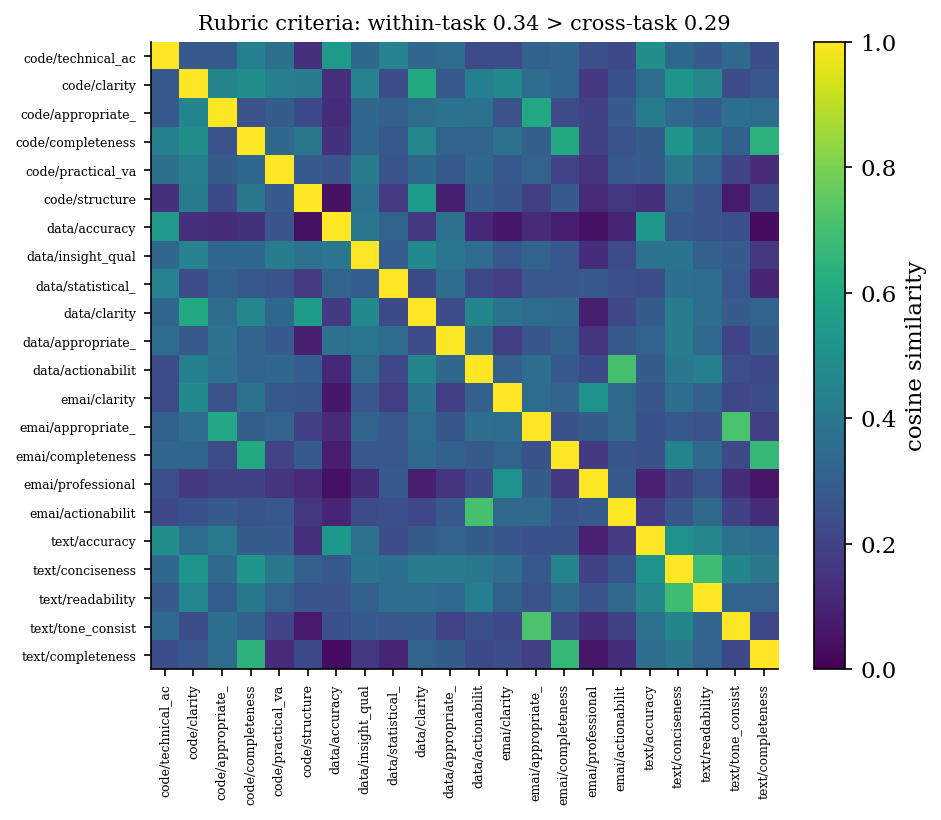
CoEval generates a scoring rubric automatically per task. We examine whether these rubrics are appropriately task-specialized while sharing a common quality core. Across the four tasks, the 22 auto-generated rubric criteria exhibit a mean within-task semantic similarity of $0.342$, exceeding the mean cross-task similarity of $0.294$: criteria cluster by task, as desired. At the same time, a shared universal “completeness” dimension recurs across three of the four tasks, indicating a common quality core. CoEval's rubrics are thus specialized to each task's demands yet anchored by a transferable notion of answer quality.
Appendix C. Worked examples on data-scarce domains
The three verticals of Section 5.6 are domains where a practitioner typically has no labeled benchmark and no trustworthy public one: drug–drug interaction (DDI) reasoning, clinical decision support, and legal analysis. The artifacts below are the actual output CoEval generated for each, from a single one-line task description and with no human labels. From that description the teacher inferred the attribute strata, synthesized $40$ contamination-free items stratified over them, and wrote a scoring rubric; the vendor-disjoint panel (OpenAI + Anthropic + Google) then ranked three candidate models (Table 6).
The pipeline is four templated calls to the teacher, all instantiated from the one-line
task_description (and an optional output_description). The first two build the attribute
space the items are stratified over; the third writes the rubric the panel scores against; the fourth generates one
contamination-free item per sampled attribute cell. The templates below are the verbatim framework prompts; a sampled
cell such as severity = moderate, mechanism = pharmacokinetic, patient_context = pregnancy
is what binds {target_attributes} and yields the corresponding DDI item shown after Table C1.
(1) Target-attribute map. Define the axes the benchmark varies over.
Generate synthetic data specifications for the {task_description} task by defining an
attribute space that characterizes possible outputs. Return a JSON object mapping each
attribute name to a list of possible values, and output only the JSON.
(2) Nuance map. Add surface-variation axes that change phrasing without changing the answer.
Define synthetic data specifications for the {task_description} task by creating a nuanced
variability-focused attribute space. Include only attributes that change document phrasing,
structure, noise, and context, without changing the underlying outputs. Return a single JSON
object mapping each attribute name to a list of allowed values, and output only the JSON.
(3) Auto-rubric. Write the task-specific scoring factors the judges apply.
For the task {task_description}, where the model's output is {output_description}, create an
evaluation rubric. Return only a JSON object where each key is a quality factor, and each
value is a concise description of that factor. Output only the JSON.
(4) Item synthesis. Generate one realistic item for a sampled attribute cell.
Generate a realistic benchmark data point.
Task: {task_description}
Output format: {output_description}
Required attributes: {target_attributes}
Nuance: {nuanced_attributes}

Return only a JSON object with exactly two string keys:
  "prompt":   a realistic input text for the task
  "response": the expected output for that input
Output only the JSON. No explanation or markdown.
Running this pipeline on the three one-line seeds below produces the auto-generated attribute strata and rubrics in Table C1, and the verbatim items that follow it.
| Domain and one-line seed | Auto-generated attribute strata | Auto-generated rubric |
|---|---|---|
| Drug–drug interaction reasoning "given two or more co-administered drugs and a patient context, assess the interaction, its mechanism, severity, and clinical action" |
severity {contraindicated, major, moderate, minor}; mechanism {pharmacokinetic, pharmacodynamic}; patient_context {renal, hepatic, polypharmacy-elderly, pregnancy} | interaction_accuracy, severity_correct, safety, completeness |
| Clinical reasoning "a clinical reasoning question a clinician would face, requiring medical knowledge and safe, accurate reasoning" |
specialty {cardiology, infectious_disease, pediatrics, oncology, emergency}; difficulty {routine, intermediate, hard} | clinical_accuracy, safety, completeness, clarity |
| Legal analysis "a legal analysis question requiring identification of the relevant rule and correct application to the facts" |
area_of_law {contracts, torts, criminal, constitutional, intellectual_property}; complexity {basic, intermediate, advanced} | legal_accuracy, reasoning_quality, completeness, clarity |
One representative generated item per domain (verbatim teacher output, labeled with its sampled attribute cell), showing the synthesized items are specific and realistic rather than templated:
- DDI (severity = moderate, mechanism = pharmacokinetic, patient_context = pregnancy): "A 30-year-old pregnant woman is prescribed lamotrigine for bipolar disorder and is also taking oral contraceptives. Assess the drug–drug interaction between these medications, identify the mechanism, and provide the severity and clinical recommendation."
- Clinical (specialty = cardiology, difficulty = routine): "A 62-year-old male with a history of hypertension and hyperlipidemia presents with progressive shortness of breath and occasional palpitations. On examination, you note elevated jugular venous pressure and a third heart sound. An ECG shows left ventricular hypertrophy. What is the most likely diagnosis and what initial management strategy should be considered?"
- Legal (area_of_law = torts, complexity = basic): "Alice, while jogging in the park, trips over a tree root that has been exposed due to erosion and falls, breaking her wrist. The park is owned by the city, and Alice claims the city is liable for her injuries due to negligence. Identify the relevant rule and determine if Alice can successfully hold the city liable."
Each item is scored on its rubric by the panel, producing the rankings in Table 6. On DDI the three judges are
unanimous, gpt-4o-mini ($0.770$) > gpt-3.5-turbo ($0.682$) >
llama-3.2-3b ($0.497$), with non-overlapping confidence intervals; on clinical reasoning the two stronger
models are statistically close ($0.873$ vs $0.864$), which the overlapping intervals correctly expose. The entire path
from a one-line description to a defensible, contamination-free ranking is a single configuration file with no labeled
data and no human raters.