A Controlled Synthetic Benchmark for Educational Aspect-Based Sentiment Analysis
Abstract
Large language models are increasingly used to synthesize labeled training data where annotation is scarce, but the generated labels are often unfaithful to the text, and it is difficult to tell whether a synthetic benchmark carries genuine learnable signal or merely reproduces label frequencies. We study both problems in educational aspect-based sentiment analysis (ABSA), a setting where real aspect-labeled feedback is private and costly to annotate, with a methodology that applies beyond it. We release a controlled corpus of 10,000 synthetic course reviews over a 20-aspect pedagogical schema, generated by sampling supervision targets separately from nuance attributes, so the same labels recur across varied course contexts and styles. We then introduce a faithfulness-aware pipeline: a cost-matched LLM audit scores how well each declared label is supported by the text, and that score both filters the training data and is itself validated across independent LLM judges and against human labels (Cohen's kappa 0.56 on two annotated corpora, and 0.62 with a fully independent model family); both the generation pipeline and the prompted baseline reproduce across four generator families spanning four providers, so the recipe is not tied to a single provider. Three controls establish that the corpus carries learnable signal rather than label priors: permuting the labels collapses detection to the trivial floor (0.182 versus 0.276 micro-F1), accuracy scales monotonically with training size (0.183 to 0.285), and restricting to faithfully labeled rows raises the ceiling. Evaluated by transfer to real human-annotated feedback (external real-data evaluation), faithfulness-aware row filtering lowers transferred sentiment error on Herath across two architectures (paired 95% bootstrap CI excludes zero), and a lowest-faithfulness control collapses transfer on both real benchmarks (Herath and EduRABSA). Synthetic-only training recovers about 52% of a real-trained model, and synthetic pre-training followed by real fine-tuning matches or slightly exceeds real-only training. The audit-filter-validate recipe is a general tool for quality-controlling LLM-supervised data; the corpus and code are released.
1. Introduction
Consider a typical undergraduate program at the end of a teaching term. Every course generates dozens to hundreds of free-text comments alongside numerical ratings, and the program lead reads, in practice, a tiny fraction. A 4.1 / 5 satisfaction score does not say whether students appreciated lecture clarity or merely tolerated it, whether exam fairness held up while workload climbed, or whether the same TA team was praised for support and criticised for grading transparency. Aspect-based sentiment analysis (ABSA) is the layer that translates raw comments into the per-dimension, per-instructor, per-cohort signals a program lead can act on. An institutional ABSA pipeline of the kind this paper enables would let a department, in one term-over-term comparison, see that tooling_usability sentiment across an introductory programming sequence dropped sharply after a submission-platform change, or that pacing declined in a senior elective as the syllabus accumulated topics without trimming.
Three institutional workflows benefit directly from such a pipeline. End-of-term review: an aspect-tagged feed converts an unread comment pile into per-aspect dashboards a program lead can scan in minutes, with negative-rate signals routed to the right intervention (TA training for support, syllabus rewrite for pacing, platform fix for tooling_usability). Mid-term pulse: a short free-text survey at week six, tagged by aspect, surfaces the categories with rising negative density (often pacing or support) early enough that the instructor can still intervene before final assessment. Longitudinal monitoring: the same course taught over four to eight semesters yields an aspect-time series whose drift exposes slow-moving problems (workload creep, declining peer_interaction as cohorts grew, gradually narrowing practical_application) that no single end-of-term reading reveals. None of these workflows demand a perfect classifier; they demand one that is available, reproducible, and substantially cheaper than the human reading they replace. The bottleneck today is not modelling architecture but supervision: educational ABSA datasets are scarce, expensive to annotate, and rarely public. A recent systematic review of educational ABSA finds that only two of fifteen studies released any annotated data [19], and the public corpora that do exist are predominantly sentence-level; review-level aspect labels are available mainly for MOOC platform reviews (for example OATS-ABSA on Coursera [4]) rather than for the institutional course and teacher feedback our schema targets. This data scarcity, not model capacity, is what a controlled synthetic corpus is meant to address.
Student reviews contain actionable evidence about workload, clarity, support, fairness, materials, and overall learning experience, yet most institutional feedback analysis still depends on manual reading or coarse sentiment summaries. For pedagogy, this matters because interventions rarely target “sentiment” in the abstract; instructors and program leaders need to know whether learners are reacting to assessment design, instructional clarity, course relevance, staff support, or the overall classroom experience. Feedback research in higher education repeatedly shows that comments become educationally useful when they can be connected to actionable teaching conditions rather than treated as isolated satisfaction signals [2, 14, 16]. ABSA is therefore well matched to this setting because the same review can simultaneously praise one aspect and criticize another. The challenge is that high-quality educational ABSA datasets are scarce, expensive to annotate, and often limited to a single institution, course type, or annotation scheme.
That scarcity is not accidental. Real student-feedback data are difficult to release because they are tied to institutional processes, often contain identifying context, and require laborious annotation decisions about implicit aspects, mixed sentiment, and local pedagogical terminology. Existing educational text-mining studies show that open-ended feedback is useful for course improvement, but the underlying data are often confidential, institution-specific, or too small for straightforward public reuse [12, 16, 20]. Even when institutions collect large amounts of feedback, the resulting labels are rarely public, rarely harmonized across universities, and rarely aligned with the fine-grained aspect schemas needed for ABSA. The present study addresses that bottleneck by pairing synthetic data generation with downstream ABSA modeling. Rather than treating data generation and model training as separate tasks, it formulates them as one end-to-end system: a synthetic review generator produces multi-aspect course reviews in multiple student personas, and an analysis pipeline learns aspect detection and sentiment scoring from those labels.
The contribution is therefore both a resource and a methodology, and although we instantiate it on educational ABSA, where labeled data are unusually scarce, the audit-filter-validate pipeline applies to any task trained on LLM-synthesized labels.
Contributions
- Controlled synthetic ABSA resource: a released 10,000-review corpus with fixed train/validation/test partitions over a 20-aspect pedagogical schema, generated by separating supervision targets from nuance attributes so the same aspect labels recur under varied course contexts and writing styles rather than collapsing into one prompt pattern.
- Faithfulness-aware data-quality methodology: a cost-matched LLM audit that scores per-label faithfulness and acts as an actionable training-data filter, with a lowest-faithfulness negative control that collapses transfer across two architectures and two real targets, a size-matched filtering gain on the Herath target, direct validation against human labels (Cohen's kappa 0.56 on two annotated corpora), direct human annotation of the synthetic corpus itself where human confirmation of declared aspects rises monotonically with the audit score, and reproduction of the pipeline across four generator families spanning four providers so the recipe is not tied to a single generator, establishing a general recipe for quality-controlling LLM-supervised data, not only this corpus.
- Signal-validity battery: label-permutation, trivial-floor, learning-curve, and clean-label-ceiling controls that distinguish genuine learnable signal from label frequencies, providing a reusable check that a synthetic benchmark is more than memorized priors.
- Real-data transfer evidence: the synthetic corpus does not merely substitute for real data, it augments it. Pretraining on the synthetic corpus and fine-tuning on real labels matches or slightly exceeds real-only training (micro-F1 0.784 versus 0.767 on Herath, four seeds), and with no real labels at all, synthetic-only training already recovers about half or more of a real-trained model on two independent human-annotated corpora (52% on Herath, 60% on EduRABSA), and synthetic pretraining then real fine-tuning matches or exceeds real-only training on both (Herath 0.784 versus 0.767, EduRABSA 0.753 versus 0.751). These are multi-seed means (five-seed synthetic-to-real transfer, four-seed real-trained references), robust to the run-to-run variance of this small-overlap setting.
The remainder of the paper proceeds as follows. Section 2 situates the study in the ABSA, synthetic-data, and educational-feedback literatures. Section 3 describes the corpus design and generation protocol, Section 4 defines the benchmark task and evaluation setup, and Section 5 presents the main benchmark, external-validation, and generator-faithfulness results before Section 6 discusses limitations and implications. Generator realism-validation and corpus-scale output-control diagnostics are reported in the appendix.
2. Related Work
This study draws on three literatures that are usually discussed separately: general ABSA benchmarks and models, synthetic text generation for supervised NLP, and educational feedback analysis. The connection among them is central to the paper. General ABSA work provides the task formulation and evaluation vocabulary; synthetic-data research motivates controlled label generation when annotation is scarce; and educational feedback studies explain why the target problem matters pedagogically and why real labeled data are unusually difficult to assemble. SemEval task definitions helped establish ABSA as a standard fine-grained sentiment problem by formalizing aspect detection and aspect sentiment prediction with shared datasets and evaluation procedures [28, 29]. More recent ABSA work continues to show the value of pretrained transformers and sentiment-aware pretraining for fine-grained polarity modeling [7, 41].
On the data side, the synthetic-data component belongs within a broader NLP literature on augmentation, weak supervision, and LLM-based example generation. Data-augmentation surveys show that gains depend on whether generated instances preserve task semantics and enlarge useful coverage of the training distribution rather than merely adding lexical variation [9]. More recent work on LLM-generated supervision shows both promise and caution: synthetic examples can improve downstream classification when prompts, controls, and filtering are carefully designed, but task difficulty and label faithfulness remain decisive constraints [21, 25]. A recent line of work formalizes this as a generation, curation, and evaluation pipeline [23] and turns directly to controlling the quality of LLM-supervised data: synthetic ABSA generators add label-refinement modules for few-shot transfer [38], LLM-generated samples help ABSA in low-resource regimes [15], and downstream classifiers can be calibrated against LLM-generated label noise after training [40]. The present work sits on the data side of that pipeline: rather than refining labels inside the generator [38] or correcting the classifier downstream [40], it audits each declared label for textual support, filters the corpus before training, and validates that audit against human labels. This caution is especially relevant here because educational ABSA is a subjective and domain-specific task whose label space often reflects local pedagogical practice rather than a universal ontology. More broadly, prompting and representation learning with large models are advancing rapidly on adjacent problems, from probing how vision-language models perceive nuanced signals such as multimodal sarcasm [5] to exploiting relational structure among unlabelled samples for generalized category discovery [24]; our contribution is orthogonal to these modeling advances, targeting instead the data-quality control of LLM-supervised labels.
In education, prior work has emphasized that student feedback is noisy, stylistically varied, and pedagogically important. A broader higher-education feedback literature also shows that formative feedback matters because it shapes student learning rather than merely administrative satisfaction tracking [10]. Welch and Mihalcea demonstrated the value of targeted sentiment analysis for student comments [36], while Chathuranga et al. released an annotated student course feedback corpus for opinion targets and polarity [3]. Herath et al. later reported a 3,000-instance student feedback corpus with annotations for aspects, opinion terms, and polarities, illustrating both the feasibility and the cost of building educational sentiment resources [17]. Nikolić et al. showed that ABSA can be informative for higher education reviews, but that source characteristics matter and performance varies across aspect frequencies and review sources [27]. Misuraca et al. repositioned opinion mining as an educational analytic rather than only a text-classification exercise, arguing that open-ended comments add value beyond numeric ratings [26]. More recent reviews synthesize the educational sentiment-analysis landscape and reiterate recurring bottlenecks around annotation cost, domain language, multi-polarity, and deployment in authentic educational settings [31, 32]. A recent systematic review of aspect-based sentiment analysis in MOOC settings similarly catalogs the aspect schemas and methods used across educational platforms [1]. Together, this literature supports the relevance of the problem, clarifies why real labeled educational data are difficult to obtain at scale, and explains why a synthetic educational ABSA resource may be useful even when realism validation remains a separate concern. Table 1 positions the present study against these prior educational-feedback resources.
| Study | Data source and focus | Label granularity | Relation to this study |
|---|---|---|---|
| Welch and Mihalcea [36] | Student comments | Targeted sentiment | Establishes pedagogical relevance, but not a public multi-aspect benchmark |
| Chathuranga et al. [3] | Student course feedback | Opinion targets and polarity | Shows feasibility of real educational annotation, but with narrower task scope |
| Herath et al. [17] | Student feedback corpus | Aspect, opinion-term, and polarity annotations | Closest educational benchmark reference and strongest evidence of annotation cost |
| Nikolić et al. [27] | Higher-education reviews | Aspect-based review analysis | Shows source sensitivity and motivates explicit realism validation |
| This study | Synthetic course reviews with separate realism and mapped real-transfer validation sets | 20-aspect benchmark corpus, controllable prompt protocol, generator realism diagnostic, and conservative transfer checks on two real corpora (9- and 7-aspect overlaps) | Positions the contribution as synthetic supervision with initial external validation rather than a replacement for real annotated corpora |
The dataset is intentionally more aspect-rich than narrow course-review setups that focus mainly on instructor praise or overall satisfaction. Its 20 aspects span workload, clarity, exam fairness, lecturer quality, relevance, interest, support, materials, overall experience, feedback quality, assessment design, pacing, organization, practical application, tooling usability, accessibility, grading transparency, peer interaction, and prerequisite fit. This wider aspect space matters pedagogically because the actionable question for instructors is rarely whether a course is “good” in the abstract; it is which design dimension is helping or harming student learning. It also matters methodologically because a broader aspect inventory creates a harder ABSA benchmark, especially for more ambiguous categories such as relevance, interest, overall experience, support, and prerequisite fit.
The novelty claim in this setting comes from the combination of pieces rather than from synthetic text alone. The study couples controlled synthetic generation with an explicitly educational 20-aspect schema, a train-validation-test benchmark protocol, and external validation on mapped student feedback. In other words, the contribution lies in the combination of task framing, controllable generation, educationally meaningful aspect design, and benchmark integration.
Synthetic augmentation and few-shot prompting also provide a natural methodological backdrop for this work. Prior augmentation research in ABSA shows that semantics-preserving edits can improve downstream learning without destroying polarity structure [18], while few-shot prompting methods demonstrate that label recovery can be possible even with very limited demonstrations [30, 32]. More recent instruction-tuned and weak-supervision studies further suggest that prompt-based ABSA can become competitive when label scarcity is severe, but that careful task formulation still matters [33, 34]. This makes it reasonable to compare trainable ABSA models with zero-shot and few-shot generative baselines on the same synthetic benchmark, even if the main paper contribution remains the dataset and the training pipeline rather than prompt engineering alone.
Generative ABSA work also supports this comparison more directly. Unified generative frameworks show that ABSA subtasks can be cast as structured text generation rather than only as classifier heads [39], and text-generation formulations of aspect category sentiment analysis report particular strength in zero-shot and few-shot settings [22]. At the same time, broader text-classification evidence suggests that in-context learning remains an informative but demanding baseline: smaller fine-tuned encoders often still outperform zero-shot and few-shot prompting when labels are structured and evaluation is strict [8], and broader sentiment-analysis reviews in the LLM era recommend caution against assuming prompt-based superiority by default [42]. This literature justifies including LLM-based baselines while keeping the central contribution focused on the synthetic educational dataset and its benchmark evaluation.
The most consequential contribution is therefore the benchmark resource itself, not synthetic text generation in isolation. What makes that resource scientifically useful is the combination of three properties. First, the aspect schema is pedagogically motivated: it separates actionable dimensions of teaching and course design rather than collapsing them into overall satisfaction. Second, the generator is controlled rather than generic: target aspect sentiments and sampled nuance attributes are manipulated independently so that labels can be realized under varied educational situations and writing styles. Third, the corpus is paired with explicit ABSA evaluation, so the study contributes not only text generation, but a reproducible experimental setting for a domain where public aspect-labeled data remain scarce.
3. Data Resource and Generation Protocol
The methodology has two linked components: a synthetic data generation protocol and a downstream ABSA analysis pipeline. The first produces educational reviews with controlled aspect-level sentiment labels and varied review conditions. The second evaluates whether those reviews function as useful ABSA training and evaluation data. Diversity and realism analyses are treated as quality analyses of the generator, whereas the main empirical results concern model behavior on the synthetic corpus.
3.1 Synthetic Data Generation Pipeline
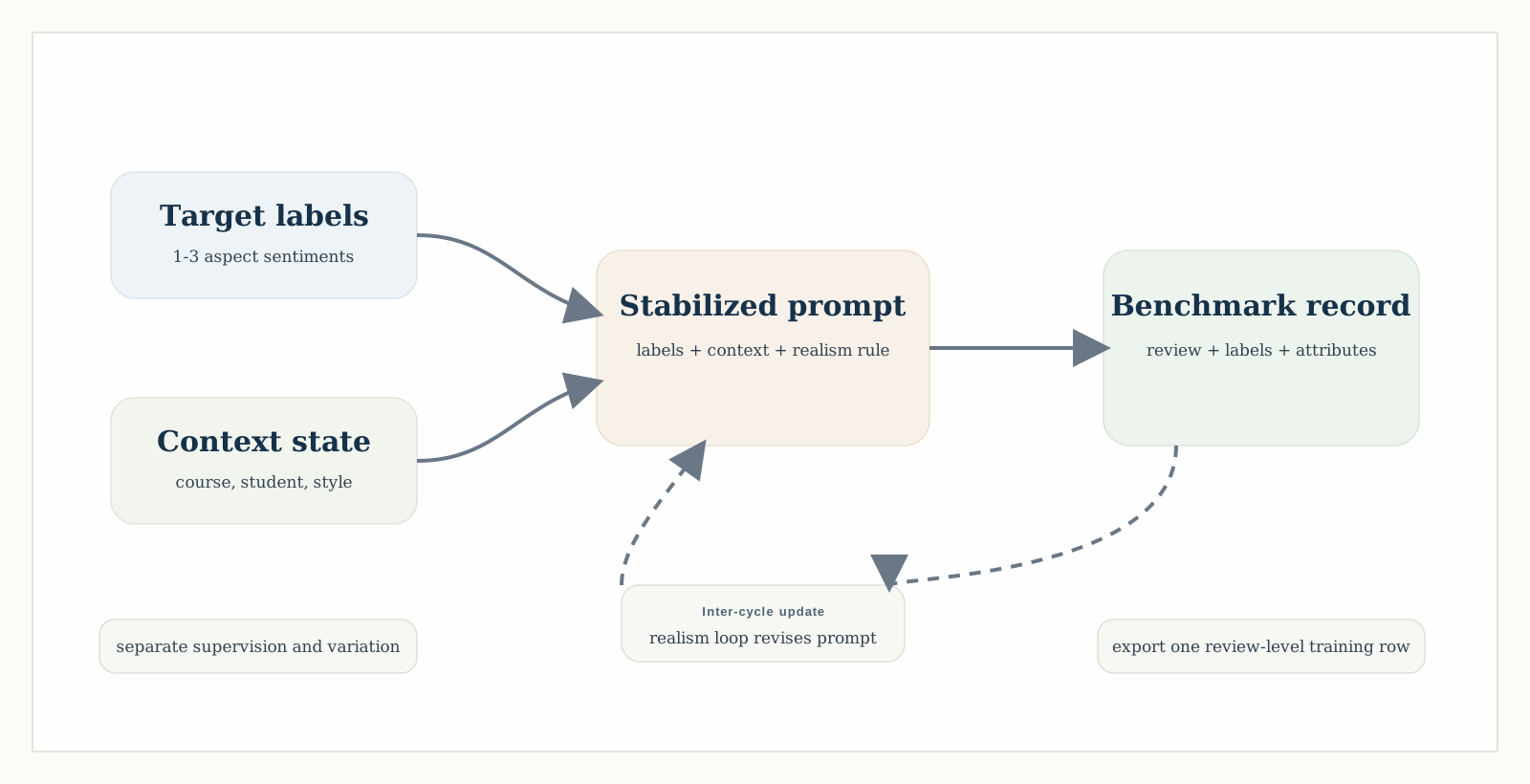
The generation process is organized as a sequence of four decisions. First, the system samples the supervision target itself: one, two, or three aspect-sentiment pairs drawn from the 20-aspect pedagogical schema. Second, it samples a separate nuance state from the attribute families that define course context, student background, assessment conditions, writing style, and realism controls. This separation is intentional. The target labels specify what the downstream ABSA model should recover, whereas the nuance state specifies how those labels are realized in the surface review. The same aspect combination can therefore appear under different course names, student trajectories, and rhetorical styles instead of collapsing into one repeated prompt pattern.
After those two states are sampled, they are merged only at prompt construction time. A realism-constrained instruction is appended to the sampled labels and attributes to form the generation request. The generator then produces the review from this prompt, and the exported record retains both its aspect labels and its sampled nuance attributes; recurrent synthetic cues are reduced between generation cycles by revising the shared instruction rather than by rewriting individual reviews. Large-scale generation is therefore not driven by a single free-form prompt, but by a fixed template whose row-level variation comes from independently sampled targets and contextual controls.
Figure 1 condenses the generation protocol to its main structural idea. One input stream defines the supervision target, namely one to three aspect-sentiment labels. A second input stream defines how those labels are realized in text through sampled course context, student state, pedagogical circumstances, and style controls. These streams meet only at prompt construction time, after which generation yields a review-level benchmark record that preserves both the text and the sampled control state. The dashed feedback path is shown as an inter-cycle revision rather than a per-row operation because realism validation updates the stabilized instruction between complete prompt states.
3.2 ABSA Analysis Pipeline
The benchmark pipeline begins from the assembled review-level corpus and applies one shared train-validation-test split to every reported method. The train partition is used for parameter estimation, the validation partition is used for early stopping, threshold calibration, and prompt selection, and the test partition is reserved for final reporting only. This split discipline is especially important here because the paper also reports realism validation and mapped real-data transfer; those additional analyses remain outside the internal benchmark and are never merged into the synthetic split.
Within that split, the primary task formulation is two-step ABSA. A first stage predicts which aspects are present in a review, and a second stage assigns sentiment only to the aspects selected by the detector. This decomposition keeps omission errors and polarity errors analytically separate and makes the evaluation easier to interpret than a single opaque score. Reported results therefore combine multi-label detection metrics such as precision, recall, and F1 with a detected-aspect sentiment MSE that measures how well polarity is recovered once an aspect has been predicted. Prompt-based methods and mapped real-data transfer are evaluated under the same output contract, but they are reported as supporting analyses rather than as the central benchmark family.
The evaluation side of the study uses a single shared contract. Every reported approach begins from the same review-level corpus and the same 8,000/1,000/1,000 split, so differences in outcome come from the modeling approach rather than from incompatible data conditions: one corpus, one split, one validation stage, and one held-out reporting stage. Validation is reserved for calibration and model choice, while mapped real-data transfer and generator-validation analyses are treated as complementary checks rather than replacements for the main synthetic benchmark.
3.3 Aspect Inventory and Pedagogical Scope
The benchmark uses a 20-aspect inventory so that distinct student concerns can be represented directly instead of being collapsed into broad categories such as overall_experience or relevance. For readability, the inventory is organized into five pedagogical blocks: instructional quality (clarity, lecturer_quality, materials, feedback_quality), assessment and course management (exam_fairness, assessment_design, grading_transparency, organization, tooling_usability), learning demand and readiness (difficulty, workload, pacing, prerequisite_fit), learning environment (support, accessibility, peer_interaction), and engagement and value (relevance, interest, practical_application, overall_experience). Appendix A.1.1 lists the full inventory with these group assignments.
These additions are motivated by pedagogy rather than by label inflation. Students frequently distinguish between a course that is difficult and one that is poorly paced, between a fair exam and a badly aligned assessment structure, and between strong content and weak tooling or feedback loops. Making those distinctions explicit is one of the main novelty claims: the goal is not only more labels, but a more educationally actionable aspect space than the small public student-feedback corpora described in prior work.
3.4 Prompting Protocol for Diversity
Diversity does not refer to surface paraphrasing alone. The generator varies course name, lecturer, grade, writing style, and one to three aspect labels, but that space would still be too narrow if reviews differed only superficially. The protocol therefore samples from a richer attribute schema that captures situational, pedagogical, and stylistic variation together. The schema contains four groups of controls: core context, assessment and teaching context, linguistic diversity, and realism controls.
Core-context attributes include course name, course level, semester stage, student background, motivation for taking the course, attendance pattern, study context, and grade band. Assessment-context attributes include assessment profile, instructional delivery, support-channel experience, administrative friction, feedback timing, prerequisite fit, collaboration structure, and platform or tooling experience. Linguistic-diversity attributes include writing style, emotional temperature, hedging level, specificity level, review length band, formality level, and recommendation stance. Realism-oriented attributes include review shape, contradiction pattern, time-pressure context, natural-noise style, comparison frame, and memory anchors. Each attribute is parameterized with a compact set of 4 to 6 values so the prompt remains controllable while still widening the review space. Each synthetic review samples five core-context attributes with course_name always required, four assessment-and-teaching attributes, three linguistic-diversity attributes, and three realism-control attributes. The result is one prompt template with a different contextual state for each review rather than a fixed bundle repeated at scale.
3.5 Prompt Stabilization and Data Generation Process
The generation process can be read as a separation of supervision targets from contextual realization. First, target attributes are sampled as one to three aspect-sentiment pairs; these are the labels the downstream ABSA system must recover. Second, nuance attributes are sampled independently from the four attribute groups described above so that the same target labels can appear in different pedagogical and stylistic contexts. Third, the prompt combines the sampled labels, the sampled nuance state, and the realism-constrained instruction used throughout corpus generation. The model then produces the review from this single combined prompt, and the stored item retains both its target labels and its sampled nuance attributes. Synthetic cues are reduced between generation cycles by revising the shared instruction rather than by rewriting individual reviews (Section 3.1 and Figure 1).
In this formalization, \(K\) is the sampled number of aspects, \(A\) is the set of target aspect-sentiment labels, \(N\) is the sampled nuance state drawn from the attribute groups \(\mathcal{G}\), \(I_c\) is the realism-constrained instruction, \(T\) is the prompt-construction function, and \(p_{\theta}\) is the review generator. The notation highlights the main design choice of the paper: labels and contextual variation are sampled separately and only later combined into one review-generation prompt.
The full dataset is generated from one prompt specification rather than from mixed prompt states. That specification is rendered into OpenAI Batch requests with gpt-5-nano as the generator, minimal reasoning effort, and low text verbosity. Length control is enforced both textually and operationally: every prompt includes a sampled review_length_band attribute, the prompt injects hard length guidance for that band, and the request builder sets band-specific max_output_tokens budgets that further depend on whether the review has one, two, or three target aspects. The resulting corpus is therefore not produced by an unconstrained free-form prompt, but by a fixed template with per-row target labels, nuance states, and output-budget controls.
Realism is treated as more than surface messiness. The stabilized instruction explicitly discourages sentence-by-sentence checklist coverage of aspect labels, over-balanced tradeoff language, stock recommendation summaries, and generic domain-term stacking. Instead, it asks for asymmetric detail, incidental mention of some aspects, and limited but grounded specificity. The number of labeled aspects is also constrained. The synthetic corpus follows the intended 30/40/30 policy over one-, two-, and three-aspect reviews, with counts of 3,032, 3,917, and 3,051 respectively. This empirical pattern justifies restricting generation to one to three aspects only; allowing more aspects would likely create unnaturally dense reviews and increase synthetic detectability. The protocol therefore uses either the empirical distribution directly or a rounded practical policy of 0.30 / 0.40 / 0.30 for one, two, and three aspects respectively.
3.6 Synthetic Training Data and Real Validation Data
The final corpus contains 10,000 synthetic records generated from the realism-tuned prompt package. All rows contain review text and at least one valid labeled aspect, although 841 rows were marked incomplete by the API because they hit the output-token cap. These capped rows are modestly different from complete rows, shorter (mean 100 vs 119 words) and carrying fewer aspects (a 0.07 versus 0.33 share of three-aspect reviews), with a similar sentiment mix (Appendix A.1.6). Retraining the benchmark with these 841 rows excluded leaves held-out detection essentially unchanged (micro-F1 0.264 versus 0.275, macro balanced accuracy 0.613 versus 0.619 across three seeds), so the corpus is robust to their inclusion. Regenerating exactly these rows at a raised output cap also removes the truncation and restores full-corpus length-band adherence to the never-truncated level (Appendix A.1.5). The generation length budget is also a deliberate and realistic constraint rather than only a limitation: real course-feedback platforms cap how much a student can write, and the retained reviews match the length profile of real full-length course reviews. On the public OMSCS reviews, the retained synthetic reviews have a median of 122 words against 104 for the real reviews, and 92% fall within the real 10th-to-90th-percentile band of 43 to 311 words (they diverge only from Herath, whose entries are sentence-level snippets rather than whole reviews). The assembled corpus spans 8 course names, 6 observed writing-style labels, 5 grade bands, and the full 20-aspect inventory. The mean review length is 117.2 words, the median is 108 words, and each review contains an average of 2.0 labeled aspects. In practical terms, the corpus is large enough for controlled internal benchmarking, while realism validation and synthetic-to-real transfer remain separate supporting analyses.
Real data are used in two different roles, and it is important not to conflate them when judging the scope of the evidence. The first role is a small blinded reference pool of 32 public OMSCS reviews drawn from four course pages (CS-6200, CS-6250, CS-6400, CS-7641); these are never used for training, validation, or test evaluation, only as blinded items in the real-versus-synthetic judge loop so prompt changes can be checked against naturally occurring educational-review language, and this pool is freely enlargeable from public sources (for example, thousands of RateMyProfessor teaching-feedback comments are available). The 32-review figure therefore bounds a diagnostic loop, not the benchmark's real-data scope. The second role, which is the actual external evaluation, uses two independent annotated real corpora under two different annotation schemes: the student-feedback corpus of Herath et al. [17] (2,829 reviews, conservatively mapped to a 9-aspect overlap) and EduRABSA (mapped to a 7-aspect overlap). Models trained only on synthetic data are evaluated out of domain on both, so the transfer evidence rests on thousands of real reviews across two schemes rather than on the blinded realism pool. This distinction matters for interpretation: synthetic data define the main ABSA benchmark, while real data are reserved for generator analysis and for two independent external evaluations.
The richness of the generator comes from the combination of target attributes and nuance attributes. Target attributes define the supervision target, while nuance attributes introduce course- and student-level variation that helps the same aspect labels appear in different contexts. In this protocol, the nuance space is grouped into four functional blocks so the prompt remains interpretable: one block anchors the course situation, one changes the pedagogical events being described, one changes linguistic realization, and one suppresses templated synthetic regularity. Table 2 lists representative variables from each block rather than exhausting the full schema, because the scientific point is the role each block plays in controlled diversity; the aspect blocks themselves are listed separately in Appendix A.1.1.
| Group | Representative attributes | Function in the generation protocol |
|---|---|---|
| Core context | course_name, course_level, semester_stage, student_background | Places the review in a recognizable educational situation so the same labels can appear under different student positions and course settings. |
| Assessment and teaching | assessment_profile, instruction_delivery, support_channel_experience, feedback_timing | Changes the pedagogical substance of the review by varying what the student is reacting to, not only how the review sounds. |
| Linguistic diversity | writing_style, emotional_temperature, hedging_level, review_length_band | Changes tone, compression, and rhetorical texture while preserving the declared aspect-sentiment targets. |
| Realism controls | review_shape, contradiction_pattern, memory_anchor, natural_noise | Discourages checklist-like coverage and overbalanced summaries by introducing the small irregularities common in human reviews. |
The benchmark uses the full 20-aspect inventory. The five aspect groups span instructional quality, assessment and course management, learning demand and readiness, learning environment, and engagement and value. Those dimensions are pedagogically important because they capture implementation details that often determine whether a student experience feels coherent or frustrating, whether the social learning environment is supportive, and whether course expectations match student preparation. In other words, Table 2 is not a style table; it is a control map for how pedagogical content, student position, and writing surface are disentangled during generation.
4. Benchmark Task and Evaluation Setup
4.1 Task Definition and Split Protocol
The ABSA benchmark is defined entirely on the synthetic corpus. Reviews are divided into train, validation, and test partitions using a strict three-way split. Training updates model parameters only on the training split; the validation split is reserved for early stopping, threshold calibration, and prompt-variant selection; and the test split is held out for final reporting only. This separation is central to the experimental design because the real-review pool is not part of the ABSA benchmark at all.
The experiments use the 10,000-review 20-aspect corpus with an 8,000/1,000/1,000 train-validation-test split. Metrics include per-aspect precision, recall, and F1 for aspect detection, together with sentiment mean-squared error on detected aspects. Because this is a sparse multilabel setting with many more negative than positive label decisions, the study also tracks macro balanced accuracy, macro specificity, and macro Matthews correlation as complementary diagnostics derived from the per-aspect confusion counts. Thresholds for discriminative detectors are chosen on the validation split only.
The split itself is deterministic. The benchmark harness applies a seeded permutation with seed 42, then assigns rows to train, validation, and test according to the fixed 0.80 / 0.10 / 0.10 proportions. No real-data rows are ever merged into this split. This point is worth stating explicitly because the paper contains both synthetic and real evaluations: the synthetic split is the main benchmark, the OMSCS pool is used only for realism validation, and the mapped Herath and EduRABSA corpora are used only after training as external evaluation sets.
4.2 Evaluation Plan for the ABSA Pipeline
The evaluation plan compares two families of ABSA approaches under one shared task definition. The first family contains trainable encoders that learn aspect detection and per-aspect sentiment from synthetic supervision. The second contains GPT-based inference methods that recover the same outputs without task-specific fine-tuning. Both families are executed and reported in the study. The difference is not whether they are tested, but how they are deployed: the local supervised models are trained on the synthetic split, whereas the GPT-based methods perform direct batch inference on the held-out test split under the same output schema.
Formally, let \(x\) denote a review, let \(\mathcal{A}=\{a_1,\dots,a_K\}\) denote the aspect inventory, let \(z \in \{0,1\}^K\) denote aspect presence indicators, and let \(s \in \{-1,0,1\}^K\) denote aspect sentiments for the aspects that are present. The benchmark can then be viewed as learning or inferring a mapping \(x \mapsto (\hat{z}, \hat{s})\), with detection quality evaluated against \(z\) and sentiment quality evaluated only on detected or gold-present aspects depending on the reporting view. The main supervised decomposition treats ABSA as
where \(f_\theta\) is a multi-label detector and \(g_\phi\) is a sentiment predictor applied only to the aspects selected by the first stage. This two-step formulation remains the main discriminative benchmark because it cleanly separates omission errors from polarity errors. The reported benchmark includes the TF-IDF two-step baseline together with transformer two-step models built on distilbert-base-uncased, bert-base-uncased, albert-base-v2, and roberta-base, all evaluated on the same 10K / 20-aspect train-validation-test split.
The training protocol is identical across the transformer baselines except for the encoder backbone. Reviews are truncated or padded to 192 tokens, optimization uses AdamW with learning rate \(3\times 10^{-5}\), and both the detection and sentiment stages are trained for up to three epochs with patience-based early stopping after two non-improving validation checks. The detection head is trained with sigmoid logits and a per-aspect weighted binary cross-entropy loss whose positive weights are estimated from the training split and clipped to the range \([1, 50]\) to avoid extreme imbalance. The sentiment head predicts one bounded score per aspect via a \(\tanh\) output layer and is optimized with masked mean-squared error so that loss is accumulated only on gold-present aspects. This explicit protocol matters because it explains why the benchmark emphasizes reproducibility and interpretable stage-wise errors rather than aggressive architecture tuning.
Threshold calibration is also separated cleanly from test evaluation. After training the detection stage, each aspect receives its own decision threshold chosen on the validation split by a grid search from 0.05 to 0.95 in steps of 0.05, maximizing per-aspect F1 on validation only. Those fixed thresholds are then applied once on the test split. Reported micro- and macro-F1 therefore reflect calibrated binary decisions, whereas the sentiment MSE is measured only on aspects that the model actually predicts as present. The balanced-accuracy and specificity diagnostics are useful here because they remain interpretable when the label space is sparse and class prevalence differs strongly across aspects. That detected-aspect view intentionally couples polarity quality to detection quality, which makes the sentiment metric more operational but also more conservative than evaluating sentiment only on gold-present aspects.
We also retain a single-stage joint family as an explicit decomposition baseline. In that setting, one model predicts both outputs simultaneously,
so that the benchmark can test whether jointly coupling aspect presence and polarity is competitive with the more interpretable two-step design. In the evaluation framework these joint variants are represented by compact bert_joint and distilbert_joint baselines, and they are reported as executed local comparisons alongside the stronger two-step models.
The prompt-based branch casts the same output space as structured generation rather than parameter updates. Given an instruction template \(\pi\), an optional demonstration set \(D\), and possibly a retrieval operator \(R(\cdot)\), a prompted model produces
This family includes six variants. The zero-shot model uses constrained structured decoding without demonstrations. Fixed few-shot prompting uses a static set of labeled training examples, while diverse few-shot prompting chooses examples that deliberately vary aspect count, tone, and review style. Retrieval-based few-shot prompting replaces static demonstrations with lexical nearest neighbors from the training split so that the context is review-dependent. The batch evaluation path uses a strict schema-constrained output contract, and the reported GPT results cover zero-shot, fixed few-shot, diverse few-shot, and retrieval-based few-shot inference under that shared contract.
Two additional prompt decompositions are included because they parallel common ABSA design choices. The two-pass prompted variant first predicts aspects and then conditions sentiment on those detected aspects,
which makes its structure directly comparable to the two-step discriminative pipeline. The aspect-by-aspect prompted variant instead factors inference over the aspect inventory,
so it asks a separate binary presence question for each \(a_k\) and only then queries sentiment where needed. This formulation is more expensive but useful for diagnosing whether per-aspect prompting improves recall control or sentiment calibration.
These GPT-based variants are part of the ABSA evaluation plan, not the realism protocol. The realism protocol (Appendix A.2.4) remains a separate judge-based validation loop used to improve the generator prompt, whereas the evaluation plan asks whether different ABSA approaches can recover the synthetic aspect labels once the dataset has been fixed. Across all planned approaches, model selection, threshold calibration, and prompt-choice decisions are confined to the validation split, and final benchmark numbers are reported only on held-out data.
Table 3 functions as a compact map of the executed experiment families. Rather than repeating implementation details, it keeps the benchmark logic visible in one place: which approaches learn from synthetic supervision, which recover labels through inference-time prompting, and which analyses are used to examine robustness and transfer.
| Family | Modeling idea | Representative variants | Role in the study |
|---|---|---|---|
| Classical baseline | Two-step sparse lexical detector plus sentiment regressor | tfidf_two_step | Main benchmark Low-cost reference point under the same validation and test contract. |
| Transformer encoders | Two-step supervised detection and sentiment models | distilbert-base-uncased, bert-base-uncased, albert-base-v2, roberta-base | Main benchmark Primary discriminative comparison family on the full 10K / 20-aspect split. |
| Joint prediction | Single model predicts aspect presence and polarity together | bert_joint, distilbert_joint | Executed comparison Used to test whether a compact joint formulation can match the stronger two-step decomposition. |
| GPT-based inference | Structured generation with demonstrations or retrieval context | gpt-5.2 zero-shot, few-shot, few-shot-diverse, retrieval-few-shot | Executed comparison Inference-only ABSA baselines under the same structured aspect-sentiment contract and the full held-out test split. |
This matrix is intentionally compact. The later results section returns to exact scores, robustness analyses, and per-aspect behavior, but Table 3 keeps the benchmark logic visible in one place: what is learned from synthetic supervision, what is inferred at test time only, and how those families complement the transfer and generator-validation analyses. Table 4 then gives the exact corpus-level counts and ranges for the synthetic benchmark and the three real-data pools it draws on.
| Measure | Value | Interpretation |
|---|---|---|
| Clean reviews | 10,000 | Usable synthetic records in the final corpus |
| Real validation reviews | 32 | Public OMSCS reviews used only for the realism-validation loop |
| Mapped external test reviews (Herath) | 2,829 | Annotated student-feedback reviews from Herath et al. used only for synthetic-to-real evaluation on a 9-aspect overlap |
| Mapped external test reviews (EduRABSA) | 2,152 | Held-out EduRABSA reviews used only for synthetic-to-real evaluation on a 7-aspect overlap |
| Course names | 8 | Multiple academic contexts rather than a single course |
| Observed writing styles | 6 | Style-conditioned prompting remains present in the assembled dataset |
| Aspect inventory | 20 | The benchmark runs directly on the 20-aspect pedagogical schema listed in Appendix A.1.1 |
| Mean / median words | 117.2 / 108 | The corpus mixes short comments with longer reflective reviews |
| Mean aspects per review | 2.0 | Many reviews are genuinely multi-aspect |
| Min-max words | 34-273 | Substantial variation in compression and detail remains visible even after length controls |
5. Results
The results are presented in the same order as the paper's claim structure. After mapping the reported analyses to their data and splits, we report the main local benchmark, then the full-test GPT and real-data comparisons, and only afterward return to generator-quality diagnostics, focusing on label faithfulness and a faithfulness-aware filtering recipe. This ordering is intentional: the central claim concerns the value of the synthetic corpus as an educational ABSA benchmark resource, whereas faithfulness analysis explains the strengths and limits of the generation process. The corpus profile and representative examples, corpus-scale output-control statistics, and the three-cycle realism-validation procedure are reported in full in the appendix as generator diagnostics.
5.1 Scope of Reported Analyses
| Analysis block | Data and split | Primary outputs | Interpretive role |
|---|---|---|---|
| Synthetic benchmark | 10,000 reviews; 8k / 1k / 1k split | Detection F1, sentiment MSE, per-aspect and robustness summaries | Principal learnability and model-comparison evidence (20 aspects). |
| Prompted inference baselines | Same 1,000-review held-out test split; batch prompting | Zero-shot detection and sentiment metrics across four prompting variants | Inference-time baselines under the same label contract as the trained models. |
| External transfer (two corpora) | Herath (2,829, 9-aspect overlap) and EduRABSA (7-aspect overlap) | Transfer metrics; overlap-matched synthetic-versus-real comparisons | Real-data check on two independent annotated feedback spaces. |
| Realism study | Three 60-item judge cycles; public OMSCS and matched synthetic reviews | Judge accuracy, confusion, entropy, cue tags | Generator-side diagnostic of how realism cues were reduced. |
| Faithfulness audit | 250-review corpus sample plus 25-review pilot | Aspect-support and sentiment-match rates versus declared labels | How to read the corpus as a useful but imperfect resource. |
| Generator and output-control robustness | 150 prompts across four generator families; the 841 output-capped rows | Per-family audit fidelity; length-band adherence recovery | Shows the pipeline is provider-agnostic and truncation is recoverable. |
Table 5 therefore complements rather than repeats Table 3. Table 3 says which method families are executed, while Table 5 says what each analysis block is meant to establish, which split it uses, and how it should be interpreted alongside the main benchmark. Supporting detail for the analyses that follow is collected in the appendix: side-by-side real and synthetic review examples (Appendix A.1.2), the exact prompt instructions used across realism-validation cycles (Appendix A.2.2), the pilot-subset procedure validation (Appendix A.2.3), complementary generator diagnostics (Appendix A.3.1), the corpus profile and representative examples (Appendix A.1.4), the per-aspect behavior of the best model (Appendix A.5.3), and prior real-data educational sentiment results placed in context (Appendix A.6.1).
5.2 Internal Benchmark on the 10K / 20-Aspect Corpus
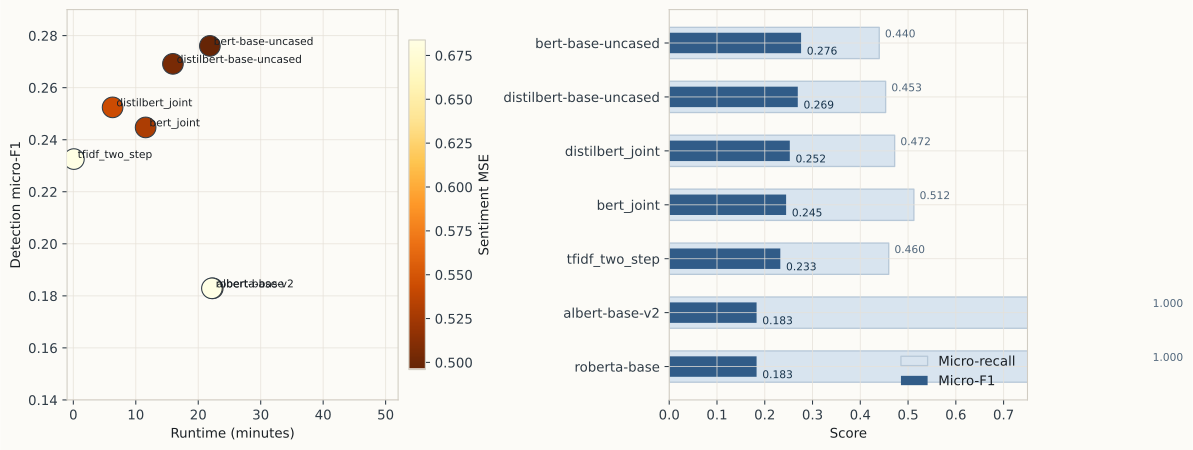
The main benchmark uses the 10,000-review corpus with a strict 8,000/1,000/1,000 train-validation-test split. Seven local approaches are reported: TF-IDF, four two-step transformer encoders, and two joint encoders that predict aspect presence and polarity together. Among the untuned models, bert-base-uncased gives the strongest held-out detection, at macro balanced accuracy 0.623 and macro AUROC 0.681 (micro-F1 0.276, detected-aspect sentiment MSE 0.4959), followed by distilbert-base-uncased at balanced accuracy 0.621 (micro-F1 0.2691). The joint variants remain competitive but lower (distilbert_joint micro-F1 0.2524, bert_joint 0.2447), which supports the two-step decomposition as the clearest baseline family in this benchmark. We lead with balanced accuracy and threshold-free AUROC rather than micro-F1 because micro-F1 is a deliberately strict operating-point metric here: with one to three aspects per review among twenty mostly-absent labels, the trivial all-present baseline already scores 0.183 micro-F1, so the absolute level is compressed by the task structure and the measured label noise rather than by weak representations. Micro-F1 is retained throughout the tables as the standard comparable metric, but it is read alongside balanced accuracy and ranking quality, not alone.
Additional robustness analyses sharpen that picture. Across three seeds for TF-IDF, DistilBERT, and BERT, the highest mean detection score comes from BERT at \(0.2791 \pm 0.0140\) micro-F1, while DistilBERT remains the most stable model at \(0.2694 \pm 0.0005\). A lower-rate four-epoch BERT schedule further raises the held-out score to 0.2930 and lowers sentiment MSE to 0.4728. Appendix A.5.1 reports the full seed-stability, joint-versus-two-step, and tuning tables and figures that support these observations.
Absolute scores are shaped by task structure and the corpus's measured label noise, and the benchmark's difficulty is itself informative; a qualitative error analysis further shows the residual failures are systematic rather than random, in four recurring patterns (Appendix A.7.1). The benchmark covers 20 aspects across five pedagogical groups, includes subtle categories such as feedback_quality, peer_interaction, and prerequisite_fit, and allows one to three aspects per review across multiple writing styles and course contexts. The ranking also has a concrete error-profile interpretation. BERT and DistilBERT improve primarily by lifting recall above 0.43 while retaining enough precision to prevent indiscriminate overprediction. ALBERT and RoBERTa, by contrast, collapse to recall 1.000 at micro-F1 0.183, and the resulting false positives inflate downstream sentiment MSE to 0.577 and 0.684 respectively. In this sense, Table 6 shows that the benchmark rewards models that recover many aspect mentions without collapsing into broad positive prediction.
Part of the moderate ceiling is a property of the labels rather than of the models. The held-out test split carries the same label faithfulness as the training corpus: under the full-corpus gpt-4.1-mini audit (Section 5.7), the 1,000-review held-out split has a mean per-row aspect-sentiment match rate of 0.58, statistically identical to the 0.58 of the full 10K. A held-out score is bounded by the faithfulness of the held-out labels, so a portion of the unrecovered detection F1 reflects test rows whose declared polarity is not visibly supported in the text rather than model limitation alone. This is directly measurable: re-scoring the trained bert-base-uncased detector on the faithful subset of the test split (the rows whose declared aspects are all supported) lifts micro-F1 from 0.276 (95% CI [0.270, 0.285]) on the full 1,000-review test set to 0.307 ([0.277, 0.337]) on the faithful subset, a paired gain of +0.030 (95% bootstrap CI [0.006, 0.054], higher in all four seeds). The model recovers labels more accurately exactly where the labels are faithful, which is the same signal the faithfulness-aware filtering in Section 5.7 exploits on the training side. The benchmark is therefore positioned as a controllable resource with an explicit, measurable label-noise level rather than as a saturated leaderboard.
Three controls establish that this signal is genuine rather than an artifact of label frequencies. First, a label-permutation control, retraining with the text-to-label correspondence destroyed, collapses detection micro-F1 to 0.182 (95% CI [0.177, 0.187]), indistinguishable from the strongest trivial baseline (predict-all-present, 0.183) and 0.094 below the real-label 0.276; the recovered F1 thus comes from text that genuinely predicts the labels. Second, detection scales monotonically with training data, from 0.183 at 250 reviews to 0.285 at 8,000, increasing in every seed with no plateau. Third, the learned model clears every trivial floor (predict-all-present 0.183, predict-by-frequency 0.000, random-at-prevalence 0.101) by at least 0.093. Consistent with the label-noise account, restricting both training and test to faithful rows raises micro-F1 to 0.319 ([0.290, 0.348], +0.043 over the full corpus) at audit row-score 1.0 and 0.340 ([0.332, 0.348], +0.064) at row-score 0.5 or above.
The additional diagnostics tell a fuller story than F1 alone. On the principal local comparison, BERT and DistilBERT are nearly tied in macro balanced accuracy at 0.6229 and 0.6207 respectively, while BERT now also holds the strongest untuned sentiment MSE and macro MCC. This is useful because the 20-aspect benchmark contains many negative label decisions per review, so balanced accuracy and specificity clarify whether a model is improving by recovering minority positives or merely by exploiting the dominant negatives. A threshold-free view confirms the same reading: on the 20-aspect held-out test set the BERT detector reaches a macro AUROC of 0.681 and a micro AUROC of 0.688, with per-aspect AUROC ranging from 0.54 to 0.83 (highest for lexically marked aspects such as pacing at 0.83 and workload at 0.81). Because AUROC is independent of the decision threshold and therefore of the noisy gold operating point, this shows the detector ranks aspect presence well above chance and that the moderate micro-F1 reflects thresholding and label noise rather than weak representations. Appendix A.5.2 reports these complementary diagnostics for the principal synthetic-benchmark, GPT-based, and mapped real-data comparisons.
Table 6 provides the exact values for the executed local benchmark. Figure 2 serves a different role: instead of repeating the table cell-by-cell, it visualizes the main trade-offs among detection quality, recall, runtime, and sentiment error. This separation is intentional so that the table remains the precise archival record while the figure highlights the comparative structure of the result space.
| Rank | Approach | Micro-F1 | Macro-F1 | Micro-recall | Sentiment MSE | Runtime (min) |
|---|---|---|---|---|---|---|
| 1 | bert-base-uncased | 0.2760 | 0.3364 | 0.4396 | 0.4959 | 21.86 |
| 2 | distilbert-base-uncased | 0.2691 | 0.3376 | 0.4531 | 0.5044 | 15.95 |
| 3 | distilbert_joint | 0.2524 | 0.3248 | 0.4719 | 0.5428 | 6.29 |
| 4 | bert_joint | 0.2447 | 0.3208 | 0.5122 | 0.5288 | 11.58 |
| 5 | tfidf_two_step | 0.2326 | 0.2867 | 0.4595 | 0.6830 | 0.10 |
| 6 | albert-base-v2 | 0.1829 | 0.1828 | 1.0000 | 0.5773 | 22.33 |
| 7 | roberta-base | 0.1829 | 0.1828 | 1.0000 | 0.6838 | 22.19 |
5.3 GPT-Based Inference Methods
GPT-based ABSA inference is also evaluated as a full-test executed method family. Using OpenAI Batch mode with gpt-5.2, we ran zero-shot, fixed few-shot, diverse few-shot, and retrieval-based few-shot prompting over the entire 1,000-review held-out test split under the same structured output contract used throughout the benchmark. The strongest configuration is zero-shot structured prompting with a micro-F1 of 0.2519, followed closely by retrieval-based few-shot prompting at 0.2501, fixed few-shot at 0.2450, and diverse few-shot at 0.2374.
These GPT runs use the same gold label schema as the local benchmark but a different inference path. The batch job uses an exact-key sparse JSON contract so that outputs can only contain recognized aspect names and ternary sentiments, and all four variants achieved a parse success rate of 1.0 on the full test split. The zero-shot variant uses no demonstrations, the fixed few-shot variant uses three static labeled demonstrations from the synthetic training split, the diverse few-shot variant uses five demonstrations deliberately chosen to vary aspect count and tone, and retrieval-based few-shot prompting replaces static demonstrations with nearest-neighbor examples from the training split. Table 7 reports the full-test detection and sentiment scores for all four prompting variants under the shared output contract; read against the trained encoders, it places prompting in a middle band that no single variant escapes.
| Approach | Micro-F1 | Macro-F1 | Micro-recall | Sentiment MSE |
|---|---|---|---|---|
gpt-5.2 zero-shot | 0.2519 | 0.2417 | 0.3135 | 0.7179 |
gpt-5.2 retrieval-few-shot | 0.2501 | 0.2395 | 0.3100 | 0.7244 |
gpt-5.2 few-shot | 0.2450 | 0.2339 | 0.3045 | 0.7325 |
gpt-5.2 few-shot-diverse | 0.2374 | 0.2261 | 0.2946 | 0.7386 |
The ranking is informative in its own right. Under this strict sparse-schema contract, zero-shot prompting and retrieval-based few-shot prompting are the strongest GPT variants, which suggests that example selection matters but that a highly constrained zero-shot formulation is already competitive. Relative to the local benchmark, the full-test GPT runs outperform TF-IDF and both joint encoders while remaining below the strongest two-step transformers. This places batch GPT inference in a meaningful middle band of the benchmark rather than at the edges of the comparison space. Because gpt-5.2 also serves as the strict faithfulness auditor (Section 5.6) and shares a provider family with the gpt-5-nano generator, these are reported as same-family reference baselines rather than independent external systems. Appendix A.2.1 records the configuration choices that distinguish the four GPT-based inference variants.
The confusion-based diagnostics reinforce that interpretation. The strongest GPT variants reach macro balanced accuracy near 0.59 with macro specificity around 0.87, which indicates conservative but well-controlled prediction behavior: the batch prompts avoid broad overprediction, but they still miss many positive aspects that the stronger local encoders recover. In other words, GPT-based inference is competitive partly because it remains selective rather than because it dominates recall. Appendix A.5.2 includes these complementary values alongside the main F1-based ranking.
Because gpt-5.2 is a same-family baseline, we additionally ran the identical zero-shot-glossary contract across four generator families spanning four providers, OpenAI gpt-5.4, Google gemini-2.5-flash, Zhipu glm-4.6, and Meta llama-3.3-70b, on the full 1,000-review held-out test split (seed 42), scored in one construct-matched pass. All four land in the same narrow band, detection micro-F1 0.239 to 0.267 and sentiment accuracy on matched aspects 0.629 to 0.663, with the non-GPT families matching or slightly exceeding gpt-5.4; the OpenAI score on this split (gpt-5.4, 0.239) is in the same band as the full-test gpt-5.2 zero-shot result (0.252). The prompted baseline is therefore not specific to a single provider or prompting family, and the placement of zero-shot prompting in a middle band below the strongest trained encoders holds across providers. Appendix A.6.2 and Table A28 report the per-family scores.
5.4 External Validation on Two Mapped Real Student-Feedback Datasets
The study includes two external validations on independently annotated real student-feedback datasets, Herath et al. [17] and EduRABSA (reported later in this section, Table 10). We begin with Herath. We conservatively mapped the original annotation scheme to the subset of our pedagogical schema with defensible correspondence, yielding a 9-aspect overlap consisting of accessibility, assessment_design, exam_fairness, grading_transparency, lecturer_quality, materials, organization, overall_experience, and workload (the mapping procedure and both corpora's source-label tables are in Appendix A.8). This produced 2,829 mapped real reviews, which were used purely as an external evaluation set: no real reviews were used during synthetic training, validation-threshold calibration, or prompt refinement.
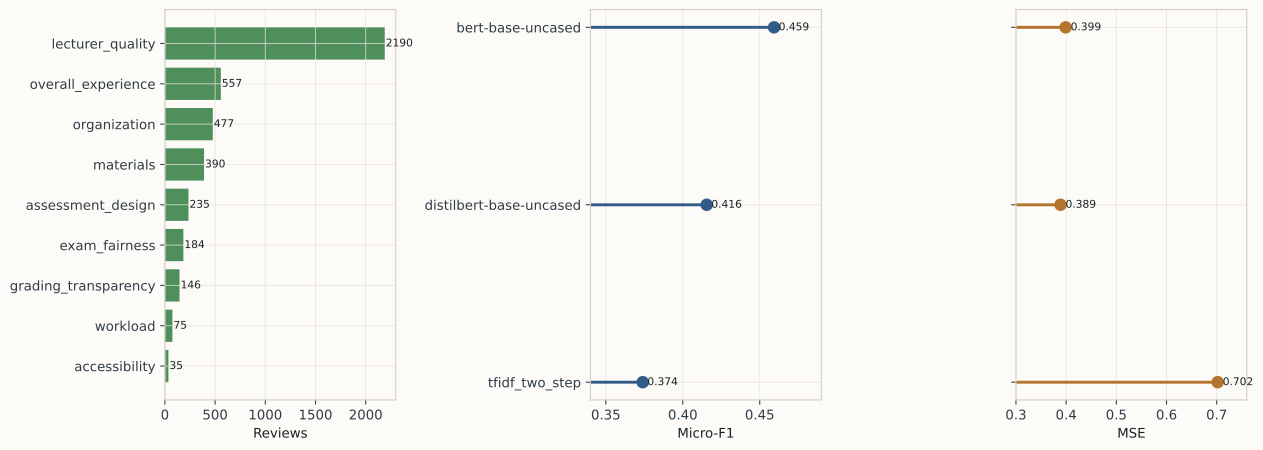
The transfer result is a focused external validation, reported as the mean across five seeds because this small-overlap setting is high-variance (Table 8). On this overlap benchmark, bert-base-uncased achieves the strongest detection micro-F1 at 0.402, followed by tfidf_two_step at 0.360 and distilbert-base-uncased at 0.322, and BERT also produces the lowest detected-aspect sentiment MSE at 0.354. These nine-aspect transfer scores are stronger than the internal 20-aspect benchmark (0.276), which is plausible because the external test covers fewer aspects, includes a dominant lecturer_quality signal, and uses a conservative overlap mapping rather than the full pedagogical schema. The result therefore supports partial synthetic-to-real transfer on one mapped educational annotation space.
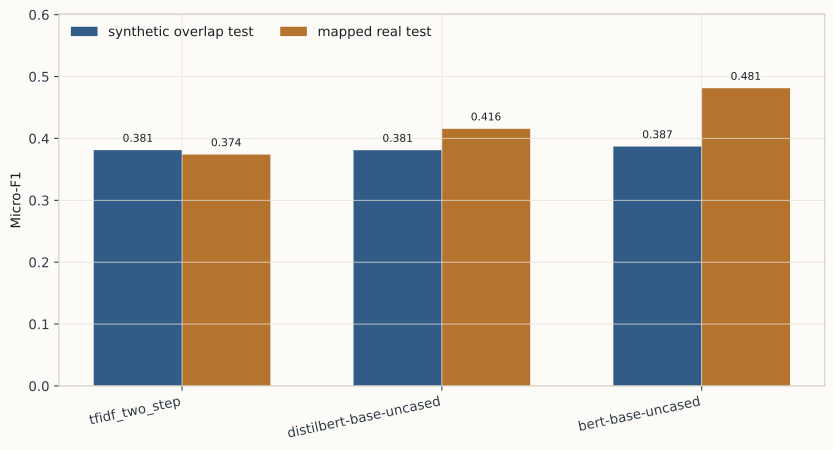
To interpret that result more carefully, we also ran an overlap-matched internal comparison using the same 9 aspects on the synthetic corpus (Table 9). Internal and external micro-F1 are comparable for the strongest model, BERT (0.409 internally versus 0.402 on the mapped real set), and the differences for the other models fall within the seed variance, so there is no large uniform domain-shift penalty. The mapped real benchmark is therefore best interpreted as a constrained overlap evaluation that demonstrates compatibility between the synthetic supervision scheme and one real educational annotation space. Table 9 and Figure 4 make this comparison explicit side by side, while Appendix A.1.3 lists the overlap counts and label balance and Appendix A.2.6 expands the result into a per-aspect transfer view.
The same comparison holds when balanced metrics are included. On the mapped real benchmark, BERT retains the strongest balance between sensitivity and specificity across the nine mapped aspects, so the best synthetic-trained encoder is not merely matching the real overlap through dominant negative decisions. Appendix A.5.2 reports the balanced-accuracy values.
A real-trained reference point puts this transfer in context. Training the same bert-base-uncased detector on a real-Herath split and evaluating it on held-out real Herath, over the identical nine-aspect detection metric, reaches micro-F1 0.767 (95% CI [0.734, 0.800], four seeds, roughly 1,980 train / 566 test reviews). Against this same-task upper reference, the synthetic-only transfer of 0.402 (five-seed mean), obtained with no real training data at all, recovers about 52% of real-trained performance, which is the relevant property when no labeled institutional data are available. This figure is a ratio of two micro-F1 scores on the identical nine-aspect detection metric (0.402 / 0.767), not a classification accuracy, so its proximity to one-half does not indicate chance-level guessing: it measures how much of the fully-supervised ceiling the transferred model reaches using no real labels. That the model carries genuine learned signal rather than reproducing label frequencies is established separately by the label-permutation control, which collapses detection to a trivial floor on the internal task (0.182 micro-F1, Section 5.2). This is consistent with the corpus authors' own published baselines on the real data (F1 0.64 for target-oriented opinion and aspect-term extraction and 0.75 for aspect-level sentiment, using fine-tuned BERT- and RoBERTa-family encoders [17]), which use different task formulations and so serve as additional context rather than a matched comparison.
The synthetic corpus is moreover a useful initializer, not only a standalone training set. Pretraining the nine-aspect detector on the synthetic corpus and then fine-tuning it on the real-Herath train split reaches micro-F1 0.784 (95% CI [0.758, 0.809], four seeds), above the real-only baseline of 0.767 and far above the synthetic-only transfer of 0.402. Synthetic supervision therefore improves a real-data model rather than merely substituting for one, which is the property that matters for the institutional bootstrapping setting of Section 6.2: a program can pretrain on the shared synthetic corpus and fine-tune on a small adjudicated slice of its own reviews to exceed what either source supports alone. Figure 3 visualizes these transfer scores together with the per-aspect overlap support, so the reader can see at a glance that the mapped benchmark is shaped by overlap coverage rather than a uniform domain-shift penalty.
| Rank | Approach | Micro-F1 | Macro-F1 | Micro-recall | Sentiment MSE | Real reviews | Overlap aspects |
|---|---|---|---|---|---|---|---|
| 1 | bert-base-uncased | 0.402 ± 0.070 | 0.267 ± 0.023 | 0.400 ± 0.089 | 0.354 ± 0.047 | 2829 | 9 |
| 2 | tfidf_two_step | 0.360 ± 0.049 | 0.222 ± 0.016 | 0.426 ± 0.049 | 0.691 ± 0.023 | 2829 | 9 |
| 3 | distilbert-base-uncased | 0.322 ± 0.079 | 0.264 ± 0.031 | 0.341 ± 0.050 | 0.404 ± 0.041 | 2829 | 9 |
| Approach | Synthetic overlap micro-F1 | Mapped real micro-F1 | Δ real minus synthetic | Synthetic overlap sentiment MSE | Mapped real sentiment MSE |
|---|---|---|---|---|---|
bert-base-uncased | 0.409 ± 0.017 | 0.402 ± 0.070 | -0.007 | 0.459 ± 0.025 | 0.354 ± 0.047 |
distilbert-base-uncased | 0.399 ± 0.009 | 0.322 ± 0.079 | -0.077 | 0.500 ± 0.016 | 0.404 ± 0.041 |
tfidf_two_step | 0.346 ± 0.011 | 0.360 ± 0.049 | +0.014 | 0.666 ± 0.025 | 0.691 ± 0.023 |
The same pattern holds on the second real corpus, EduRABSA (seven-aspect overlap, 2,152 held-out test reviews), which we report in full as a companion to the Herath analysis (Table 10). Across eight seeds, synthetic-only transfer reaches detection micro-F1 0.448 for bert-base-uncased and 0.435 for distilbert-base-uncased. A real-trained EduRABSA reference over the identical seven-aspect metric reaches micro-F1 0.751 (four seeds), so synthetic-only training recovers about 60% of real-trained performance, closely mirroring the 52% recovered on Herath. Exactly as on Herath, synthetic pretraining followed by real fine-tuning reaches 0.753 (four seeds), matching or slightly exceeding the real-only reference. On both independent human-annotated corpora, therefore, synthetic-only training recovers roughly half or more of a real-trained model with no real labels, and synthetic pretraining augments rather than merely substitutes for real supervision.
| Setting | Model | Detection micro-F1 | Macro-F1 | Micro-recall | Sentiment MSE |
|---|---|---|---|---|---|
| Synthetic-only transfer | bert-base-uncased | 0.448 ± 0.051 | 0.303 ± 0.019 | 0.443 ± 0.091 | 0.483 ± 0.078 |
| Synthetic-only transfer | distilbert-base-uncased | 0.435 ± 0.039 | 0.303 ± 0.019 | 0.434 ± 0.058 | 0.502 ± 0.049 |
| Real-only reference | bert-base-uncased | 0.751 ± 0.005 | n/a | n/a | n/a |
| Synthetic pretrain + real fine-tune | bert-base-uncased | 0.753 ± 0.006 | n/a | n/a | n/a |
5.5 Corpus-Scale Generation Diagnostics
The next two subsections return from downstream model behavior to generator quality: first the model-assisted label-faithfulness audit, then a faithfulness-aware filtering recipe that turns that audit into a training-data selection method. Corpus-scale output-control statistics (Appendix A.1.5) and the three-cycle realism-validation protocol and results (Appendices A.2.4 and A.2.5) are reported separately as generator diagnostics.
5.6 Model-Assisted Label-Faithfulness Audit
A complementary label-faithfulness analysis asks whether generated reviews visibly express the aspect-sentiment labels they were assigned, not only whether the text looks realistic. We therefore ran a conservative model-assisted audit with gpt-5.2 as a strict checker over two samples: 250 reviews from the 10K corpus and all 25 reviews from the pilot sample. For each review, the auditor received the raw text and declared aspect sentiments, then judged whether each declared aspect was supported in the text and whether the polarity matched. Table 11 reports the resulting aspect-support and sentiment-match rates.
| Split | Audit model | Reviews | Declared aspects | Aspect support rate | Aspect sentiment-match rate | Full-row support rate | Full-row sentiment-match rate |
|---|---|---|---|---|---|---|---|
| 10K corpus (250-review sample) | gpt-5.2 | 250 | 501 | 0.7705 | 0.4232 | 0.5920 | 0.2120 |
| Pilot sample | gpt-5.2 | 25 | 44 | 0.7727 | 0.3182 | 0.6000 | 0.2800 |
These results make the character of the corpus clearer. Many declared aspects are visibly present in the text, but polarity faithfulness is weaker, especially at full-corpus scale. At the same time, the larger 250-review audit is more favorable than the earlier smaller probe, which suggests that the benchmark preserves declared aspect presence more consistently than the harsher initial sample implied, even though polarity drift remains substantial. The benchmark is therefore strongest as a controllable and useful educational ABSA resource whose labels remain informative but imperfect. The 0.42 aspect sentiment-match rate should be read precisely: it is a strict, conservative, per-aspect exact-polarity match required by the strictest auditor (gpt-5.2, instructed to be strict and conservative) on the raw, unfiltered corpus, so it is a lower bound on faithfulness rather than a claim that "over half the sentiments conflict with the text"; a partly-correct multi-aspect row can score zero on an aspect whose polarity is merely understated. This raw diagnostic is precisely the signal the faithfulness-aware filter in Section 5.7 exploits: the low-scoring rows are demonstrably worse training data, and discarding them by audit score improves downstream sentiment fidelity. This interpretation supports benchmarking and method comparison while also motivating the filtering recipe that follows. Appendix A.4.1 retains the detailed audit table for direct comparison with later regenerated versions of the corpus.
5.7 Faithfulness-Aware Filtering of the Training Corpus
The 250-row audit in Section 5.6 reports a corpus-level aspect-sentiment match rate of 0.42 as a generator diagnostic. To turn that diagnostic into a method-level result, we extended the audit to the full 10,000-review corpus using a cost-matched judge (gpt-4.1-mini, calibrated against the gpt-5.2 audit on the original 250 rows at per-aspect support agreement 0.874 and per-aspect sentiment-match agreement 0.790). For each row we recorded the fraction of declared aspects whose polarity is supported by the text, producing a per-row faithfulness score with a heavily quantized distribution: 22.2% of rows scored 0.00, 11.1% 0.33, 18.2% 0.50, 11.0% 0.67, and 37.5% 1.00. This per-row score averages 0.58, higher than the 0.42 aspect-sentiment-match rate reported in Section 5.6 because it is a per-row mean under the more lenient cost-matched gpt-4.1-mini judge rather than a per-aspect rate under the stricter gpt-5.2 auditor; the two judges agree on 79% of per-aspect sentiment decisions.
We then partitioned the corpus into five training subsets: the highest-scoring 25% (top25, n = 2,500, all rows with row-score 1.00), the highest-scoring 50% (top50, n = 5,000), the full corpus (full, n = 10,000), the lowest-scoring 25% (bot25, n = 2,500), and a uniform-random 5,000-row sample (random_5k) that controls for training size. We trained BERT-base-uncased and DistilBERT-base-uncased on each bucket using the calibrated Section 5.2 recipe and evaluated each resulting model on two transfer targets: the same 9-aspect mapped Herath benchmark used in Section 5.4, and the EduRABSA 7-aspect mapping of the Hua et al. educational-review corpus (5,651 English course-and-staff reviews from RateMyProfessor, Waterloo, and Exeter). To separate effect from seed variance, every (bucket, architecture, target) configuration was retrained at eight random seeds (17, 23, 41, 42, 53, 89, 101, 137) on Modal A10G, with results aggregated across seeds.
| Bucket | n train | Mean row score | Sentiment MSE (detected) | Macro balanced accuracy |
|---|---|---|---|---|
top25 | 2,500 | 1.000 | 0.389 [0.372, 0.408] | 0.566 [0.558, 0.574] |
top50 | 5,000 | 0.912 | 0.356 [0.331, 0.385] | 0.584 [0.571, 0.598] |
full | 10,000 | 0.577 | 0.351 [0.329, 0.376] | 0.580 [0.565, 0.595] |
bot25 | 2,500 | 0.038 | 0.710 [0.654, 0.787] | 0.522 [0.516, 0.530] |
random_5k | 5,000 | 0.585 | 0.411 [0.386, 0.434] | 0.585 [0.577, 0.592] |
Two findings carry the experiment, stated as paired bucket-versus-baseline differences whose 95% bootstrap CI over eight seeds excludes zero. First, at fixed training size, filtering reduces sentiment-polarity error on aspects the detector identified as present: the top50 subset cuts sentiment MSE by 0.054 relative to the size-matched random sample (top50 − random_5k mean −0.054, 95% bootstrap CI [−0.090, −0.020], top50 wins in 7 of 8 seeds). The effect replicates on DistilBERT-base-uncased at the same scale (top50 − random_5k mean −0.063, CI [−0.138, −0.002], 6 of 8 seeds), so the filtering signal is architecture-general rather than BERT-specific. Second, the negative-control bot25 bucket collapses on the same metric across both architectures and both transfer targets: on BERT-Herath bot25 − full = +0.358 [+0.295, +0.436] (0/8 seeds), on DistilBERT-Herath +0.341 [+0.271, +0.422] (0/8), on BERT-EduRABSA +0.416 [+0.342, +0.480] (0/8), and on DistilBERT-EduRABSA +0.371 [+0.328, +0.411] (0/8). The audit score discriminates informative training rows from uninformative ones at both ends of the distribution, on both architectures, and on both transfer targets, across all 32 (bucket, architecture, target, seed) configurations of the negative control. The size-matched filtering gain is specific to sentiment-polarity fidelity, the metric most sensitive to label faithfulness; on detection (macro balanced accuracy, Table 12) the audit score's effect is concentrated at the unfaithful end, where the bot25 bucket alone drops to 0.522.
Because the sentiment MSE is computed only on aspects each model detected, we checked that the contrasts are not an artifact of different detection sets across buckets. They run, if anything, against the effect. At fixed training size, top50 detects fewer aspects than the random sample (BERT-Herath micro-recall 0.371 vs 0.438) yet still has the lower sentiment MSE, so its win does not come from scoring an easier or larger set. The bot25 control is the reverse: it degenerates into a high-recall, low-precision detector (micro-recall 0.793 vs the full corpus's 0.380) and nonetheless records the worst sentiment MSE. The sentiment-MSE differences therefore track label faithfulness, not how many or which aspects each model chose to score.
| Architecture | Transfer target | top50 − random_5k |
bot25 − full |
|---|---|---|---|
| BERT-base | Herath (9-aspect) | −0.054 [−0.090, −0.020] | +0.358 [+0.295, +0.436] |
| DistilBERT-base | Herath (9-aspect) | −0.063 [−0.138, −0.002] | +0.341 [+0.271, +0.422] |
| BERT-base | EduRABSA (7-aspect) | n/a | +0.416 [+0.342, +0.480] |
| DistilBERT-base | EduRABSA (7-aspect) | n/a | +0.371 [+0.328, +0.411] |
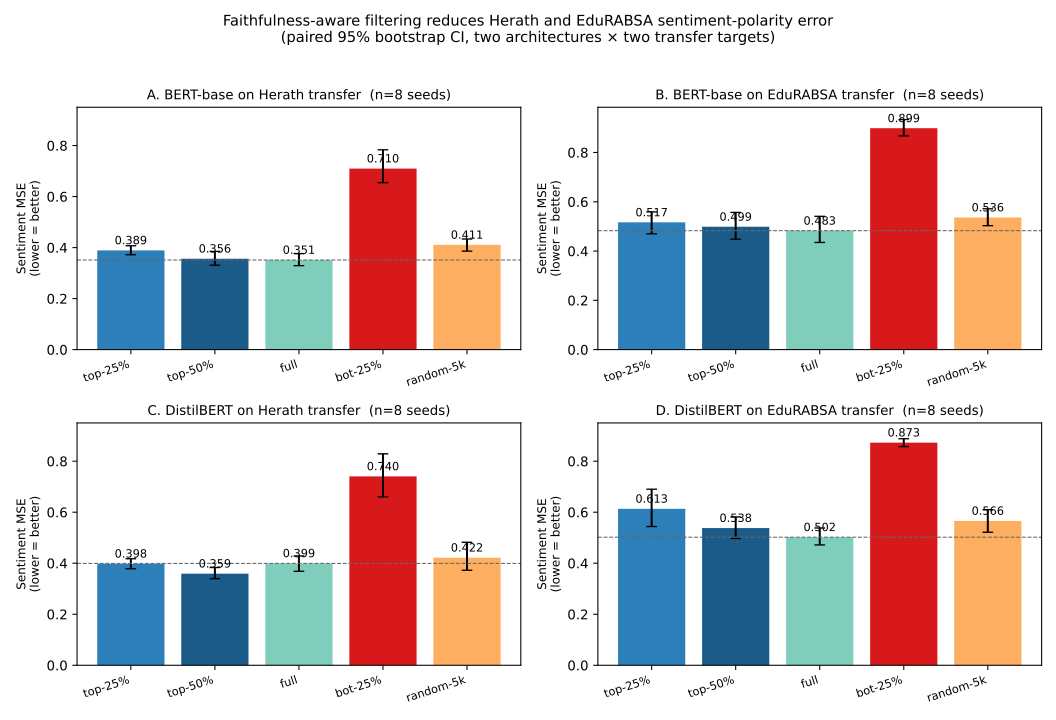
bot25 bucket fails on every condition, confirming the audit score is informative at the unfavorable end of the distribution. The top50 bucket beats the size-matched random sample on both Herath transfer conditions, and matches the full corpus while training on half the data.Table 13 collects these paired contrasts across both architectures and both transfer targets, and Figure 5 visualizes all conditions. Practically, the result is that the audit score in Section 5.6 is an actionable filter for downstream training. Discarding the bottom 50% of the corpus by faithfulness score matches the full-corpus sentiment-MSE level at half the training cost on Herath, and the recipe transfers to a smaller distilled architecture without loss. Discarding the bottom 25% is decisively the wrong move: that bucket is an active liability for sentiment polarity on every (architecture, target) condition we tested, with sentiment MSE 0.34 to 0.42 above the full corpus.
To isolate the filtering gain from any residual composition difference, we ran a strict covariate-matched comparison. From the corpus we drew a high-faithfulness retained subset and a low-faithfulness control subset that are matched one-to-one on aspect set, aspect count, review-level polarity composition, length band, and formality band, so the two subsets are identical on every covariate except the audit score itself (matched-pair audit-score means 0.90 retained versus 0.26 control; 3,441 matched pairs). Both subsets are then trained and scored on the same common gold-present aspect cells on the 9-aspect Herath overlap (4,289 shared cells), which removes the prediction-mask confound entirely: the two models are graded on one identical set of aspect-sentiment targets. Under this design the faithfulness-retained subset has the lower transferred sentiment error in every seed (Table 14): sentiment MSE 0.412 versus 0.519 on average, a paired reduction of 0.108 (three of three seeds), together with a higher detection micro-F1 (0.400 versus 0.338). Because aspect, polarity, aspect-count, length, and style are held fixed and the evaluation cells are shared, the improvement is attributable to label faithfulness alone rather than to differing composition or prediction sets.
| Seed | Retained sentiment MSE | Control sentiment MSE | Δ MSE (retained − control) | Retained det. micro-F1 | Control det. micro-F1 |
|---|---|---|---|---|---|
| 42 | 0.383 | 0.527 | −0.144 | 0.394 | 0.354 |
| 17 | 0.441 | 0.533 | −0.092 | 0.415 | 0.303 |
| 23 | 0.411 | 0.497 | −0.087 | 0.390 | 0.357 |
| mean | 0.412 | 0.519 | −0.108 | 0.400 | 0.338 |
We additionally cross-checked that the bucketing is not specific to the chosen audit judge by re-auditing the original 250-row calibration sample with three independent cost-matched judges across two providers. Per-aspect agreement against the GPT-5.2 audit converges for all three: gpt-4.1-mini at 0.874 support / 0.790 sentiment-match, gpt-4o-mini at 0.845 / 0.715, and Claude 3.5 Haiku (via OpenRouter) at 0.817 / 0.678. The audit-derived buckets are therefore robust to the choice of cost-matched judge. Using an LLM as a label auditor is consistent with evidence that LLM annotators can rival or exceed crowd workers on annotation tasks [11]; because LLM judges also carry documented biases [13], we control for them with the cross-provider agreement here and with the human-label validation below.
Two properties make this filtering result robust to the audit being a model rather than ground truth. First, the audit score is validated behaviorally, not by judge agreement alone: the bot25 bucket is defined purely as the rows the audit scored lowest, and training on it degrades transfer on every architecture and target above, so low-audit rows are demonstrably worse training data regardless of whether any single verdict matches a human label. Second, because the same model family both generates and audits the corpus, the score is best read as an LLM-audit signal that is useful for training-row selection rather than as a measurement of ground-truth faithfulness; the cross-provider agreement above bounds single-judge bias, and the audit additionally reproduces human faithfulness labels on annotated data, as we show next.
We close the loop by validating the audit directly against human labels. From the two human-annotated corpora (Herath and EduRABSA) we build 1,200 perturbation-controlled label variants: each sampled review carries a faithful variant with its human gold labels, a polarity-flipped variant, and an aspect-injected variant, and the Section 5.6 audit scores all three. The right comparison is per aspect, because the filter audits each declared aspect independently. Across 2,482 aspect-label decisions the audit reproduces the human judgment at Cohen's kappa 0.56 (moderate agreement on the Landis-Koch scale; precision 0.88, accuracy 0.78): it retains 0.69 of genuinely faithful aspects, rejects 0.89 of polarity-flipped aspects, and rejects 0.87 of injected absent aspects, with agreement higher on EduRABSA (kappa 0.62) than on Herath (kappa 0.51). The audit that drives the filter therefore tracks human faithfulness judgments on real annotated data, not only the verdicts of other LLM judges, and its precision means a label it accepts as faithful agrees with the human annotation 88% of the time. Because the generator and the cost-matched auditor share a provider family, one might worry that this agreement reflects a shared latent space rather than genuine textual faithfulness. To rule that out, we repeat the identical human-validation with a fully independent family: Google gemini-2.5-flash scores the same 1,200 variants and agrees with the human labels at Cohen's kappa 0.62 (precision 0.89), matching and slightly exceeding the same-family GPT auditor. A model with no shared provenance with the gpt-5-nano generator therefore reproduces the human faithfulness judgments at least as well, so the audit signal is human-validated rather than an artifact of the generator's own family. Agreement is broken out by corpus in Appendix A.4.2 (Table A15): both auditors agree with humans more on EduRABSA (kappa 0.62 same-family, 0.67 independent) than on Herath (0.51 and 0.58). This tracks item granularity rather than a defect in either corpus, Herath items are single sentences (median 20 words) while EduRABSA items are short passages (median 38 words), so a shorter item gives the auditor less textual evidence per aspect. Because each decision is a binary faithful-versus-unfaithful judgment, the metric is invariant to the two corpora's different aspect label sets. Appendix A.4.3 decomposes this reliability further: recall on genuine aspects rises with review length, while specificity against fabricated aspects falls as a review packs more aspects, so agreement peaks at moderate length and aspect count.
We further validate the audit on the synthetic corpus itself, which is the text the filter actually scores. Three annotators independently labeled a stratified sample of 300 synthetic reviews (610 declared review-aspect decisions): for each review they were shown a candidate declared aspect and, without seeing the generator's declared presence or sentiment for it, marked whether that aspect is expressed in the review and with what sentiment. A single human judgment per aspect is the majority vote of the three annotators (presence: at least two of three; sentiment: the majority sentiment among annotators who marked the aspect present). Inter-annotator reliability is substantial for presence (Fleiss kappa 0.70; pairwise Cohen kappa 0.60, 0.66, and 0.87) and moderate for sentiment (Fleiss kappa 0.49; pairwise Cohen 0.38 to 0.57), the same presence-faithful, sentiment-noisier ordering the audit reports. Three findings validate the audit directly on synthetic text. First, the annotators confirm the declared aspect is present in 70% of cases by majority vote, and human and audit presence judgments agree 76% of the time. Second, and most directly, human confirmation rises monotonically with the audit score, from 0.546 in the lowest audit-score quartile to 0.786 in the highest (Table 15, Wilson 95% intervals); resampling at the review level (a clustered bootstrap over the 300 reviews) the overall confirmation rate is 0.70 (95% CI 0.66 to 0.74) and the highest-minus-lowest-quartile difference is 0.24 (95% CI 0.12 to 0.36), so the monotone increase holds once within-review clustering is accounted for. Third, the human annotation independently reproduces the audit's central finding that aspect presence is the faithful signal while aspect sentiment is the noisier one: human-declared aspect-sentiment agreement is 0.38 (95% CI 0.34 to 0.43), closely matching the audit's strict per-aspect sentiment-match rate of 0.42. The direct human annotation therefore confirms both that the audit score is a human-validated selection signal on synthetic text and that the corpus's measured noise level is accurate.
| Audit-score quartile | Audit row-score (mean) | Declared aspect decisions | Human majority confirms aspect present | Wilson 95% CI |
|---|---|---|---|---|
| Q1 (lowest) | 0.10 | 152 | 0.546 | 0.467-0.623 |
| Q2 | 0.42 | 152 | 0.711 | 0.634-0.777 |
| Q3 | 0.73 | 152 | 0.750 | 0.676-0.812 |
| Q4 (highest) | 1.00 | 154 | 0.786 | 0.714-0.843 |
A final robustness check asks whether the generate-audit-filter pipeline is specific to the GPT family that produced the corpus. We regenerated the same 150 label-conditioned prompts with four generator families spanning four providers, OpenAI gpt-5-nano, Google gemini-2.5-flash, Zhipu glm-4.6, and Meta llama-3.3-70b, and scored every generation with the identical gpt-5.2 label-fidelity audit. All four families produce auditable, label-faithful reviews: aspect support ranges from 0.921 to 0.968 and per-aspect sentiment match from 0.759 to 0.904, and the two non-GPT families, one closed (Google) and one open-weight (Zhipu), match or exceed the same-family gpt-5-nano generator (sentiment match 0.857 and 0.904 versus 0.759). The audit therefore behaves consistently across providers and the pipeline is not tied to a single generator family. Appendix A.3.2 and Table A13 report the per-family rates.
5.8 Overall Interpretation
Taken together, the study assembles controlled synthetic supervision for educational ABSA into one account: a characterized 20-aspect corpus, calibrated discriminative baselines under a strict split, two conservative synthetic-to-real transfer checks (Herath 9-aspect and EduRABSA 7-aspect), a three-cycle realism study, and a faithfulness-aware filtering recipe that retains the top-50% of the corpus by audit score. The Discussion below draws out the implications, limits, and practitioner guidance.
6. Discussion
The results support interpreting the study as a synthetic educational ABSA benchmark together with a strong internal modeling analysis and two conservative external transfer checks (Herath and EduRABSA). The strongest evidence lies where those pieces connect directly: controlled generation produces aspect-labeled educational reviews, and a downstream ABSA pipeline tests whether those labels are learnable under a strict train-validation-test regime. The study's value lies in offering a controllable benchmark resource for a domain where public aspect-labeled data remain scarce, together with a transparent account of how that benchmark connects to two real educational annotation spaces.
6.1 Limitations
Five limitations remain central. First, external validation uses two real educational corpora (Herath 9-aspect, EduRABSA 7-aspect) and conservative aspect overlaps, so broader claims about the entire 20-aspect schema still require additional real-data tests. These two targets are also sentence-level (Herath median 20 words, EduRABSA 38) while the synthetic corpus is full-length reviews (median 122 words), so transfer here is a cross-granularity test. This granularity mismatch is not, however, the limiting factor: a review-level real target (OATS, median 70 words) transfers no better than the sentence-level targets, so transfer difficulty is governed by how closely a target's aspect vocabulary and register align with the synthetic supervision rather than by review length (Appendix A.5.4). Training granularity can nonetheless be aligned to the target: training the detector on synthetic sentences rather than full reviews raises transfer to the two sentence-level targets by a paired 0.21 (M-ABSA [37]) and 0.04 (Herath) micro-F1 across seeds (Appendix A.5.6). A full-review real benchmark matched to institutional course feedback is the natural next target; the one public review-level educational corpus is MOOC-focused (OATS-ABSA, Coursera reviews [4]), while course-evaluation feedback of the kind our schema targets remains annotated only at the sentence level [19]. Aspect-annotating a set of full-length institutional reviews (for example public OMSCS reviews) is therefore the concrete path to fully closing this granularity gap. Practitioners should therefore not read the transfer results as validating the full schema: only 9 of the 20 aspects are externally checked, synthetic-only training recovers about 52% of a real-trained model, and any high-stakes or personnel decision requires human-in-the-loop review rather than reliance on the eleven aspects that have no real-data validation. The scope is also bounded in domain: the synthetic corpus and every real target here are English-language higher-education course reviews (STEM and graduate-level in the mapped corpora), so extension to other languages, to K-12, and to non-STEM disciplines is future work rather than a claim of the present study. Second, the realism-validation analysis is conducted with LLM judges and improves prompt quality without establishing statistical indistinguishability from real reviews under an adversarial frontier-model detector, a bar that current LLM-generated text does not clear regardless of generator family; the realism that is operative for a labeled training benchmark is functional rather than perceptual, and is evidenced by the synthetic-to-real transfer results above, where a model trained on the synthetic corpus recovers real-review aspect and polarity signal on two independent external corpora. A sentence-level distributional check places the synthetic corpus at MAUVE 0.23 from the real OMSCS reviews, below both the 0.98 real-to-real ceiling and the 0.63 between two independent real corpora (OMSCS and Herath), so at the pool level the synthetic sentence distribution is still separable from real. This gap reflects writing style rather than course or platform identity: scrubbing course codes, instructor names, and platform terms from both sides leaves it essentially unchanged. A more consequential gap is structural: synthetic reviews sample aspect polarities independently, so they are internally balanced far more often than the opinion-consistent real reviews (Appendix A.1.7), and they sample aspect sets more uniformly than the semantically clustered real reviews (Appendix A.1.8). The polarity gap is actionable: conditioning per-aspect polarity on a review-level sentiment disposition robustly lowers gold-present sentiment transfer error across seeds, by a paired 0.23 (OATS) and 0.16 (Herath) in mean squared error (Appendix A.5.5); aspect co-occurrence matching, by contrast, leaves transfer unchanged, so per-aspect polarity conditioning is the actionable lever (Appendix A.1.8). Most tellingly, the separability is a document-structure effect rather than a sentence-realism one: judged sentence by sentence, individual synthetic sentences are near-indistinguishable from real ones, with the same judge only 60% accurate (close to the 50% chance floor, versus 93% on whole reviews) and calling 63% of synthetic sentences real. The detectability is a cumulative property of extended synthetic text: a weak per-sentence signal accumulates across a full review, and a control that assembles real sentences into equally multi-aspect documents is still judged real, so it is not multi-aspect coverage or incoherence. The signal is thus orthogonal to the individual sentences that carry the aspect-sentiment supervision (Appendix A.2.7). The label-faithfulness audit is validated four ways (a behavioral negative control, cross-provider judge agreement, direct agreement with human labels at Cohen's kappa 0.56 on two annotated corpora, and direct human annotation of a stratified sample of the synthetic corpus itself, where human confirmation of declared aspects rises monotonically with the audit score, Section 5.7 and Table 15). Because the generator and the cost-matched auditor share a provider family, we further confirm that the audit is not merely detecting same-family latent patterns by reproducing the human-agreement check with a fully independent family (Google Gemini, Cohen's kappa 0.62), and two independent open-weights auditors, Llama-3.3-70B and GLM-4.6, reproduce the audit at the same level (Appendix A.4.4). The human study validates the precision of the declared labels the filter scores; because annotators judged only the declared aspects rather than exhaustively labeling all twenty, it does not measure recall of aspects that are present in the text but were never declared, and the corpus therefore does not yet have a fully adjudicated twenty-aspect gold test set. Exhaustive re-annotation across the full 20-aspect schema, which would surface undeclared-but-present aspects and yield such a gold set, remains the natural extension. Third, a nontrivial share of rows (841 of 10,000) reached the output-token cap and lowered full-corpus length-band adherence to 0.6819; this is a recoverable token-budget artifact rather than a control failure, since regenerating exactly those rows at a higher cap eliminates the truncation and restores full-corpus adherence to 0.7125, close to but still below the never-truncated rate of 0.7304 (Appendix A.1.5); these token-capped rows are moreover not systematically biased across aspects or polarities, so excluding them leaves the benchmark unchanged (Appendix A.1.6), and length band is in any case a soft stylistic target rather than a labeled control variable. Fourth, downstream training on the 10K corpus benefits from the Section 5.7 top-50% faithfulness filter (validated across two BERT-family architectures and both transfer targets); the audit score is the validated way to select training rows for sentiment-polarity fidelity on transferred aspects, and a quartile dose-response confirms this end to end, with higher-audit training quartiles yielding a monotonically better detector (Appendix A.4.5). Fifth, the four-way prompting-method comparison in Table 7 (zero-, fixed-, diverse-, and retrieval-few-shot) is run on a single provider (gpt-5.2); the provider axis, however, is covered separately, since the prompted zero-shot baseline reproduces the same narrow band across four families spanning four providers on the full 1,000-review test split (detection micro-F1 0.239 to 0.267, Appendix A.6.2), and the generate-audit-filter loop likewise reproduces comparable label fidelity across four generator families (Appendix A.3.2), and a held-out-generator check confirms the learnable signal itself is generator-invariant rather than a single generator's fingerprint (Appendix A.3.3). What remains single-provider is therefore the head-to-head of prompting variants, not the provider comparison or the corpus construction.
These limitations help define the next stage of work rather than undercut the contribution of the study. The reported evidence supports a resource-and-benchmark study with meaningful generator validation, informative internal comparisons, and a first mapped real-data check.
The most important extensions are broader synthetic-to-real tests across more real educational datasets and more of the 20-aspect schema, improved generation or filtering to raise label faithfulness and sentiment correctness on generated reviews, and broader prompt-based comparisons that add decomposition variants and cross-provider LLM baselines on the same fixed benchmark split.
6.2 Educational Implications
Although this study is framed as a benchmark-and-corpus contribution, the underlying motivation is practical: institutions accumulate large volumes of course feedback, and aspect-level summaries are pedagogically more useful than overall sentiment. A controllable synthetic resource has four complementary roles in this setting, each tied to a concrete institutional workflow and to the constraints that the label-faithfulness audit makes visible.
First, it lowers the cost of model bootstrapping. Producing the per-comment annotations needed for an institution-specific ABSA model is expensive: even at modest academic-crowdsourcing rates, a multi-thousand-comment private corpus typically costs several thousand dollars in annotation plus reviewer adjudication, often beyond the budget of a single department. A 10,000-review synthetic corpus generated through an LLM API is a one-time cost far below that annotation budget: on the OpenAI Batch API the full pipeline came to roughly US$3, about US$0.44 for corpus generation (gpt-5-nano), approximately US$1.7 for the full-corpus faithfulness audit (gpt-4.1-mini over all 10,000 rows), and about US$0.5 for the three realism-validation cycles, or on the order of US$0.0003 per review. At fair-pay academic-crowdsourcing rates (about US$0.08 per aspect decision with threefold rater redundancy, matching our own validation study), human annotation of the roughly 20,000 aspect-labels in the same corpus would cost on the order of US$5,000, about three orders of magnitude more per label, and the synthetic corpus is moreover reusable across institutions. Programs that cannot fund private annotation can pretrain on the synthetic corpus and fine-tune on a small adjudicated slice of their own reviews, capturing the bulk of supervision at a fraction of the cost. The shared schema also avoids the situation in which each institution invents a new, incompatible aspect inventory, which has historically made cross-institution comparison impossible.
Second, it supports longitudinal monitoring. Course-improvement cycles depend on comparable aspect distributions across terms, instructors, and cohorts. A department running the same course over eight semesters cannot reliably interpret year-over-year shifts in raw sentiment without a stable instrument: shifts may reflect rater drift, syllabus changes, or external events, and the instrument itself may have drifted between iterations. A documented synthetic benchmark gives the modelling layer a stable yardstick against which a department-specific model can be tracked; the benchmark fixes the schema, the splits, and the evaluation, so when a per-aspect F1 changes on the department's own data, the change is attributable to the data rather than the instrument.
Third, it allows controlled stress-testing. The synthetic corpus exposes minority aspects (accessibility, grading_transparency, peer_interaction) that are rarely well represented in any single institution's archive. A program with two semesters of real comments has effectively no signal on accessibility; the synthetic corpus has hundreds of items per minority aspect, so it can act as a probing set for known coverage gaps. Institutions can thereby diagnose whether their model handles low-frequency but high-stakes aspects before deploying it on a real cohort, which is particularly relevant for accessibility and grading-transparency aspects whose mishandling has direct equity implications.
Fourth, it supports instructor-level reflective practice. Aspect-tagged feedback enables individualised end-of-term debriefs (a mathematics instructor receives a summary highlighting clarity and pacing trends across their own sections rather than program-level averages) and feeds faculty-development workshops with concrete patterns rather than anecdotes. Used this way, the model becomes part of formative review rather than summative evaluation, and noise on individual labels matters less than the aggregate pattern across many comments.
A concrete adoption roadmap follows from a fine-tuning-size sweep. Pretraining the detector on the synthetic corpus and then fine-tuning on a subsampled slice of real, locally adjudicated reviews traces a smooth curve (Figure 6): as few as 100 real reviews lift 9-aspect detection to micro-F1 0.59 (well above the 0.402 five-seed synthetic-only transfer), 500 reach 0.68, 1,000 reach 0.74, and the full real set 0.78, matching a model trained on real data alone (0.77). Two operational guidelines follow. First, minimum data: roughly 250 to 500 locally labeled reviews already capture most of the benefit and are a realistic annotation budget for a single department, and across every budget synthetic pretraining stays above training on the same reviews from scratch (Figure 6), roughly doubling data efficiency in the low-data regime (pretrained on 100 real reviews it matches from-scratch training on about 250) before the two curves converge near the full real set. Second, expected degradation and monitoring: a deployment fine-tuned on N local reviews should expect the micro-F1 in Figure 6 rather than the internal-benchmark or full-real numbers, and should be monitored against a held-out slice of locally adjudicated examples, re-checking whenever the feedback distribution shifts (new platform, course redesign, or cohort change). Practitioners applying the faithfulness audit itself should note that its reliability is review-shape dependent: it is most trustworthy on moderate-length reviews with a handful of aspects, under-confirming genuine aspects on very short comments and under-rejecting spurious ones on aspect-dense reviews (Appendix A.4.3).
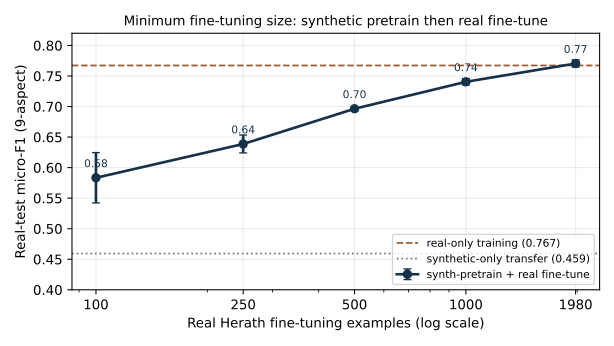
None of these uses presume that synthetic supervision replaces human annotation. The label-faithfulness audit constrains them directly: with a strict per-aspect lower-bound aspect-sentiment match of 0.42 on a 250-review sample (per-row mean 0.58, Section 5.7), the corpus should be treated as a noisy training resource rather than as a calibrated ground truth. Practical guidance follows. For the model-bootstrapping and stress-testing workflows, the noise is tolerable because outputs are aggregated and the resource serves model development rather than the final classifier; the institution always fine-tunes on local data before deployment. For the longitudinal-monitoring and reflective-practice workflows, deployments built on top of the corpus should be checked against locally adjudicated examples, and the faithfulness-aware filtering result reported in Section 5.7 should be applied: retaining the top 50% of the corpus by audit score reduces sentiment-polarity error on transferred aspects at half the training cost. In governance terms, the resource is appropriate for low-stakes, aggregate, formative-feedback workflows and inappropriate for high-stakes personnel decisions about instructors without human-in-the-loop review, a documented appeals process, and local institutional approval.
6.3 Ethics Statement
The synthetic corpus released with this study contains no identifiable student data: instructor names, course codes, and personas are sampled or invented as part of the controlled-generation protocol, and the corpus is generated rather than scraped. The mapped external evaluation uses the publicly released Herath et al. 2022 student-feedback corpus under its MIT license; that release was prepared by the authors of the original study with their institutional approvals, and our use is limited to evaluation, citation, and a conservative schema mapping documented at paper/real_transfer/herath_mapping.json. Preliminary realism-validation work also drew on the public OMSCS course-review pages; only public text was used and no individual reviewer is identified in any downstream artifact. Any institutional deployment of the resulting models should re-consent or re-anonymize student-authored text per local research-ethics policy and should make clear to students and instructors that an automated aspect summary is produced from feedback they submit. We do not recommend using model outputs as inputs to high-stakes personnel decisions about instructors without human review.
Three further risks warrant explicit attention in any deployment. First, stylistic bias: the synthetic corpus is fluent LLM text, so a model trained on it may systematically mishandle feedback written by non-native speakers or in non-standard registers, under-detecting aspects or mis-assigning sentiment for exactly the students whose voices are already least represented. Deployments should therefore monitor per-aspect error stratified by writing style and language background and must not let a model's lower confidence on such text translate into their feedback counting less. Second, attribution to identifiable entities: because courses, instructors, and incidents in the corpus are invented, model outputs are aggregate estimates over many comments and must never be used to attach a model-inferred negative aspect to a specific, identifiable course or instructor as if it were a factual record; doing so would risk propagating a fictional negative judgement onto a real person. Third, uncertainty reporting: given the moderate label faithfulness (0.42 aspect-sentiment match, Section 5.7) and the review-shape-dependent audit reliability (Appendix A.4.3), any institutional dashboard built on these models should surface per-aspect uncertainty rather than point predictions, route low-confidence cases to human review, and provide an appeals process for instructors who contest an automated summary.
6.4 Data and Code Availability
The synthetic corpus, the mapped Herath and EduRABSA evaluation sets, the fixed train/validation/test splits (seed 42, 8,000/1,000/1,000), the generation prompts and attribute schema, the Herath and EduRABSA mapping files, the full-corpus audit scores, model configurations, and the training and evaluation scripts are released as a versioned Zenodo archive (DOI 10.5281/zenodo.21717252). The released corpus ships the regenerated higher-output-cap replacements for the 841 originally token-capped rows (Appendix A.1.5) and also includes the original truncated rows separately, so the truncation analysis (Appendix A.1.6) is fully reproducible.
7. Conclusion
This study contributes a 10K synthetic educational ABSA corpus over a 20-aspect pedagogical schema, a documented generation protocol, and a benchmark setting that makes internal train-validation-test evaluation possible in a domain where public labeled data remain difficult to obtain. It also includes a conservative synthetic-to-real evaluation on mapped annotated student feedback, which supports partial transfer on a 9-aspect Herath overlap and a 7-aspect EduRABSA overlap, and generator validations that clarify how realism control and label faithfulness behave at corpus scale. Taken together, the evidence supports controlled synthetic supervision as a productive way to study educational ABSA and compare model families in a data-scarce domain. Consistent with the label-faithfulness audit (0.42 aspect-sentiment match, Section 5.7), the resource is best understood as openly reusable and reproducible but noisy synthetic supervision with a documented benchmark setting, rather than a gold-labeled corpus; its value is as a controlled instrument for model development that institutions fine-tune and validate on their own data before use.
Reproducibility: the generation artifacts, local benchmark outputs, and realism-study files are kept distinct throughout, so each reported number traces to its own artifact.
Appendix
A.1 Corpus, Aspects, and Structure
A.1.1 Twenty-Aspect Inventory
Table A1 lists the 20-aspect inventory used for generation, realism validation, and benchmarking, grouped into the five pedagogical blocks discussed in Sections 3 and 6.
| Group | Aspect | Description |
|---|---|---|
| Instructional quality | clarity | How understandable the teaching and explanations feel. |
| Instructional quality | lecturer_quality | Perceived quality of the lecturer or lead instructor. |
| Instructional quality | materials | Usefulness of slides, notes, readings, and resources. |
| Instructional quality | feedback_quality | Usefulness and timeliness of feedback on student work. |
| Assessment and course management | exam_fairness | Whether exams feel aligned and fair. |
| Assessment and course management | assessment_design | Alignment and structure of assignments, projects, and exams. |
| Assessment and course management | grading_transparency | How clearly grading criteria, rubrics, and score interpretation are communicated. |
| Assessment and course management | organization | Administrative clarity, course structure, and coordination. |
| Assessment and course management | tooling_usability | Friction or support created by LMS, submission systems, and required software. |
| Learning demand and readiness | difficulty | Conceptual or technical challenge of the course. |
| Learning demand and readiness | workload | Amount of sustained effort required across the term. |
| Learning demand and readiness | pacing | Whether the course tempo and weekly rhythm are manageable. |
| Learning demand and readiness | prerequisite_fit | How well the course matches the advertised prerequisite level and student preparation. |
| Learning environment | support | Quality of help from instructor, TAs, or forums. |
| Learning environment | accessibility | Perceived accessibility and inclusiveness of materials, pace, and course participation. |
| Learning environment | peer_interaction | Whether peer discussion, teamwork, and class community help or hinder learning. |
| Engagement and value | relevance | Perceived usefulness to the program or future goals. |
| Engagement and value | interest | Level of engagement or curiosity the course creates. |
| Engagement and value | practical_application | Connection to real-world practice or authentic tasks. |
| Engagement and value | overall_experience | Global student impression after tradeoffs. |
A.1.2 Side-by-Side Real and Synthetic Examples
Table A2 shows representative real and synthetic review pairs from the realism study. For the synthetic reviews, the table includes both the target aspect labels and the sampled nuance attributes used to construct the prompt.
| Source | Review text | Annotation context |
|---|---|---|
| Pair 0 | ||
| Real | I took this class my first semester in the program, alongside networks (6250). I almost feel like I shouldn’t review this – I didn’t take advantage of the resources it offered. The instructor and TAs all seemed great and response time to questions and concerns was near immediate. But I acted like they didn’t exist except the few times I had a specific question, and I suspect my learning suffered for it. The lectures comprise the bulk of the learning material, along with journal articles assigned for most lectures. |
Public real review used only as a blinded realism-validation item. |
| Synthetic | CS-6200 / Graduate Introduction to Operating Systems was useful for me, but honestly not a fun class. I took it my last semester before graduation and it definitely felt like one of those mid-program core courses that everyone should probably do anyway. What I remember most is one systems assignment week where I was up way too late debugging something dumb, and the peer chat helped more than the actual course materials. |
|
| Pair 1 | ||
| Real | TLDR: This was a great course, got a B overall but thoroughly enjoyed it. This course requires a lot of time and prerequisite knowledge of C and C++. Exams are disconnected from the project work. 25+ hours/week. This was my first class in OMSCS. I wanted a challenge and I definitely got it. |
Public real review used only as a blinded realism-validation item. |
| Synthetic | Honestly the platform stuff in CS-6200 was a pain and caused way more stress than it needed to. I took Graduate Introduction to Operating Systems mostly because it fit my schedule, not because OS was my thing, and that probably showed. I have a pretty strong coding background, but the theory side was rough for me, so I kept falling behind and then basically crammed around project deadlines. |
|
A.1.3 Mapped Real-Data Overlap and Label Balance
Table A3 documents the conservative overlap used for external validation against the Herath student-feedback corpus. The mapped real benchmark is intentionally narrower than the full 20-aspect schema, because only defensible correspondences were retained.
| Aspect | Reviews | Positive | Neutral | Negative |
|---|---|---|---|---|
lecturer_quality | 2190 | 1402 | 398 | 390 |
overall_experience | 557 | 395 | 61 | 101 |
organization | 477 | 266 | 155 | 56 |
materials | 390 | 137 | 194 | 59 |
assessment_design | 235 | 83 | 100 | 52 |
exam_fairness | 184 | 29 | 97 | 58 |
grading_transparency | 146 | 49 | 66 | 31 |
workload | 75 | 12 | 21 | 42 |
accessibility | 35 | 11 | 12 | 12 |
A.1.4 Corpus Profile and Representative Examples
Figure A1 and Figure A2 establish the corpus-level structure before any model results are introduced. Figure A1 shows how label support is distributed across aspects and sentiment polarities, which makes it easier to distinguish heavily represented pedagogical dimensions from thinner parts of the schema. Figure A2 complements that view with review length, aspect-count mixture, course coverage, and style variation. Table A4 then gives a qualitative sense of how these distributions appear in actual review text. These examples are included to help the reader interpret the benchmark qualitatively, not as a substitute for aggregate model evidence.
| Example type | Style | Aspect labels | Excerpt |
|---|---|---|---|
| Tradeoff-heavy | Neutral everyday prose | difficulty=positive, materials=positive |
"I took Computer Networks mainly to fit my schedule ... the material felt accessible at times ... Dr. Chen’s delivery varies week to week ... the LMS was smooth, but feedback came too late to be useful." |
| Compressed complaint | Analytic but Simple | interest=negative |
"I stuck with Cyber Security Basics only when I needed it ... the lead-in theory never clicked for me ... the few but heavy deadlines left me frustrated but still fair about the effort." |
| Pedagogical frustration | Analytic but Simple | assessment_design=negative, relevance=negative |
"Data Structures felt like a required hurdle more than a doorway to real understanding ... the assessments were exhausting and overbearing ... even when I passed a task, I was not convinced it reflected useful learning." |
A.1.5 Full-Corpus Output Control
The full dataset is large enough to support a realistic internal benchmark, and it also reveals how output control behaves at scale. All 10,000 rows returned usable review text and no duplicates were detected. At the same time, 841 rows were marked incomplete because they reached the output-token cap, and overall length-band adherence settled at 0.6819 over the full corpus. This shortfall is a token-budget artifact rather than a control failure: on the 9,159 rows that never hit the cap, length-band adherence is 0.7304, and the 841 truncated rows account for the entire gap below that level. Regenerating exactly those 841 rows with the same generator (gpt-5-nano) and prompt at a raised output cap eliminates the truncation (incomplete rate 8.41% to 0%) and recovers full-corpus adherence to 0.7125, close to but still below the never-truncated rate of 0.7304 (the regenerated rows themselves reach about 0.52, so a small residual gap remains). Length band is a soft stylistic target sampled per review; the controlled variables are the per-review aspect-sentiment labels, which truncation does not affect. The released corpus is left unchanged and this regeneration is reported only as an output-control diagnostic (paper/outputs/n1_adherence_summary.json).
This behavior does not invalidate the benchmark, because every row still contains the target labels and usable text, and the train-validation-test pipeline runs cleanly on the assembled corpus. It does, however, matter for interpretation: stronger long-form length control would further improve the controllability of future releases. Figure A2 makes this visible directly by combining length, aspect-count, course, and style evidence in one place.
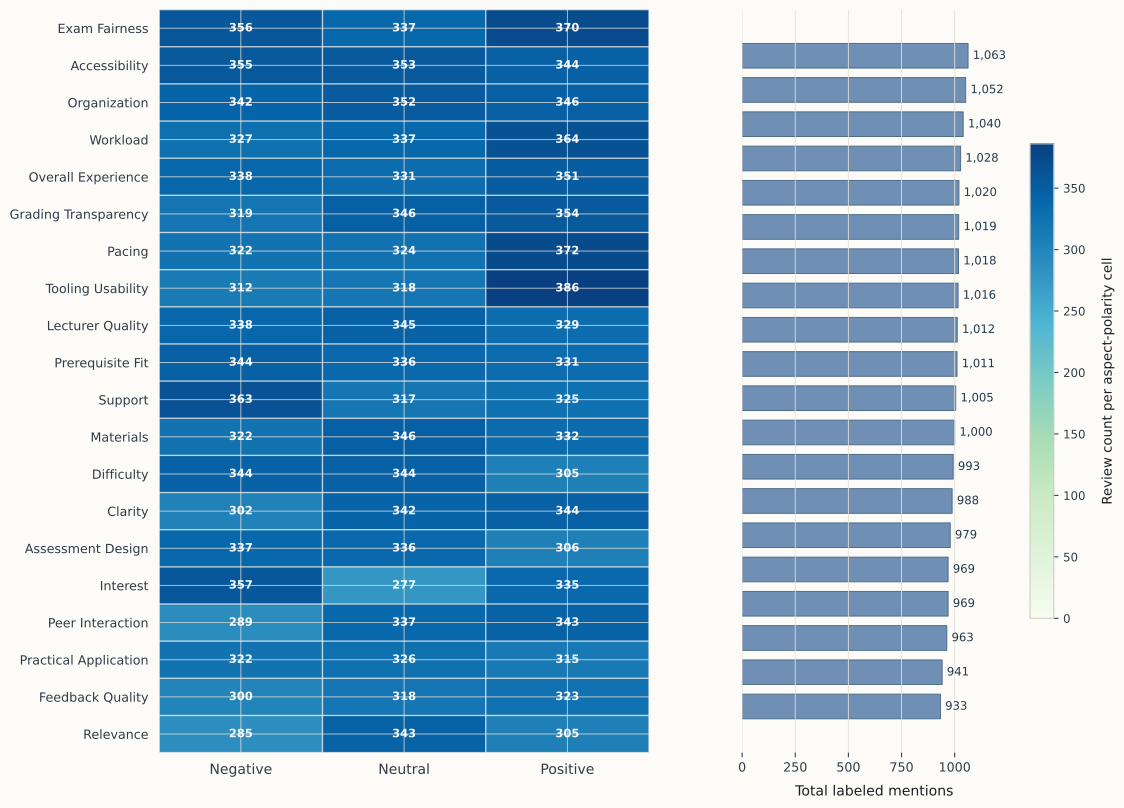
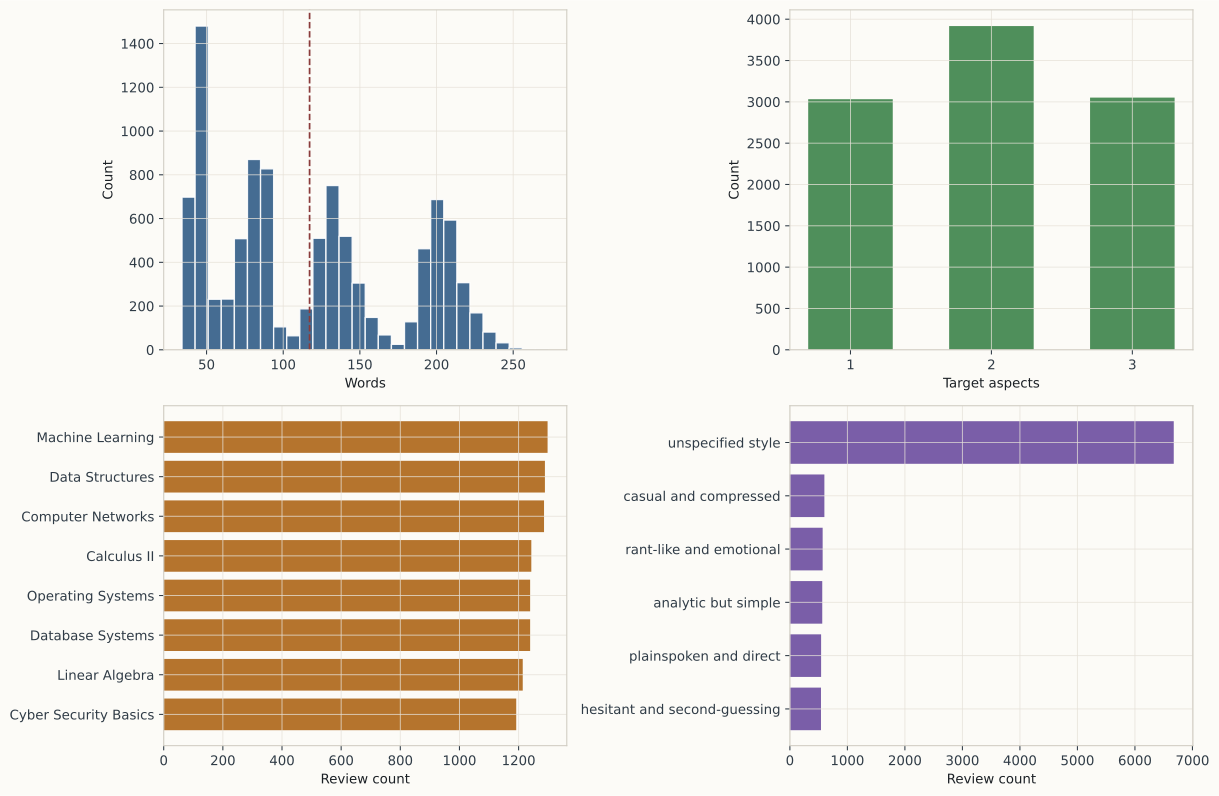
A.1.6 Output-Token-Capped (Incomplete) Rows
The 841 rows the API marked incomplete (Section 3.6) were identified exactly by joining the generation batch output's per-row status to the assembled corpus. Relative to the 9,159 complete rows they are shorter and carry fewer aspects, with a comparable sentiment mix (Table A5). Retraining bert-base-uncased detection on the corpus with these rows excluded, at three seeds, changes the held-out benchmark only marginally and not favorably (micro-F1 0.264 versus 0.275, macro balanced accuracy 0.613 versus 0.619), a difference consistent with the roughly 8% smaller training set rather than a systematic label-quality gain. The reported benchmark is therefore robust to their inclusion.
| Measure | Incomplete (841) | Complete (9,159) |
|---|---|---|
| Mean / median words | 100 / 89 | 118.8 / 122 |
| Aspects per review (1 / 2 / 3 share) | 0.43 / 0.51 / 0.07 | 0.29 / 0.38 / 0.33 |
| Sentiment share (positive / neutral / negative) | 0.36 / 0.30 / 0.34 | 0.34 / 0.34 / 0.33 |
| Held-out detection micro-F1 (3 seeds, excluded vs full) | complete-only 0.264 ± 0.007 versus full 0.275 ± 0.003 | |
The capped rows are also not systematically biased in a way that would distort the benchmark. Their aspect distribution is not skewed (chi-square p=0.23, Cramer's V=0.034) and their polarity distribution differs negligibly (Cramer's V=0.020); they differ from the complete corpus only in the mechanically-expected ways (mean 1.64 versus 2.03 declared aspects and 100 versus 119 words, the direct consequence of truncation). Critically, their label-faithfulness profile is statistically indistinguishable from the complete corpus (mean audit score 0.573 versus 0.577, Welch p=0.76). The truncated rows are therefore representative in aspect, polarity, and faithfulness, so excluding them leaves the benchmark's label and faithfulness composition unchanged. Script: paper/e3_truncated_bias (outputs under paper/outputs/e3_truncated_bias/).
A.1.7 Within-Review Sentiment Correlation
One concrete way the synthetic corpus departs from real reviews is the correlation of sentiment across a review's aspects. Because the generator samples each aspect's target polarity independently, a synthetic multi-aspect review is often internally balanced, praising one aspect while criticizing another. Real reviews instead show a strong halo effect: a student who likes a course tends to rate most of its aspects positively. Across the multi-aspect reviews in each corpus (Table A6), 50 to 72% of real reviews assign the same polarity to every aspect, against only 22% of synthetic reviews, and synthetic reviews mix positive and negative aspects in 33% of cases, roughly one and a half to two and a half times the real rate. This independence is a genuine realism gap and a likely contributor to the weaker sentiment transfer, since the polarity head is trained on aspect-sentiment combinations that are comparatively rare in real feedback. A natural remedy is to draw a review-level sentiment disposition first and condition the per-aspect polarities on it, rather than sampling them independently; Appendix A.5.5 implements this remedy and confirms it improves sentiment transfer. Script: paper/within_review_sentiment.py.
| Corpus | Multi-aspect reviews | All aspects same polarity | Mixes positive and negative |
|---|---|---|---|
| Synthetic | 6,485 | 0.22 | 0.33 |
| Herath | 1,061 | 0.50 | 0.13 |
| EduRABSA | 3,466 | 0.62 | 0.24 |
| OATS (review-level) | 1,404 | 0.72 | 0.22 |
A.1.8 Aspect Co-occurrence Structure
A second structural property, orthogonal to the polarity correlation of Appendix A.1.7, is which aspects appear together. Because the generator draws each review's aspect set by uniform sampling, synthetic aspect co-occurrence reflects only the marginal frequencies. We measure the standard deviation of pairwise log-lift (the log of observed-over-expected co-occurrence) across aspect pairs with sufficient support, at a common sample size of 1,680 reviews so the statistic is comparable across corpora (Table A7). The synthetic corpus sits at 0.228, near the finite-sample floor of a uniform sampler, while real corpora range from 0.30 (OATS and EduRABSA) to 0.47 (Herath). Real co-occurrence is semantically coherent, clustering course-delivery aspects (materials with organization, clarity with organization) and evaluation aspects (assessment design with grading transparency). The gap is pronounced for the institutional Herath corpus and modest for the two MOOC corpora; it is a real but uneven departure from real feedback. Script: paper/analysis_stratified_cooccur.py.
| Corpus | Log-lift std @ N=1,680 |
|---|---|
| Synthetic | 0.228 ± 0.011 |
| Herath | 0.473 ± 0.016 |
| EduRABSA | 0.297 ± 0.013 |
| OATS | 0.302 ± 0.000 |
A.2 Generation Configuration and Realism Validation
A.2.1 GPT-Based Inference Configuration Details
Table A8 complements Table 7 by documenting the configuration differences behind the four GPT-based inference variants rather than repeating the same held-out scores. All four methods used the same exact-key sparse JSON contract and achieved parse success of 1.00 on the full 1,000-review test split.
| Approach | Demonstration policy | Context selection | Test reviews | Parse success | Intended comparison |
|---|---|---|---|---|---|
gpt-5.2 zero-shot | No demonstrations | Schema instructions only | 1000 | 1.00 | Measures the strongest constrained inference baseline without example conditioning. |
gpt-5.2 retrieval-few-shot | Nearest-neighbor labeled demonstrations | Examples retrieved from the synthetic training split per test review | 1000 | 1.00 | Tests whether instance-level example selection improves over fixed prompting. |
gpt-5.2 few-shot | Three static labeled demonstrations | Fixed examples drawn from the synthetic training split | 1000 | 1.00 | Reference few-shot condition with stable prompt context across the full test set. |
gpt-5.2 few-shot-diverse | Five static demonstrations with varied tone and aspect count | Curated fixed examples from the synthetic training split | 1000 | 1.00 | Tests whether broader example diversity changes the precision-recall trade-off. |
A.2.2 Prompt Instructions Across Realism-Validation Cycles
The realism-validation procedure rewrites the prompt between complete 60-question cycles. The prompt used in the next cycle is the editor-refined output from the previous cycle when correctly detected synthetic reviews provide sufficient cue evidence. Table A9 shows the generation instruction at each cycle.
| Stage | Prompt instruction |
|---|---|
| Baseline cycle-0 instruction | Write a realistic first-person course review with uneven detail. Avoid textbook sentiment wording, avoid obvious label leakage, and keep the tone consistent with the sampled student persona. |
| Cycle-1 stable instruction | Write a realistic first-person course review with uneven detail and a mildly informal voice. Include 1-2 concrete, course-plausible specifics (for example a project, tool, rubric quirk, deadline pattern, exam format, or memorable incident), but do not force every aspect to appear. Avoid textbook sentiment wording, explicit label leakage, neat pros/cons symmetry, and generic praise/complaint lists. Let the review sound a little partial or messy, like recalled experience rather than a polished summary, and end naturally with a complete final thought. Keep all details consistent with the sampled student persona and the actual course/instructor context. |
| Cycle-2 stable instruction | Write a realistic first-person course review in a mildly informal voice. Make it feel like recalled experience, not a balanced evaluation: focus on 1-2 things the student would actually remember, with uneven detail and some partialness. Include at most 1-2 concrete, course-plausible specifics (such as a project, tool, grading quirk, deadline pattern, exam format, or small incident), and make at least one of them individualized rather than just subject jargon. Do not try to cover every aspect or balance praise and criticism; avoid tidy contrast patterns, stacked common review motifs, generic domain-term lists, and polished summary phrasing. Keep the sentiment and details consistent with the sampled student persona and the real course/instructor context, and end with a natural complete final sentence. |
| Final generation instruction | You are writing one realistic student course review for research validation.
The review must feel like a naturally written student comment rather than a labeled synthetic sample.
Target aspect sentiments:
{aspect_block}
Target attributes:
{attribute_block}
Requirements:
- Keep the review first-person and specific.
- Do not mention aspect labels or sentiment labels explicitly.
- Do not force a tidy conclusion.
- Do not cover every aspect with the same level of detail.
- Let at least one point feel incidental rather than checklist-driven.
- Preserve mixed feelings when the attributes imply them.
- Additional stable realism instruction: Write a realistic first-person course review in a mildly informal voice. Make it feel like recalled experience, not a balanced evaluation: focus on 1-2 things the student would actually remember, with uneven detail and some partialness. Include at most 1-2 concrete, course-plausible specifics (such as a project, tool, grading quirk, deadline pattern, exam format, or small incident), and make at least one of them individualized rather than just subject jargon. Do not try to cover every aspect or balance praise and criticism; avoid tidy contrast patterns, stacked common review motifs, generic domain-term lists, and polished summary phrasing. Keep the sentiment and details consistent with the sampled student persona and the real course/instructor context, and end with a natural complete final sentence.
Return only the review text. |
A.2.3 Pilot Subset Procedure-Validation Details
The pilot subset is included to document the small-scale validation used before full-scale generation, and documents end-to-end validation of the data contract rather than serving as a model comparison. Table A10 records the acceptance criteria and Figure A3 shows the sampled aspect-count mix used in that validation subset.
| Criterion | Value | Interpretation |
|---|---|---|
| Pilot subset | 25 reviews | Small-scale generation used for end-to-end validation of the data contract |
| Split sizes | 21 / 2 / 2 | Train / validation / test |
| Completed rate | 1.00 | All pilot responses completed |
| Text success rate | 1.00 | All rows returned parsable review text |
| Duplicate rate | 0.00 | No duplicate reviews detected |
| Length-band match rate | 0.80 | Length control cleared the predeclared pilot threshold |
| Mean review length | 125.6 words | Observed average output length under the validated generation settings |
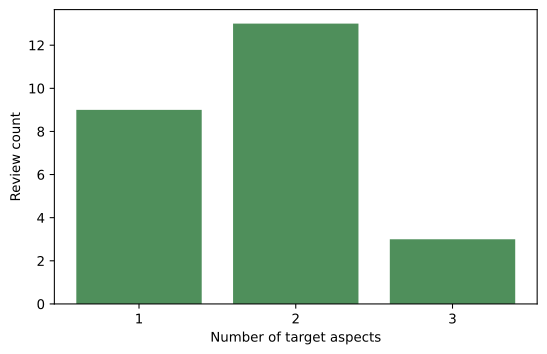
A.2.4 Generator Realism-Validation Protocol
To assess generator quality without redefining the paper's main task, we built a small-scale real-versus-synthetic discrimination protocol. The reference pool is a public OMSCS review source from which 32 reviews were prepared across four computer science courses. This source is useful for a first realism stress test because it provides naturally written educational reviews with concrete course experiences, but it is not representative enough to serve as the only real benchmark. It is graduate-level, computer-science-heavy, English-only, and drawn from a single public review website. Accordingly, OMSCS is treated as a constrained validation source rather than a final external evaluation set, and these reviews are never mixed into the ABSA train, validation, or test splits.
The realism-validation procedure is iterative. In this protocol, one cycle means a complete pass over 60 judge questions: 30 real reviews and 30 synthetic reviews, each judged independently as a binary REAL-versus-SYNTHETIC decision with confidence, cue tags, and justification. Synthetic reviews are generated from sampled aspect sentiments together with a sampled subset of nuance attributes rather than the full schema, so the prompt remains controllable without looking templated. Each cycle records judge labels, confidence, entropy, a chance-confusion percentage, and exact-versus-chance significance statistics. When the judge correctly identifies synthetic cues, those explanations are fed into an editor step that rewrites the instruction before the next cycle, so each cycle is evaluated under one fixed prompt specification rather than an ad hoc prompt mixture. These checks are positioned as generator validation steps that support the main synthetic-data ABSA study, not as a substitute for the paper's core training-and-evaluation experiments. They are diagnostic, single-source, and single-judge evidence rather than a broad realism claim.
Here \(y_i\) is the hidden ground-truth source label, \(\hat{y}_{c,i}\) is the judge decision for item \(i\) in cycle \(c\), \(q_{c,i}\) is the judge confidence, \(r_{c,i}\) denotes the textual cue explanation, \(\mathrm{Acc}_c\) is the judge accuracy, \(\mathrm{Confusion}_c\) is the paper-facing chance-confusion statistic, \(H_c\) is mean decision entropy, and \(E\) is the editor function that produces the next stable realism instruction only from cues that correctly exposed synthetic items.
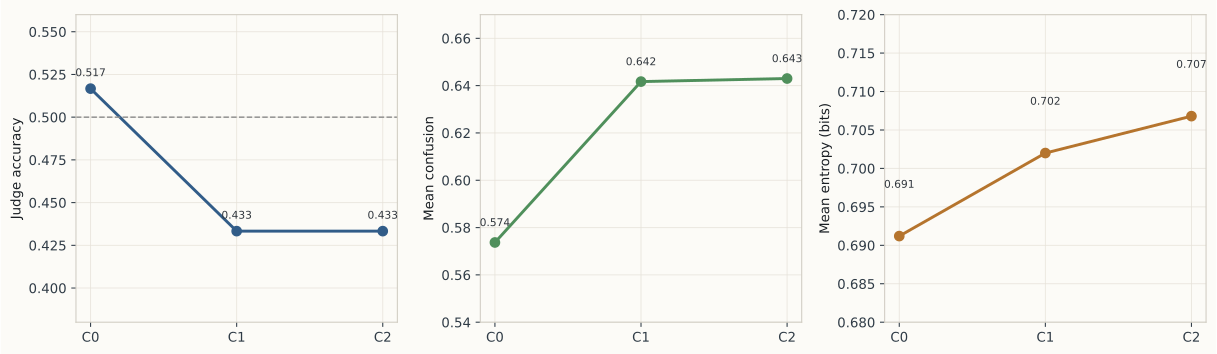
A.2.5 Three-Cycle Realism-Validation Results
The realism study remains diagnostic, and it is reported here as a complete three-cycle procedure rather than as a single pass. Each cycle used 60 independent judge questions: 30 real OMSCS reviews and 30 synthetic reviews generated from the richer attribute prompt, with binary REAL-versus-SYNTHETIC decisions, confidence scores, cue tags, and textual justification. Across cycles 0, 1, and 2, judge item accuracy was 0.5167, 0.4333, and 0.4333; mean confusion was 0.5737, 0.6417, and 0.6430; mean entropy was 0.6912, 0.7020, and 0.7068 bits; and the number of correctly detected synthetic reviews fell from 5 to 1 to 0. These diagnostics indicate that the stabilized prompt reduced several synthetic cues, even though the accuracy-based chance-confusion statistic was not monotonic across cycles. Figure A4 plots the per-cycle accuracy, confusion, and entropy, and Table A11 summarizes the three cycles.
The final cycle does not support an equivalence claim. In cycle 2, the judge accuracy remained 0.4333, the exact binomial test against chance yielded p = 0.366294, and the Wilson 95% interval was [0.3157, 0.5590], which is too wide for the predefined ±0.10 equivalence margin. The value of the procedure is therefore diagnostic rather than confirmatory. Judge explanations repeatedly highlighted generic specificity, overbalanced structure, overpolished prose, stacked motifs, and occasional persona inconsistencies; those cues were then used by the editor step to stabilize the next-cycle prompt. The realism analysis therefore contributes a cycle-level improvement curve, cue summaries, prompt states, and side-by-side appendix examples rather than only a final binary verdict.
| Prompt state | Cycle | Judge accuracy | Mean confusion | Mean entropy (bits) | Binomial p-value | Editor triggered |
|---|---|---|---|---|---|---|
rich_attributes_baseline | 0 | 0.5167 | 0.5737 | 0.6912 | 0.8974 | yes |
reduce_synthetic_signatures | 1 | 0.4333 | 0.6417 | 0.7020 | 0.3663 | yes |
messier_realism | 2 | 0.4333 | 0.6430 | 0.7068 | 0.3663 | no |
To make the realism analysis auditable, the appendix includes side-by-side real and synthetic review examples together with the synthetic review's sampled aspects and nuance attributes. The paper therefore reports not only the final cycle summary, but also the prompt instructions and qualitative evidence used to justify revision between cycles; the paired examples appear in Appendix A.1.2.
A.2.6 Per-Aspect Synthetic-to-Real Diagnostics
Figure A5 expands the external-validation result into an aspect-by-model matrix. It is included in the appendix because it is diagnostically valuable, but too detailed for the main body.
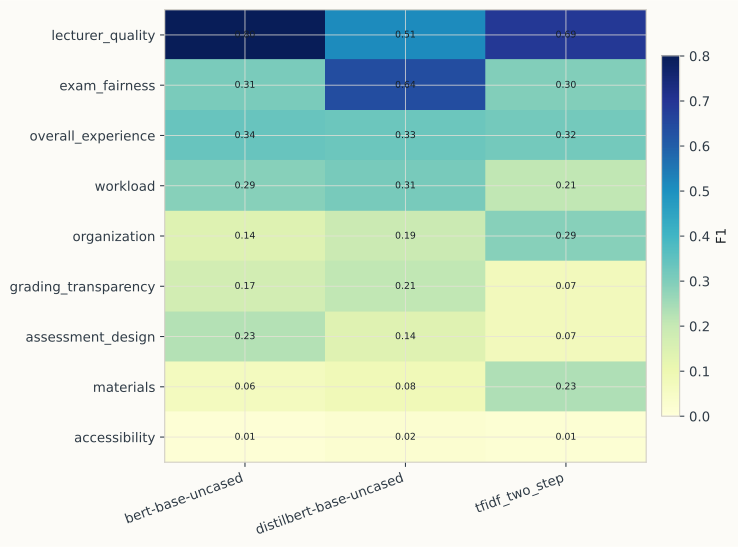
lecturer_quality and exam_fairness transfer more cleanly than sparse or weakly aligned categories such as accessibility.A.2.7 Sentence-Versus-Review Realism
The realism-validation judge separates whole synthetic reviews from real ones easily, but this reflects document structure rather than the realism of the text itself. We re-ran the identical real-versus-synthetic judgment at sentence granularity, giving the judge one sentence at a time (150 synthetic and 150 real OMSCS sentences of 5 to 40 words), and compared it to the review-level decision (Table A12). Accuracy falls from 93% to 60%, close to the 50% chance floor: the judge flags only 37% of synthetic sentences as synthetic (versus 97% of whole reviews) and calls 63% of them real, while its false-synthetic rate on real sentences is unchanged at 16%. Individual synthetic sentences are therefore near-indistinguishable from real ones to the same detector. The detectability is instead a cumulative property of extended synthetic text: each synthetic sentence carries only a weak signal (flagged synthetic 37% of the time, against a 15% floor on real sentences), and that signal accumulates across a full generated review to near-certain detection (97%). To confirm this is not merely an effect of covering several aspects in one document, we ran a control that assembles real OMSCS sentences from the same course into equally multi-aspect documents (mean 63 words); these all-real-sentence documents are judged synthetic only 19% of the time, essentially the real-review rate, so neither multi-aspect coverage nor mild incoherence triggers the tell (Table A12). The signal is the accumulated style of genuinely synthetic text, which is orthogonal to the sentence-level aspect-sentiment labels the corpus supplies for training; a MAUVE gap of 0.23 between the sentence pools reflects an aggregate distributional shift consistent with this weak per-sentence signal. Scripts: paper/n2_sentence_judge.py, paper/n2_assembled_real.py.
| Condition | Median words | Flagged synthetic |
|---|---|---|
| Real full reviews | 104 | 0.15 |
| Assembled real (multi-aspect documents) | 63 | 0.19 |
| Individual synthetic sentences | ~12 | 0.37 |
| Whole synthetic reviews | 122 | 0.975 |
A.3 Generator Diagnostics and Robustness
A.3.1 Complementary Generator Diagnostics
- A real-versus-synthetic validation harness with cycle-by-cycle prompt-debug logging.
- Compact model-assisted audits of aspect support and sentiment consistency on both stable-prompt samples and the full dataset.
We also ran compact model-assisted auxiliary audits with gpt-5.2. On 30 synthetic reviews generated directly from the corpus-generation prompt, all declared aspects were judged to be textually supported (\(1.0000\) support rates at both the aspect and review level), while exact sentiment agreement was lower (\(0.7377\) at the aspect level and \(0.5333\) at the full-review level). This prompt-level result should be read together with the harsher full-dataset audit reported in Section 5.6: the combination suggests that target aspect presence can be preserved under the generation prompt, but large-scale generation still introduces substantial label-faithfulness drift, especially for sentiment polarity. Together these diagnostics justify treating realism and faithfulness checks as generator audits rather than as evidence that the 10K corpus is a synthetic gold standard.
A.3.2 Generator-Family Robustness
To check that the generate-audit-filter pipeline is not specific to the GPT family that produced the corpus (Section 5.7), we regenerated the same 150 label-conditioned prompts with four generator families spanning four providers, accessed through a common OpenRouter interface, and scored every generation with the identical gpt-5.2 label-fidelity audit used in Section 5.6. The comparison is construct-matched: one auditor, one prompt set, one scoring pass. All four families yield high and comparable aspect support (0.921 to 0.968) and per-aspect sentiment match (0.759 to 0.904), with the two non-GPT families matching or exceeding the same-family gpt-5-nano generator. Non-GPT generators therefore produce auditable, label-faithful data, and the audit signal is consistent across providers rather than tuned to one family. GLM-4.6 is a reasoning-first model whose default output is empty under a plain chat call; it was queried with explicit-reasoning disabled, which is why its usable aspect count is slightly lower.
| Provider | Generator | Declared aspects | Aspect support rate | Aspect sentiment-match rate |
|---|---|---|---|---|
| OpenAI | gpt-5-nano (corpus generator) | 315 | 0.9365 | 0.7587 |
gemini-2.5-flash | 315 | 0.9683 | 0.8571 | |
| Zhipu | glm-4.6 | 251 | 0.9681 | 0.9044 |
| Meta | llama-3.3-70b | 315 | 0.9206 | 0.7873 |
A.3.3 The Learnable Signal Is Generator-Invariant
Because the train and test splits come from one generator and prompt, a reviewer may ask whether the detector exploits generator-specific patterns rather than aspect content. It does not. Training the detector on the GPT-generated corpus and evaluating it on held-out corpora generated by three other families (Table A14) does not collapse: GPT-trained detection reaches micro-F1 0.32 to 0.38 on the gpt5nano, GLM, and Llama corpora and 0.23 on Gemini, comparable to or above its own in-domain 0.277. The learnable signal is thus generator-invariant rather than a single generator's fingerprint. Outputs: paper/outputs/w5_heldout_generator/.
| Train → test corpus | Detection micro-F1 |
|---|---|
| GPT → GPT (in-domain) | 0.277 |
| GPT → gpt5nano | 0.376 |
| GPT → GLM-4.6 | 0.321 |
| GPT → Llama-3.3-70B | 0.318 |
| GPT → Gemini-flash | 0.233 |
A.4 Label-Faithfulness Audit: Reliability, Human Agreement, and Independence
A.4.1 Label-Faithfulness Audit Details
The strict model-assisted label-faithfulness audit checks whether declared aspect sentiments are visibly supported in the generated text; the exact audited rates for the full-corpus and pilot samples are reported in the main body as Table 11 and are retained there for future comparison after regeneration or filtering.
A.4.2 Per-Corpus Audit-versus-Human Agreement
The audit-versus-human agreement of Section 5.7 is reported here per corpus, for both the cost-matched auditor that drives the filter and the fully independent auditor. It is computed over the same 2,482 aspect-level decisions from 1,200 perturbation-controlled variants (faithful / polarity-flipped / aspect-injected). Each decision is a binary faithful-versus-unfaithful judgment (does the auditor accept an aspect that is genuinely faithful, and reject a flipped or injected one), so the metric is invariant to the two corpora's different aspect label sets and is directly comparable across them. Both auditors agree more with humans on EduRABSA than on Herath; this tracks item length (EduRABSA passages median 38 words versus Herath sentences median 20), and the independent auditor equals or exceeds the same-family one on both corpora, reinforcing that the audit signal is human-validated rather than a same-family artifact.
| Auditor | Corpus | Decisions | Cohen's kappa | Precision |
|---|---|---|---|---|
gpt-4.1-mini (cost-matched) | Herath | 1,396 | 0.51 | 0.87 |
gpt-4.1-mini (cost-matched) | EduRABSA | 1,086 | 0.62 | 0.89 |
gpt-4.1-mini (cost-matched) | Both | 2,482 | 0.56 | 0.88 |
gemini-2.5-flash (independent) | Herath | 1,396 | 0.58 | 0.89 |
gemini-2.5-flash (independent) | EduRABSA | 1,086 | 0.67 | 0.89 |
gemini-2.5-flash (independent) | Both | 2,482 | 0.62 | 0.89 |
A.4.3 Audit Reliability by Review Length and Aspect Count
The audit-versus-human agreement of Table A15 varies systematically with two correlated review properties (Pearson 0.48): review length and the number of declared aspects. Decomposing the 2,482 decisions isolates two opposing forces (Table A16). Recall, the rate at which the audit confirms a genuinely faithful aspect, rises with content: from 0.61 on one-aspect reviews to 0.74 on reviews with four or more aspects, and, holding the aspect count fixed at one, from 0.50 on reviews of at most 20 words to 0.56 on reviews over 40 words. More text lets the audit verify that a real aspect is present. Specificity, the rate at which it rejects an injected absent aspect, instead falls with aspect density: from 0.90 on one-aspect reviews to about 0.74 on reviews with three or more aspects, because a fabricated aspect blends in when a review already discusses many aspects. Agreement is therefore highest for moderate-length, moderate-aspect reviews: the shortest reviews are hard because the audit cannot confirm real aspects, and the most aspect-dense reviews are hard because it cannot reject fabricated ones. This also explains the per-corpus ordering in Table A15, where the shorter Herath sentences sit below the longer EduRABSA passages. Scripts: paper/v7_kappa_by_length.py, paper/v7_by_len_and_aspects.py.
| Aspects per review | Decisions | Mean words | Cohen's kappa | Recall (confirm faithful) | Specificity (reject injected) |
|---|---|---|---|---|---|
| 1 | 792 | 23 | 0.51 | 0.61 | 0.90 |
| 2 | 959 | 35 | 0.59 | 0.72 | 0.88 |
| 3 | 460 | 55 | 0.56 | 0.71 | 0.74 |
| 4+ | 271 | 110 | 0.55 | 0.74 | 0.74 |
A.4.4 Independent Open-Weights Auditors Reproduce the Faithfulness Audit
The generator and the cost-matched auditor are both OpenAI models, which raises the question of whether the audit detects genuine textual faithfulness or a same-family latent pattern. We re-ran the audit on the same 250-review sample with two independent open-weights auditors, Llama-3.3-70B (Meta) and GLM-4.6 (Zhipu). All three families converge (Table A17): mean support-rates are within a few points (0.77, 0.74, 0.73), cross-architecture agreement with the GPT auditor is Cohen's kappa 0.56 to 0.65 with row-score Spearman 0.54 to 0.69, and the two open-weights auditors agree with each other at the same level (supported kappa 0.65), so no auditor is privileged. A same-family artifact would make out-of-family auditors diverge; instead they reproduce the audit, indicating it measures textual faithfulness rather than a generator-auditor family effect. This complements the Gemini human-agreement check (Cohen's kappa 0.62, Appendix A.4.2). Outputs: paper/outputs/w3_openweights_auditor/.
| Auditor (family) | Support-rate | vs GPT: supported kappa | vs GPT: sentiment_match kappa |
|---|---|---|---|
| GPT-5.2 (OpenAI, baseline) | 0.77 | n/a | n/a |
| Llama-3.3-70B (Meta) | 0.74 | 0.63 | 0.65 |
| GLM-4.6 (Zhipu) | 0.73 | 0.61 | 0.56 |
A.4.5 Audit Score Predicts Training Quality Monotonically
The faithfulness-aware filter rests on the claim that the audit score tracks how useful a row is for training. We test this directly with a dose-response: training the detector on each audit-score quartile of the corpus at matched size and evaluating on the 9-aspect overlap of a held-out synthetic test split (Table A18). The response is monotone on both seeds: detection micro-F1 (9-aspect overlap) rises from 0.285 in the lowest-audit quartile to 0.411 in the highest, and sentiment mean squared error falls from 0.744 to 0.529. Higher-audit training data yields a strictly better detector across the whole distribution, not only at the extremes, which is the end-to-end validation of the audit score as a training-data quality signal. Outputs: paper/outputs/w7_dose_response/.
| Audit-score quartile | Detection micro-F1 | Sentiment MSE |
|---|---|---|
| Q1 (lowest audit) | 0.285 | 0.744 |
| Q2 | 0.335 | 0.677 |
| Q3 | 0.383 | 0.529 |
| Q4 (highest audit) | 0.411 | 0.529 |
| full corpus | 0.418 | 0.399 |
A.5 Modeling, Detection, and Transfer Diagnostics
A.5.1 Additional Local-Benchmark Robustness Analyses
Tables A19-A21 and Figures A6-A7 collect the robustness analyses cited in Section 5.2. They show how the two-step and joint formulations compare directly, how stable the strongest local models are across three seeds, and how a modest training-budget change affects BERT and DistilBERT.
| Family | Approach | Micro-F1 | Macro-F1 | Micro-recall | Sentiment MSE | Runtime (min) |
|---|---|---|---|---|---|---|
| Two-step | bert-base-uncased | 0.2760 | 0.3364 | 0.4396 | 0.4959 | 21.86 |
| Two-step | distilbert-base-uncased | 0.2691 | 0.3376 | 0.4531 | 0.5044 | 15.95 |
| Joint | distilbert_joint | 0.2524 | 0.3248 | 0.4719 | 0.5428 | 6.29 |
| Joint | bert_joint | 0.2447 | 0.3208 | 0.5122 | 0.5288 | 11.58 |
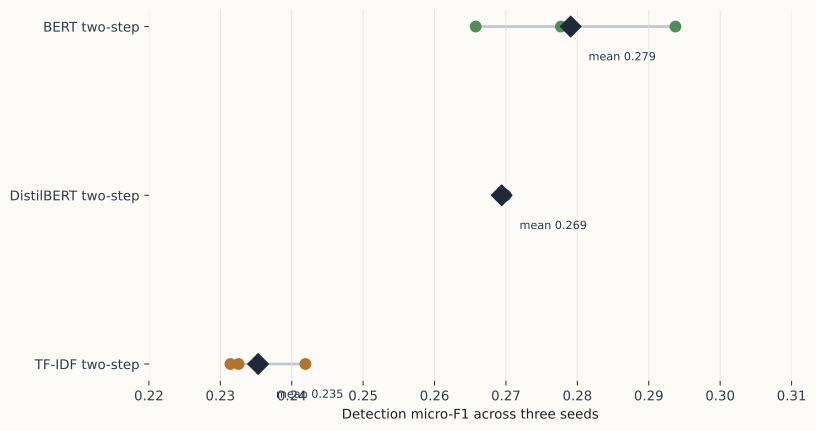
| Approach | Seeds | Micro-F1 mean | Micro-F1 std | Sentiment MSE mean | Sentiment MSE std |
|---|---|---|---|---|---|
bert-base-uncased | 3 | 0.2791 | 0.0140 | 0.5004 | 0.0296 |
distilbert-base-uncased | 3 | 0.2694 | 0.0005 | 0.5097 | 0.0188 |
tfidf_two_step | 3 | 0.2353 | 0.0058 | 0.6667 | 0.0158 |
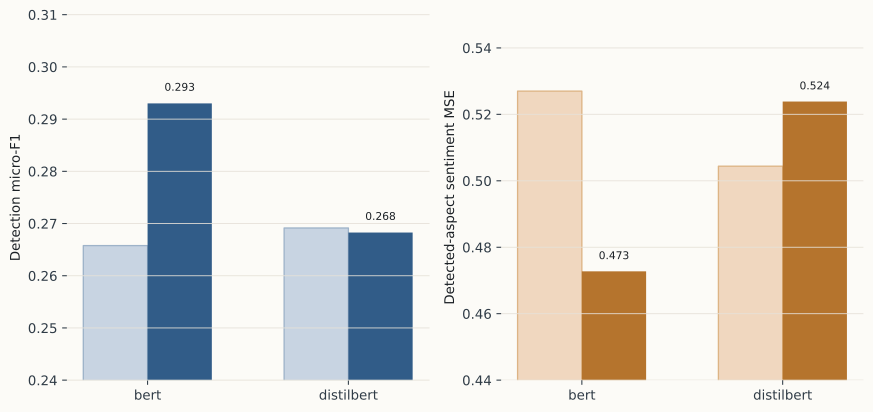
| Approach | Baseline micro-F1 | Tuned micro-F1 | Δ micro-F1 | Baseline sentiment MSE | Tuned sentiment MSE | Δ sentiment MSE |
|---|---|---|---|---|---|---|
bert-base-uncased | 0.2760 | 0.2930 | +0.0170 | 0.4959 | 0.4728 | -0.0231 |
distilbert-base-uncased | 0.2691 | 0.2683 | -0.0009 | 0.5044 | 0.5239 | +0.0195 |
A.5.2 Additional Detection Diagnostics
Table A22 complements the headline F1 metrics with three confusion-based summaries that are less sensitive to label sparsity: macro balanced accuracy, macro specificity, and macro Matthews correlation. These values are especially useful in the present 20-aspect multilabel setting because they show whether a model is improving through better minority-positive recovery, through conservative rejection of negatives, or through a more balanced combination of both.
| Family | Approach | Micro-F1 | Macro-F1 | Macro balanced accuracy | Macro specificity | Macro MCC | Sentiment MSE |
|---|---|---|---|---|---|---|---|
| Local synthetic benchmark | bert-base-uncased | 0.2760 | 0.3364 | 0.6229 | 0.8050 | 0.2766 | 0.4959 |
| Local synthetic benchmark | distilbert-base-uncased | 0.2691 | 0.3376 | 0.6207 | 0.7863 | 0.2713 | 0.5044 |
| Local synthetic benchmark | tfidf_two_step | 0.2326 | 0.2867 | 0.5955 | 0.7225 | 0.1920 | 0.6830 |
| GPT batch inference | gpt-5.2 zero-shot | 0.2519 | 0.2417 | 0.5899 | 0.8686 | 0.1799 | 0.7179 |
| GPT batch inference | gpt-5.2 retrieval-few-shot | 0.2501 | 0.2395 | 0.5883 | 0.8693 | 0.1823 | 0.7244 |
| GPT batch inference | gpt-5.2 few-shot | 0.2450 | 0.2339 | 0.5848 | 0.8679 | 0.1798 | 0.7325 |
| GPT batch inference | gpt-5.2 few-shot-diverse | 0.2374 | 0.2261 | 0.5800 | 0.8673 | 0.1653 | 0.7386 |
| Mapped real-data transfer | bert-base-uncased | 0.402 | 0.267 | 0.5925 | 0.8327 | 0.1874 | 0.354 |
| Mapped real-data transfer | distilbert-base-uncased | 0.322 | 0.264 | 0.5778 | 0.7976 | 0.2182 | 0.404 |
| Mapped real-data transfer | tfidf_two_step | 0.360 | 0.222 | 0.5403 | 0.7992 | 0.1162 | 0.691 |
A.5.3 Per-Aspect Behavior of the Best Model
The per-aspect profile of the best untuned model, BERT, is uneven in a way that matches the pedagogical complexity of the label space. Stronger aspect categories concentrate in the assessment-and-management and learning-demand blocks, especially workload, grading_transparency, exam_fairness, pacing, and tooling_usability. Harder categories cluster in the instructional-quality, learning-environment, and engagement blocks, including peer_interaction, support, interest, feedback_quality, and clarity, which likely require more implicit reasoning and weaker lexical cues. This pattern shows that the benchmark is not uniformly easy even when labels are known by construction. Figure A8 plots the per-aspect detection and sentiment profile, and Table A23 lists the strongest and weakest aspect categories.
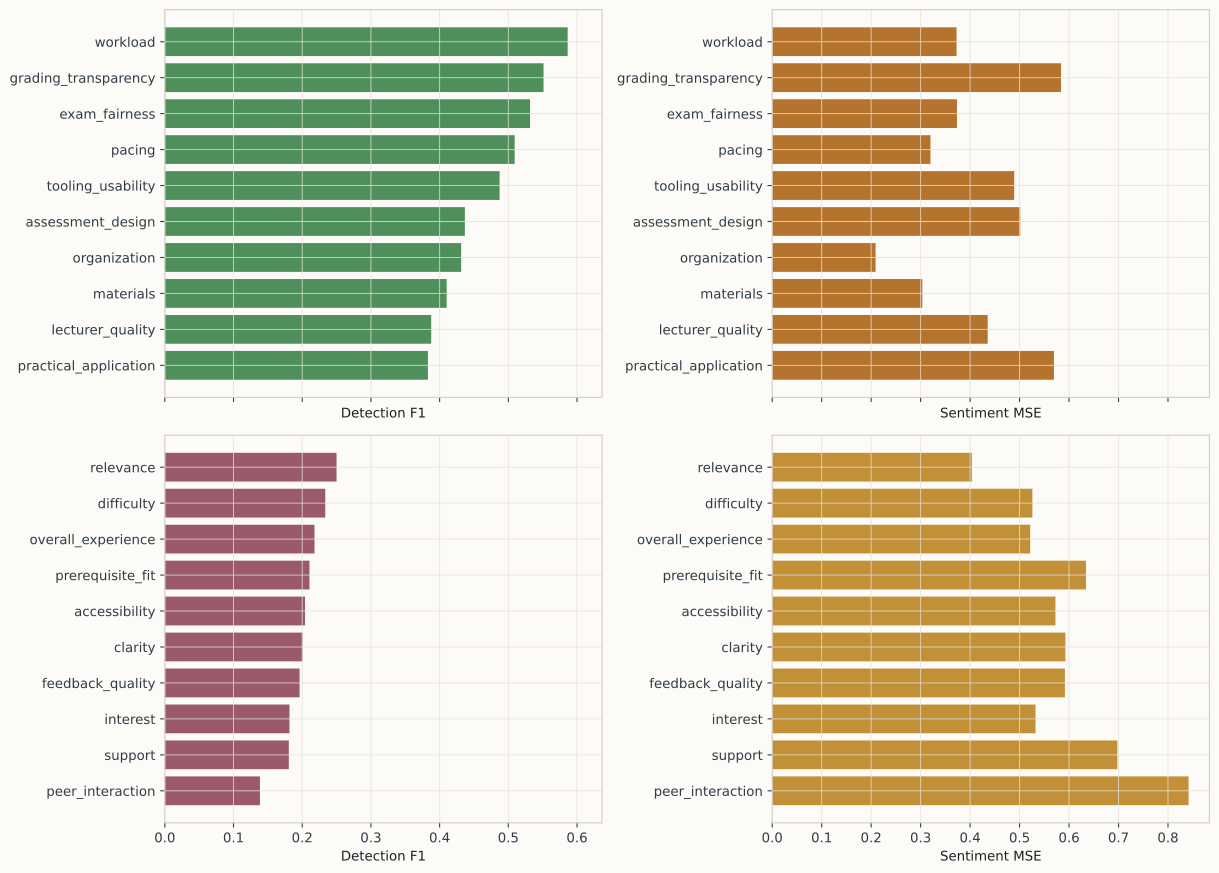
| Model | Group | Aspect | F1 | Sentiment MSE | Precision | Recall |
|---|---|---|---|---|---|---|
bert-base-uncased | top-5 | workload | 0.5864 | 0.3727 | 0.6437 | 0.5385 |
bert-base-uncased | top-5 | grading_transparency | 0.5513 | 0.5838 | 0.8958 | 0.3981 |
bert-base-uncased | top-5 | exam_fairness | 0.5316 | 0.3735 | 0.7500 | 0.4118 |
bert-base-uncased | top-5 | pacing | 0.5093 | 0.3199 | 0.5000 | 0.5189 |
bert-base-uncased | top-5 | tooling_usability | 0.4873 | 0.4892 | 0.5333 | 0.4486 |
bert-base-uncased | bottom-5 | clarity | 0.2006 | 0.5926 | 0.1166 | 0.7172 |
bert-base-uncased | bottom-5 | feedback_quality | 0.1961 | 0.5917 | 0.1117 | 0.8049 |
bert-base-uncased | bottom-5 | interest | 0.1814 | 0.5322 | 0.1114 | 0.4889 |
bert-base-uncased | bottom-5 | support | 0.1805 | 0.6977 | 0.1049 | 0.6458 |
bert-base-uncased | bottom-5 | peer_interaction | 0.1385 | 0.8416 | 0.3913 | 0.0841 |
A.5.4 Review Granularity Does Not Predict Transfer
A natural concern is that the synthetic corpus is full-review while the two primary transfer targets are sentence-level, so transfer might be limited by this granularity mismatch. It is not. We evaluated the same synthetic-trained bert-base-uncased detector on four real targets that vary in granularity, over each target's conservative aspect overlap (Table A24). A review-level MOOC target (OATS, median 70 words) transfers no better (micro-F1 0.275, single-seed screening) than the sentence-level MOOC target (M-ABSA 0.263, single-seed screening), so review length is not the bottleneck. The two course-feedback targets whose register matches the synthetic supervision transfer far better: Herath at 0.402 (five-seed mean) and EduRABSA at 0.448 (eight-seed mean, Table 10), both well above the two Coursera MOOC corpora. Transfer difficulty is therefore governed by how closely a target's aspect vocabulary and register align with the synthetic supervision, not by review length; the cross-granularity mismatch is not the operative limitation. The two Coursera-derived MOOC targets (M-ABSA, OATS) are additionally short and positive-skewed, which further depresses their transferred scores.
| Target | Granularity (median words) | Source | Transfer micro-F1 |
|---|---|---|---|
| Herath | sentence (20) | student feedback | 0.40 |
| EduRABSA | sentence (38) | Waterloo course / teacher reviews | 0.448 |
| M-ABSA | sentence (14) | Coursera MOOC | 0.263 |
| OATS | review (70) | Coursera MOOC | 0.275 |
A.5.5 Correlated-Polarity Generation Improves Sentiment Transfer
The polarity-independence gap of Appendix A.1.7 is not merely descriptive: closing it improves sentiment transfer. We regenerated a correlated-polarity corpus that first draws a review-level sentiment disposition and then conditions the per-aspect polarities on it, raising within-review polarity agreement from 0.22 to 0.51 (into the real 0.50 to 0.72 range of Table A6), while holding the aspect-count distribution, seed attributes, prompt template, and generation pipeline fixed. The baseline is an equal-size, identically-generated independent-polarity corpus, so the only difference is the polarity structure. Training the sentiment head on each and evaluating gold-present mean squared error on the real targets, with paired per-seed comparison across three seeds (Table A25), correlated polarity lowers the error on both targets in every seed: a paired reduction of 0.231 ± 0.117 on OATS and 0.157 ± 0.114 on Herath. The per-seed magnitude varies but the direction is consistent, and the paired design removes the substantial between-seed variance of this transfer task. Scripts: paper/exp4_generate.py, paper/exp_indep_generate.py, paper/multiseed_validation.py.
| Target | Independent polarity | Correlated polarity | Paired Δ (mean ± sd) |
|---|---|---|---|
| OATS | 0.724 | 0.493 | −0.231 ± 0.117 |
| Herath | 0.566 | 0.409 | −0.157 ± 0.114 |
A.5.6 Sentence-Level Training Improves Transfer to Sentence-Level Targets
The synthetic corpus is full-length reviews, but it can be trained at review or at sentence granularity. Because a single aspect is usually expressed in one or two sentences, we split each synthetic review into sentences and localize its declared aspects to the sentences that mention them (a lexicon weak-supervision step), then train the detector on those sentence-level examples. This aligns the training granularity with sentence-level real targets. With paired per-seed comparison across three seeds (Table A26), sentence-level training raises detection micro-F1 on both sentence-level targets in every seed: a paired gain of 0.211 ± 0.061 on M-ABSA and 0.039 ± 0.012 on Herath. The effect is specific to granularity rather than to training quantity: it appears on the sentence-level targets but not on the review-level OATS target, where sentence-level training instead underperforms review-level training. A pure data-quantity effect from the larger sentence set would help all targets uniformly, so the differential pattern isolates granularity alignment as the operative factor. Scripts: paper/exp2_sentence_train.py, paper/exp2b_matched.py, paper/multiseed_validation.py.
| Target (granularity) | Review-trained | Sentence-trained | Paired Δ (mean ± sd) |
|---|---|---|---|
| M-ABSA (sentence) | 0.263 | 0.474 | +0.211 ± 0.061 |
| Herath (sentence) | 0.381 | 0.419 | +0.039 ± 0.012 |
A.6 Baselines and Prior Work
A.6.1 Prior Real-Data Educational Sentiment Results in Context
| Study | Setting | Reported metric | Task | Comparability to this study |
|---|---|---|---|---|
| Welch and Mihalcea [36] | Real student comments with automatically extracted entities | F1 = 0.586 | Targeted sentiment toward courses and instructors | Low; entity-targeted sentiment is narrower than review-level 20-aspect ABSA |
| Welch and Mihalcea [36] | Real student comments with ground-truth entities | F1 = 0.695 | Targeted sentiment with gold entities | Low; useful upper-bound reference, but not a directly matched benchmark |
| Herath et al. [17] | Real student feedback baseline | F1 = 0.750 | Aspect-level sentiment analysis | Medium; closest real educational sentiment benchmark, but different label unit and task structure |
| Herath et al. [17] | Real student feedback best tree-based ALSC | F1 = 0.710 | Aspect-level sentiment classification with FT-RoBERTa induced RGAT | Medium; stronger educational baseline under their own annotation protocol |
| This study | Mapped Herath overlap after synthetic training | micro-F1 = 0.402 (five-seed mean) | Synthetic-to-real transfer on a 9-aspect overlap | Medium; the closest comparison here because it uses real educational reviews, but it still depends on conservative aspect mapping |
Table A27 is included to prevent overinterpretation of the transfer result. Our mapped-overlap score should not be read as “worse than Herath” or “better than Welch” in any simple leaderboard sense, because the task definitions differ substantially. Welch and Mihalcea study targeted sentiment toward extracted course or instructor entities, while Herath et al. evaluate aspect-level sentiment under their own annotation structure. The most defensible reading is narrower: the reported result shows that models trained only on the synthetic corpus recover some real educational signal on one mapped real benchmark, but the paper does not yet claim parity with prior real-data educational sentiment systems under their native tasks.
A.6.2 Multi-Provider Prompted Baseline
To check that the prompted inference baseline (Section 5.3) is not confined to one provider or one prompting family, we ran the identical zero-shot-glossary ABSA contract across four families spanning four providers on the full 1,000-review held-out synthetic test split (seed 42, 20 aspects), scored in one construct-matched pass with the same per-aspect detection and sentiment metrics. All four families fall in the same narrow band, detection micro-F1 0.239 to 0.267 and sentiment accuracy on matched aspects 0.629 to 0.663, and sit below the strongest trained encoders (BERT detection micro-F1 around 0.28), consistent with the paper's reading that zero-shot prompting is an informative but non-dominant baseline regardless of provider. Predictions are parsed leniently so a model is scored on content rather than exact JSON syntax. The OpenAI score on this full split (gpt-5.4, 0.239) is in the same band as the full-test gpt-5.2 zero-shot result of 0.252 in Table 7; these are two different OpenAI models, compared only for band placement.
| Provider | Model | Detection micro-F1 | Sentiment accuracy (matched) | Parsed |
|---|---|---|---|---|
| OpenAI | gpt-5.4 | 0.2389 | 0.6627 | 1000/1000 |
gemini-2.5-flash | 0.2521 | 0.6290 | 983/1000 | |
| Zhipu | glm-4.6 | 0.2666 | 0.6618 | 1000/1000 |
| Meta | llama-3.3-70b | 0.2651 | 0.6492 | 1000/1000 |
A.7 Qualitative Error Analysis
A.7.1 Qualitative Error Analysis
A qualitative pass over the bert-base-uncased predictions (1,000 held-out synthetic reviews and 1,680 real Herath transfer reviews) shows the errors are systematic rather than random, in four recurring patterns. First, a detection frequency bias: high-prevalence diffuse aspects are over-predicted while specific low-frequency aspects are under-detected. Four broad aspects (overall_experience, clarity, support, feedback_quality) account for the bulk of false positives, whereas peer_interaction is recovered in only 8% of its gold mentions, prerequisite_fit in 14%, and difficulty in 17%. Second, a linked substitution pattern: when a specific aspect is present the model tends to drop it and fire a generic aspect instead, so the most common confusions are peer_interaction miss-substituted by overall_experience or clarity, and organization and practical_application collapsing into overall_experience; the shared evaluative vocabulary of the generic aspects makes them attractors. Third, polarity compression toward neutral: the regression head pulls strong polarities to the middle, mislabelling 178 of 319 gold-negative and 209 of 364 gold-positive detections as neutral, while direct negative-to-positive flips are rare. Fourth, this compression acquires a positive skew under real-review transfer: on Herath only 26 of 272 gold-negative aspects are labelled negative, reflecting the enthusiastic register of real course reviews that the synthetic training distribution under-represents. These are structural properties of the label distribution and shared aspect vocabulary, not sporadic noise: practitioners can expect reliable detection and polarity on frequent, lexically distinctive aspects, and should treat fine-grained aspects and non-positive polarities on out-of-domain reviews as the model's weak regime. Outputs: paper/outputs/e8_error_analysis/.
A.8 Real-Data Mapping (Herath and EduRABSA)
A.8.1 Mapping Procedure and Source-Label Correspondence
Both real corpora were mapped to the 20-aspect pedagogical schema by the authors, conservatively: each source label or category was assigned to the schema aspect with the clearest correspondence, and source categories without a defensible single mapping were left unmapped rather than forced. This is what yields the conservative nine-aspect (Herath) and seven-aspect (EduRABSA) overlaps used for transfer; the two corpora differ only in that assessment_design and grading_transparency are present in Herath but have no EduRABSA counterpart. Both mapping files are released (paper/real_transfer/herath_mapping.json and paper/real_transfer/edurabsa_mapping.json) so the correspondence can be inspected and revised. Table A29 gives the source-label-to-aspect correspondence for both corpora side by side, and Table A30 gives the EduRABSA overlap support and polarity distribution (the Herath equivalent is Table A3).
| Schema aspect | Herath source labels | EduRABSA source categories |
|---|---|---|
lecturer_quality | Lecturer#X_1..3, Lecturer#X_x | Staff - Teaching; Staff - Knowledge & skills |
overall_experience | Course#X_x | Course - Overall; Staff - Overall |
organization | Course_Structure#X_1 | Course - Learning activity |
workload | Course_Structure#X_2 | Course - Difficulty; Course - Workload |
materials | Subject_Material#X_1, Subject_Material#X_x | Course - Course materials; Course - Technology & tools |
exam_fairness | End_Exam#X_x | Course - Assessment |
accessibility | Learning_Environment#X_x | Staff - Helpfulness; University - Information & services |
assessment_design | CA#X_x | n/a |
grading_transparency | Course_Structure#X_5 | n/a |
| Aspect | Reviews | Positive | Neutral | Negative |
|---|---|---|---|---|
overall_experience | 3,697 | 2,514 | 182 | 1,001 |
lecturer_quality | 2,153 | 1,344 | 53 | 756 |
workload | 1,814 | 961 | 239 | 614 |
exam_fairness | 1,167 | 524 | 136 | 507 |
organization | 819 | 343 | 142 | 334 |
accessibility | 795 | 672 | 2 | 121 |
materials | 581 | 263 | 101 | 217 |
Bibliography
- Wed Akeel Awadh, Rosnafisah Bte Sulaiman, and Moamin A. Mahmoud. 2025. Aspect-based sentiment analysis in MOOCs: a systematic literature review introducing the MASC-MEF framework. Journal of King Saud University Computer and Information Sciences.
- David Carless and David Boud. 2018. The development of student feedback literacy: enabling uptake of feedback. Assessment & Evaluation in Higher Education, 43(8), 1315-1325.
- Janaka Chathuranga, Shanika Ediriweera, Ravindu Hasantha, Pranidhith Munasinghe, and Surangika Ranathunga. 2018. Annotating Opinions and Opinion Targets in Student Course Feedback. LREC 2018 Workshop paper.
- Siva Uday Sampreeth Chebolu, Franck Dernoncourt, Nedim Lipka, and Thamar Solorio. 2024. OATS: A Challenge Dataset for Opinion Aspect Target Sentiment Joint Detection for Aspect-Based Sentiment Analysis. Proceedings of LREC-COLING 2024, pages 12336-12347.
- Junjie Chen, Xuyang Liu, Subin Huang, Linfeng Zhang, and Hang Yu. 2025. Seeing Sarcasm Through Different Eyes: Analyzing Multimodal Sarcasm Perception in Large Vision-Language Models. IEEE Transactions on Computational Social Systems.
- Charalampos Dervenis, Giannis Kanakis, and Panos Fitsilis. 2024. Sentiment analysis of student feedback: A comparative study employing lexicon and machine learning techniques. Studies in Educational Evaluation, 83, 101406.
- Jacob Devlin, Ming-Wei Chang, Kenton Lee, and Kristina Toutanova. 2019. BERT: Pre-training of Deep Bidirectional Transformers for Language Understanding. Proceedings of NAACL-HLT 2019, pages 4171-4186.
- Aleksandra Edwards and Jose Camacho-Collados. 2024. Language Models for Text Classification: Is In-Context Learning Enough?. Proceedings of LREC-COLING 2024, pages 10058-10072.
- Steven Y. Feng, Varun Gangal, Jason Wei, Sarath Chandar, Soroush Vosoughi, Teruko Mitamura, and Eduard Hovy. 2021. A Survey of Data Augmentation Approaches for NLP. Findings of ACL 2021, pages 968-988.
- J.W. Gikandi, D. Morrow, and N.E. Davis. 2011. Online formative assessment in higher education: A review of the literature. Computers & Education, 57(4), 2333-2351.
- Fabrizio Gilardi, Meysam Alizadeh, and Maël Kubli. 2023. ChatGPT outperforms crowd workers for text-annotation tasks. Proceedings of the National Academy of Sciences, 120(30), e2305016120.
- Swapna Gottipati, Venky Shankararaman, and Jeff Rongsheng Lin. 2018. Text analytics approach to extract course improvement suggestions from students’ feedback. Research and Practice in Technology Enhanced Learning, 13, 6.
- Jiawei Gu, Xuhui Jiang, Zhichao Shi, Hexiang Tan, Xuehao Zhai, Chengjin Xu, Wei Li, Yinghan Shen, Shengjie Ma, Honghao Liu, Saizhuo Wang, Kun Zhang, Yuanzhuo Wang, and Jian Guo. 2025. A Survey on LLM-as-a-Judge. arXiv:2411.15594.
- John Hattie and Helen Timperley. 2007. The Power of Feedback. Review of Educational Research, 77(1), 81-112.
- Nils Constantin Hellwig, Jakob Fehle, and Christian Wolff. 2025. Exploring large language models for the generation of synthetic training samples for aspect-based sentiment analysis in low resource settings. Expert Systems with Applications, 261, 125514.
- Michael Henderson, Michael Phillips, Tracii Ryan, David Boud, Phillip Dawson, Elizabeth Molloy, and Paige Mahoney. 2019. Conditions that enable effective feedback. Higher Education Research & Development, 38(7), 1401-1416.
- Missaka Herath, Kushan Chamindu, Hashan Maduwantha, and Surangika Ranathunga. 2022. Dataset and Baseline for Automatic Student Feedback Analysis. Proceedings of the 13th Conference on Language Resources and Evaluation, pages 2042-2049.
- Ting-Wei Hsu, Chung-Chi Chen, Hen-Hsen Huang, and Hsin-Hsi Chen. 2021. Semantics-Preserved Data Augmentation for Aspect-Based Sentiment Analysis. Proceedings of EMNLP 2021, pages 4067-4079.
- Yan Cathy Hua, Paul Denny, Jörg Wicker, and Katerina Taskova. 2025. EduRABSA: An Education Review Dataset for Aspect-based Sentiment Analysis Tasks. arXiv:2508.17008.
- Maija Hujala, Antti Knutas, Timo Hynninen, and Heli Arminen. 2020. Improving the quality of teaching by utilising written student feedback: A streamlined process. Computers & Education, 157, 103965.
- Zhuoyan Li, Hangxiao Zhu, Zhuoran Lu, and Ming Yin. 2023. Synthetic Data Generation with Large Language Models for Text Classification: Potential and Limitations. EMNLP 2023, pages 10443-10461.
- Jian Liu, Zhiyang Teng, Leyang Cui, Hanmeng Liu, and Yue Zhang. 2021. Solving Aspect Category Sentiment Analysis as a Text Generation Task. Proceedings of EMNLP 2021, pages 4406-4416.
- Lin Long, Rui Wang, Ruixuan Xiao, Junbo Zhao, Xiao Ding, Gang Chen, and Haobo Wang. 2024. On LLMs-Driven Synthetic Data Generation, Curation, and Evaluation: A Survey. Findings of ACL 2024.
- Qiubo Ma, Hang Yu, Yuan Shan, and Pinzhuo Tian. 2025. Exploiting the Relationship within the Unlabelled Samples by Set Matching for Generalized Category Discovery. ICASSP 2025, IEEE International Conference on Acoustics, Speech and Signal Processing.
- Yu Meng, Jiaxin Huang, Yu Zhang, and Jiawei Han. 2022. Generating Training Data with Language Models: Towards Zero-Shot Language Understanding. Advances in Neural Information Processing Systems 35.
- Michelangelo Misuraca, Germana Scepi, and Maria Spano. 2021. Using Opinion Mining as an educational analytic: An integrated strategy for the analysis of students’ feedback. Studies in Educational Evaluation, 68, 100979.
- Nikola Nikolić, Olivera Grljević, and Aleksandar Kovačević. 2020. Aspect-based sentiment analysis of reviews in the domain of higher education. The Electronic Library, 38(1), 44-64.
- Maria Pontiki, Haris Papageorgiou, Dimitrios Galanis, Ion Androutsopoulos, John Pavlopoulos, and Suresh Manandhar. 2014. SemEval-2014 Task 4: Aspect Based Sentiment Analysis. Proceedings of the 8th International Workshop on Semantic Evaluation, pages 27-35.
- Maria Pontiki, Dimitris Galanis, Haris Papageorgiou, Ion Androutsopoulos, Suresh Manandhar, Mohammad AL-Smadi, Mahmoud Al-Ayyoub, Yanyan Zhao, Bing Qin, Orphée De Clercq, Véronique Hoste, Marianna Apidianaki, Xavier Tannier, Natalia Loukachevitch, Evgeniy Kotelnikov, Nuria Bel, Salud María Jiménez-Zafra, and Gülşen Eryiğit. 2016. SemEval-2016 Task 5: Aspect Based Sentiment Analysis. Proceedings of SemEval-2016, pages 19-30.
- Timo Schick and Hinrich Schütze. 2021. Exploiting Cloze-Questions for Few-Shot Text Classification and Natural Language Inference. Proceedings of EACL 2021, pages 255-269.
- Thanveer Shaik, Xiaohui Tao, Yan Li, Christopher Dann, Jacquie McDonald, Petrea Redmond, and Linda Galligan. 2022. A Review of the Trends and Challenges in Adopting Natural Language Processing Methods for Education Feedback Analysis. IEEE Access, 10, 56720-56739.
- Thanveer Shaik, Xiaohui Tao, Christopher Dann, Haoran Xie, Yan Li, and Linda Galligan. 2023. Sentiment analysis and opinion mining on educational data: A survey. Natural Language Processing Journal, 2, 100003.
- Robert Vacareanu, Siddharth Varia, Kishaloy Halder, Shuai Wang, Giovanni Paolini, Neha Anna John, Miguel Ballesteros, and Smaranda Muresan. 2024. A Weak Supervision Approach for Few-Shot Aspect Based Sentiment Analysis. Proceedings of EACL 2024, pages 2381-2395.
- Siddharth Varia, Shuai Wang, Kishaloy Halder, Robert Vacareanu, Miguel Ballesteros, Yassine Benajiba, Neha Anna John, Rishita Anubhai, Smaranda Muresan, and Dan Roth. 2023. Instruction Tuning for Few-Shot Aspect-Based Sentiment Analysis. Proceedings of WASSA 2023, pages 28-37.
- Yizhong Wang, Yeganeh Kordi, Swaroop Mishra, Alisa Liu, Noah A. Smith, Daniel Khashabi, and Hannaneh Hajishirzi. 2023. Self-Instruct: Aligning Language Models with Self-Generated Instructions. Proceedings of ACL 2023, pages 13484-13508.
- Charles Welch and Rada Mihalcea. 2016. Targeted Sentiment to Understand Student Comments. COLING 2016, pages 2471-2481.
- ChengYan Wu, Bolei Ma, Yihong Liu, Zheyu Zhang, Ningyuan Deng, Yanshu Li, Baolan Chen, Yi Zhang, Yun Xue, and Barbara Plank. 2025. M-ABSA: A Multilingual Dataset for Aspect-Based Sentiment Analysis. Proceedings of EMNLP 2025, pages 2530-2557.
- Hongling Xu, Yice Zhang, Qianlong Wang, and Ruifeng Xu. 2025. DS2-ABSA: Dual-Stream Data Synthesis with Label Refinement for Few-Shot Aspect-Based Sentiment Analysis. Proceedings of ACL 2025.
- Hang Yan, Junqi Dai, Tuo Ji, Xipeng Qiu, and Zheng Zhang. 2021. A Unified Generative Framework for Aspect-Based Sentiment Analysis. Proceedings of ACL-IJCNLP 2021, pages 2416-2429.
- Liqin Ye, Agam Shah, Chao Zhang, and Sudheer Chava. 2025. Calibrating Pre-trained Language Classifiers on LLM-generated Noisy Labels via Iterative Refinement. Proceedings of KDD 2025.
- Yice Zhang, Yifan Yang, Bin Liang, Shiwei Chen, Bing Qin, and Ruifeng Xu. 2023. An Empirical Study of Sentiment-Enhanced Pre-Training for Aspect-Based Sentiment Analysis. Findings of ACL 2023, pages 9633-9651.
- Wenxuan Zhang, Yue Deng, Bing Liu, Sinno Jialin Pan, and Lidong Bing. 2024. Sentiment Analysis in the Era of Large Language Models: A Reality Check. Findings of NAACL 2024, pages 3892-3910.